
Greyhound racing is one of the most data-rich betting markets in Australia. Races run across Wentworth Park, The Meadows, Sandown Park, Dapto, Albion Park, and dozens of other tracks every day. Every greyhound has a detailed race record, sectional times, box history, and trainer statistics attached to it. Yet most punters still bet on feel, and most bookmakers know it.
The result is a market that is genuinely exploitable if you know what you're looking for. The key is not picking winners - it's identifying when the price on offer is better than what the true probability of the outcome warrants. That's the definition of a value bet greyhounds punters should be hunting every single race day.
Why Value Exists in Greyhound Racing
Value bets exist in any market where a bookmaker misprices an outcome. In greyhounds, this happens more frequently than in major sports for several reasons.
First, the sheer volume of races makes thorough pricing difficult. Australian bookmakers price 60 to 100 greyhound races daily across multiple states. No pricing team can analyse every race with the same depth applied to, say, a marquee AFL match. Markets are often set quickly, with prices based on historical win percentages, trainer ratings, and simple form algorithms rather than deep race-specific modelling.
Second, the greyhound betting market is less liquid than horse racing or major sports. This means sharp money has a bigger effect on the tote, but it also means soft bookmakers are slower to adjust when a race has a particular structure that materially changes win probabilities. A classic example is a field where the two fastest early-speed dogs drew boxes 1 and 2 - an edge that a sharp model would immediately price in, but that a volume-pricing algorithm may miss entirely.
Third, punter bias exists. The favourite wins roughly 30 to 35% of greyhound races across Australian tracks, and punters consistently over-bet short-priced dogs. This compresses favourite prices and inflates the prices of mid-range runners - exactly where value bets greyhounds enthusiasts should focus their attention.
Understanding these structural inefficiencies is the foundation of profitable greyhound betting.
Box Draw and Early Speed Analysis
The box draw is one of the most important variables in greyhound racing, and it is frequently underweighted in bookmaker markets.
At most Australian greyhound tracks, the inside boxes - particularly boxes 1 and 2 - carry a statistically significant win advantage. Track data from Wentworth Park, for example, shows box 1 winning at roughly 18 to 22% historically across all grades, well above the 12.5% you'd expect from a purely random eight-dog field. At tighter tracks with sharper first bends, this bias is even more pronounced.
But raw box statistics are only the starting point. The more important question is whether a greyhound's early speed suits its drawn box. Early speed - measured by sectional times from the boxes to the first split - determines whether a dog will reach the first corner in a favourable position or get caught in traffic. A fast early-speed dog drawn in box 1 or 2 at a tight first-bend track is in an ideal position. The same dog drawn in box 7 or 8 may need to cross the field, creating collision risk and burning energy.
When evaluating early speed, look at:
- Box-to-first-split sectionals: The time from the boxes to the first split marker, measured in tenths of a second. A consistently fast first split signals a genuine early-speed runner.
- Wide runner history: Some dogs drawn wide actually prefer to run on the outside rail and are uncomfortable cutting in. Track-specific notes matter here.
- First bend positions: How often does the dog arrive at the first corner in positions 1 or 2? A dog arriving consistently at the front from various box draws has genuine natural speed, not just box bias.
- Clash risks: Are there two or three fast-tempo dogs in the field all drawn inside? A clash at the first bend benefits the widest dog from outside, and bookmakers often fail to reprice when multiple early-speed runners conflict.
The practical implication: when a top early-speed runner draws box 1 or 2 and there is minimal early-speed competition in the race, the market often still prices the race as though box position is irrelevant. This is where value bets greyhounds punters can find a consistent edge.
Understanding Market Overround
Every bookmaker greyhound market contains a built-in margin called the overround. This is the difference between 100% and the sum of implied probabilities across all runners in the field. It guarantees the bookmaker a profit regardless of who wins, assuming balanced book.
In an eight-dog greyhound race, a perfectly fair market would sum to exactly 100%. In practice, Australian bookmakers price greyhound win markets with overrounds typically ranging from 112% to 130%, depending on the race and the book. TAB and Sportsbet tend to sit at the tighter end for feature races; smaller markets at mid-week provincial meetings can hit 125% or more.
Why does this matter? Because the overround tells you how much ground you need to make up through selection skill or line shopping before your betting strategy breaks even. A 120% overround market means you are systematically paying 20 cents in every dollar to the bookmaker just to participate. Strip out that margin and compare against actual win probabilities, and you quickly find which dogs are genuinely overpriced and which are underpriced.
To calculate overround yourself, convert every runner's decimal odds to an implied probability (1 divided by decimal odds) and sum them. The excess above 100% is the margin. For example, in an eight-runner race where probabilities sum to 118.4%, the overround is 18.4%. A runner's fair price is then its implied probability divided by 1.184, converted back to decimal odds. Any bookmaker offering above that fair price on a given runner is offering a value bet.
Best-Tote vs Fixed Odds
One of the most misunderstood edges in Australian greyhound betting is the choice between best-tote and fixed-odds pricing. Getting this decision right on every race is itself a form of value betting.
Most major Australian bookmakers - including Sportsbet, Neds, BlueBet, and Ladbrokes - offer a best-tote guarantee on greyhounds. This means they will pay you the highest tote dividend from the state totes (NSW, VIC, QLD) if it beats their fixed price at jump time. Fixed odds, on the other hand, lock in a price at the time you place your bet.
The best-tote option is most valuable when:
- You are backing a runner at short odds where late heavy support is unlikely to collapse the tote significantly.
- The fixed price on offer is meaningfully lower than the current tote dividend, suggesting late tote money may firm it further.
- The race is at a major metropolitan track where tote pools are large enough to be liquid and resistant to manipulation.
Fixed odds are preferable when:
- A bookmaker is offering a fixed price significantly above the current tote and you want to lock it in before it tightens.
- The race has a small tote pool (provincial or country meeting) where a single large bet can move the dividend substantially.
- You have identified a bookmaker offering a best-fixed price that beats the market, and want certainty.
The key skill is comparing the fixed prices offered by different bookmakers at the same moment and comparing both against the current tote dividend across state pools. A runner showing $4.20 fixed at Ladbrokes, $3.80 at TAB, and a current tote sitting at $4.60 is a clear signal to take best-tote at a book offering that guarantee - you're likely to land well above the fixed-odds market.
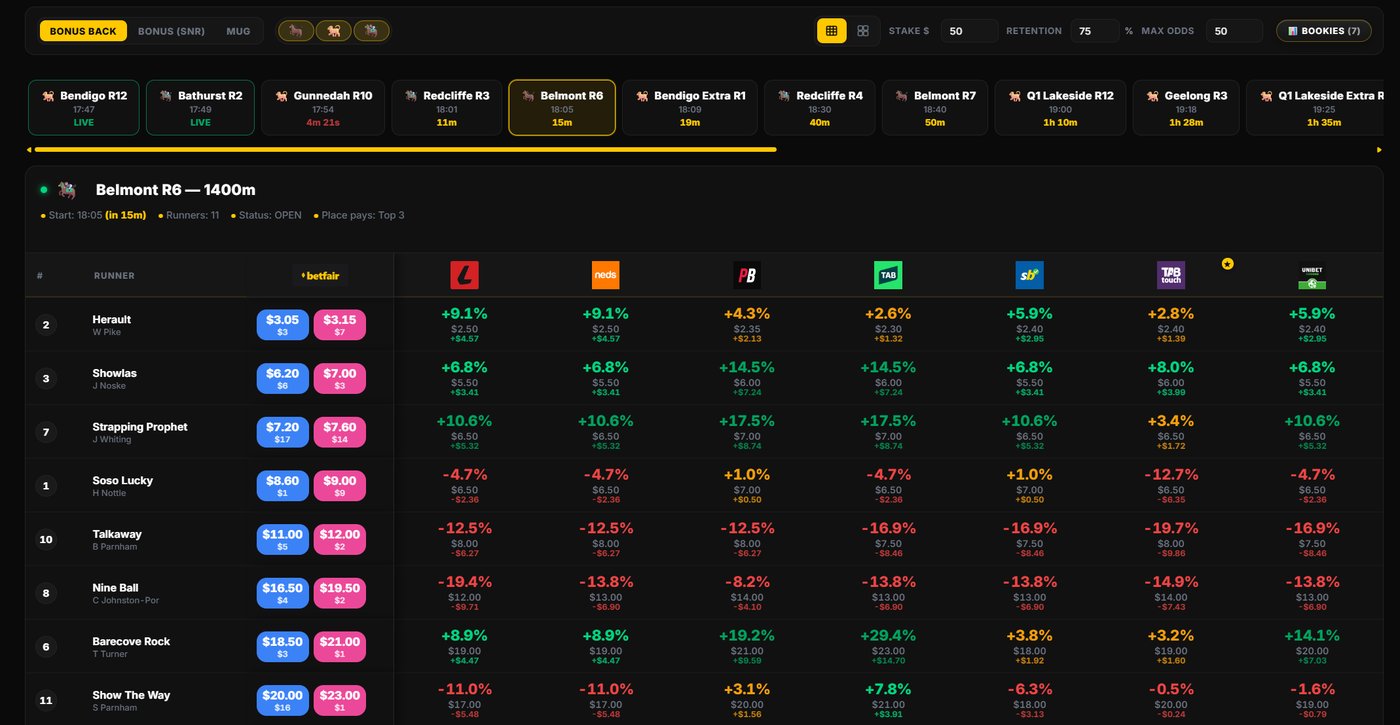
DegenToPro's dedicated racing software runs this comparison live, displaying the best fixed price and best-tote option across all Australian books for every greyhound race, right up to the jump.
Using Betfair SP as a Reference Price
Betfair's Starting Price (SP) - the automated price matched at the moment a race jumps - is one of the most useful reference points available to Australian greyhound punters. Because it is derived from a peer-to-peer exchange where bettors wager against each other rather than against a bookmaker margin, it represents a cleaner estimate of market probability than any fixed-odds bookmaker price.
Betfair SP is not perfect. Liquidity on greyhound markets varies significantly - major feature races like the Sandown Cup or National Distance Championship attract deep pools, while a Tuesday afternoon race at Dapto may have very limited exchange activity. Low-liquidity SP figures are more susceptible to late one-sided money and should be treated with caution.
However, for any greyhound race with reasonable exchange liquidity, Betfair SP serves as an excellent benchmark. The process is straightforward: identify what the Betfair market is suggesting as a fair price for a runner, apply a small adjustment for Betfair's 5% commission on net winnings, and compare the resulting fair price against what Australian bookmakers are offering in their fixed-odds markets.
If Betfair SP on a runner closes at 5.50 and a soft Australian bookmaker is offering 6.20 fixed before the jump, that is a meaningful discrepancy. The Betfair market - incorporating sharp money from professional exchange traders - is implying a fair price of roughly 5.78 after commission adjustment. The bookmaker at 6.20 is offering an implied edge of approximately 7%. That's a value bet by any measure.
The practical challenge is monitoring Betfair SP movements and cross-referencing them against multiple Australian fixed-odds books simultaneously across dozens of races. This is precisely the workflow that DegenToPro's racing software is built to handle.
Reading and Using Price Fluctuations
Greyhound markets typically open a few hours before jump time and experience meaningful price movement as punters bet, tote pools form, and sharp money lands. Understanding how to read these fluctuations is a key component of greyhound value betting.
A runner that shortens consistently from its opening price to jump time is attracting genuine confidence - either from the market, from the kennel, or from sharp punters who have identified a structural edge. This is called a "firmer" or a "mover." Conversely, a runner that drifts steadily from opening price suggests either public money is avoiding it, stable confidence has diminished, or the market has found a reason to downgrade its chances.
How to use fluctuations in your value betting process:
- Early movers: A dog that opens at $5.00 and firms to $3.80 within the first hour of markets opening has attracted serious money. If that same dog's fixed price at a soft bookmaker is still sitting at $4.40 when the tote has moved to $3.80, you have a clear value opportunity - the soft book has not repriced to match the sharp market.
- Late drifters: A runner that opens at $4.50 and drifts to $6.00 in the 30 minutes before jump has been passed over by sharp money. Chasing drifters based on form alone ignores why the market has moved away from them. Be cautious.
- Stable prices: A runner whose price holds firm across all books and the tote despite heavy overall betting in the race is often the sharpest play in the field - no one has found a reason to move it, which implies it is correctly priced or marginally underpriced.
- Price discrepancies between books: When one bookmaker is significantly slower to tighten a runner than its competitors, there is a window to take the superior price. These windows are typically short - sometimes only minutes - and require live monitoring.
Manually tracking fluctuations across six Australian bookmakers plus the state totes across 80-plus daily greyhound races is not realistic. Automated tools are not a luxury - they are a necessity.
Value in Exotics Markets
Beyond the win market, greyhound exotics - quinellas, exactas, trifectas, and first fours - offer some of the richest value opportunities in Australian racing. They also carry significantly higher overround, which makes understanding value even more important.
Tote-based exotic dividends are pooled and distributed among winning tickets, which means their effective overround is set by the pool structure (typically 16 to 25% take-out depending on the bet type and jurisdiction). Fixed-odds exotic prices, offered by some bookmakers, often differ from the tote dividend and can present genuine arbitrage or value opportunities when compared.
Key exotic value approaches for greyhounds:
- Quinellas with value pairs: When two dogs in a race are both priced above their fair win probability, a quinella combining them can carry positive expected value even after the quinella take-out. This is especially true in races where the field is genuinely open and no single runner is a standout favourite.
- Boxed trifectas in small fields: In a six or seven dog race with a single clear standout, boxing trifectas over the remaining field at tote can occasionally yield positive expected value if public money has ignored mid-range runners with genuine track suitability.
- Fixed-odds exactas vs tote: If a bookmaker offers a fixed-odds exacta on a specific 1-2 finish and the tote is paying significantly more for the same combination, you can hold the tote exotic while hedging or cross-referencing the fixed price. These discrepancies are uncommon but real.
The overround on exotic bets is real and significant. Always calculate your expected cost against the realistic probability of each combination before placing exotic bets purely on form. Value in exotics requires the same EV discipline as win betting.
Worked Win-Market Example
To make this concrete, here is a worked example of how to identify a value bet greyhounds punters would want to take in a standard eight-dog win market.
Race: Wentworth Park, Race 5, Thursday evening. Eight-dog field, 520m distance. The focus runner is Box 2 - a consistent early-speed dog with the fastest first split sectional in the field over its last three runs at the track.
Betfair Exchange has the runner at a current lay price of 4.40 (backing at approximately 4.20) with moderate liquidity. After adjusting for 5% commission, the Betfair-implied fair price is approximately 4.41 - call it a fair price of $4.40.
We now compare fixed-odds prices across Australian bookmakers:
| Bookmaker | Fixed Odds | Implied Probability | Fair Odds (Betfair ref) | Edge% |
|---|---|---|---|---|
| Betfair Exchange (ref) | 4.20 (back) | 23.81% | 4.40 | -4.55% (commission) |
| TAB | 3.90 | 25.64% | 4.40 | -11.36% |
| Sportsbet | 4.20 | 23.81% | 4.40 | -4.55% |
| Neds | 4.40 | 22.73% | 4.40 | 0.00% |
| Ladbrokes | 4.60 | 21.74% | 4.40 | +4.55% |
| BlueBet | 5.00 | 20.00% | 4.40 | +13.64% |
The same runner ranges from -11.36% EV at TAB to +13.64% EV at BlueBet. TAB is actively mispricing the runner as a shorter favourite than the sharp Betfair market suggests. BlueBet has failed to tighten its fixed price in line with the Betfair move, creating a 13.64% edge.
The correct play is clear: ignore TAB and Sportsbet entirely for this runner. Take BlueBet at $5.00 and, if stake sizing allows, Ladbrokes at $4.60 as a secondary. Neds at $4.40 is fair value but offers no edge. You are being paid significantly above the true probability at both BlueBet and Ladbrokes.
This type of discrepancy occurs multiple times every race day across Australian greyhound markets. Identifying it manually across 80-plus races is not practical. DegenToPro's racing software surfaces exactly these gaps in real time, live to the jump.
Find greyhound value bets automatically
DegenToPro's dedicated racing software compares fixed odds and best-tote across all major Australian bookmakers for every greyhound race, live to the jump. Free tier - no credit card needed.
Start Free →How DegenToPro Automates This for Australians
Every step outlined in this guide - calculating overround, stripping margins, comparing fixed versus best-tote, referencing Betfair SP, monitoring fluctuations, and flagging positive-EV markets - is a significant amount of work when done manually. Across 80-plus daily greyhound races, it is simply not humanly possible to do it at scale without dedicated software.
DegenToPro is Australian-built software designed from the ground up for this exact workflow. The dedicated racing software module is built specifically for greyhounds (and thoroughbred and harness racing), with a live price comparison engine that monitors every major Australian bookmaker - Sportsbet, TAB, Ladbrokes, Neds, BlueBet - and Betfair, updating right up to the jump.
- Compares fixed-odds prices field-wide across all major Australian bookmakers for every greyhound race
- Identifies best fixed price and best-tote option side by side for each runner
- References Betfair SP and tote dividends as a fair-value benchmark
- Calculates and displays edge% in real time, flagging positive-EV bets the moment they appear
- Monitors price fluctuations live, alerting you to movers and drifters before the window closes
- Covers greyhound racing nationally - metropolitan, provincial, and country meetings
- Integrates with the full DegenToPro platform: +EV finder, arbitrage finder, 100+ bookmakers, bet tracker with verified Closing Line Value, daily tips, and race alerts
- Backed by a 6,000+ member Discord community sharing sharp plays and track knowledge daily
The practical result is that instead of juggling six browser tabs, a spreadsheet, and a racing form guide simultaneously, you get a single ranked view of every greyhound value bet opportunity across Australia, sorted by edge%, updated live. You focus on deciding what to back. DegenToPro handles the maths and monitoring.
Over 6,000 members across Australia use DegenToPro to bet smarter on greyhounds and sport. Member bet results are tracked and verified live within the platform - not cherry-picked after the fact.
Pricing
DegenToPro offers a free tier with no credit card required. You can explore the platform and racing software before spending a cent. Paid plans unlock the full live EV screener, racing software, and all premium tools:
- Weekly: $59.99 AUD
- Monthly: $299.99 AUD
- Lifetime: $699.99 AUD
There is currently a World Cup Offer - 20% off running across all paid plans. Visit the pricing page to lock in the discount before it expires.
Key Takeaways
- Value bets greyhounds punters can exploit exist because of volume pricing, punter bias towards favourites, and slow bookmaker repricing. The market is genuinely beatable with the right process.
- Box draw and early speed are systematically underweighted in bookmaker markets. A fast early-speed runner drawn in box 1 or 2 with minimal early-speed competition in the field is a structural edge most soft books do not fully price.
- Overround reveals the cost of participating. Australian greyhound markets carry 112% to 130% overround. Strip the margin and compare against true probability to find which runners are priced above their fair odds.
- Best-tote vs fixed is a decision you should make on every single race. Compare the best available fixed price against the current tote dividend and take whichever is larger. Over a season, this alone adds material profit.
- Betfair SP is your sharpest reference price for greyhounds. After adjusting for commission, it gives you a clean fair-value benchmark to compare against Australian soft bookmakers. Gaps above Betfair-implied fair odds are value bets.
- Price fluctuations carry information. Movers in the hour before jump often reflect sharp or stable money. Soft bookmakers that lag the Betfair movement create short windows to take superior fixed prices.
- Exotics carry higher overround but can offer positive EV when value pairs are combined in quinellas or when public money has overlooked mid-range runners with strong track suitability.
- Doing this manually at scale is not practical. DegenToPro's dedicated racing software handles the live comparison, edge calculation, and alerting across every Australian greyhound race, every day.
Ready to find greyhound value bets automatically?
Join 6,000+ Australians using DegenToPro's racing software to find best price and positive-EV bets on greyhounds every day. Free tier available - no credit card required.
Start Free →