
Horse racing is Australia's most popular wagering code. Thoroughbreds, harness, and greyhounds together generate billions of dollars in turnover each year across TAB, Sportsbet, Ladbrokes, Neds, BlueBet, and dozens of other bookmakers. That volume creates enormous pricing complexity, and with it, genuine value opportunities for punters who know where to look.
Finding value bets in horse racing is not about having a trainer's phone number or knowing which jockey is riding at their best. It is about understanding how bookmakers build their markets, where those markets are inefficient, and how to use the tools available to consistently find prices that exceed the true probability of a runner winning.
What Value Means in Horse Racing
A value bet in horse racing exists whenever a bookmaker offers you odds that imply a lower probability of winning than you believe to be accurate. If you estimate a horse has a 25% chance of winning and a bookmaker is offering 5.00 (which implies only a 20% chance), you have found a value bet. The price exceeds what the outcome is worth.
This is the foundation of long-term profitable punting. You do not need to win every race. You need to find prices that, averaged across a large number of bets, return more than you stake. A bettor who consistently finds 5% positive expected value (EV) on their selections will profit over time even if they lose more individual bets than they win.
The challenge in horse racing is that bookmakers are very good at pricing markets. They have access to ratings, sectionals, barrier draws, track conditions, trainer and jockey stats, and historical form databases. Their starting prices are often quite accurate. Value exists, but it requires a systematic approach to find it reliably.
The Overround and Market Percentage
Every bookmaker embeds a profit margin into their racing markets. This margin is called the overround (also referred to as the "vig," "juice," or "margin"). Understanding it is the first step toward finding value.
To calculate the overround, convert each runner's odds to an implied probability (1 divided by the decimal odds) and add them all together. In a fair market with no margin, these probabilities would sum to exactly 100%. In a bookmaker's market, they sum to more than 100%, and the excess is the overround.
For example, in a six-runner field at TAB:
- Runner 1: 2.80 - implied probability 35.71%
- Runner 2: 3.40 - implied probability 29.41%
- Runner 3: 5.00 - implied probability 20.00%
- Runner 4: 8.00 - implied probability 12.50%
- Runner 5: 15.00 - implied probability 6.67%
- Runner 6: 26.00 - implied probability 3.85%
Total: 108.14%. The overround is 8.14%. That means for every $100 wagered across all runners proportionally, the bookmaker retains $8.14 on average. Your job is to identify individual runners where the bookmaker has mispriced their true probability.
Tote markets (parimutuel pools like WIN and PLACE on TAB) operate differently. They have no fixed overround because the odds are determined by the total pool and the distribution of bets. The TAB takes a fixed percentage from the pool (typically 14-16% on WIN) before calculating dividends. This pool takeout is the tote's equivalent of the overround.
A key insight: the higher the overround in a bookmaker's fixed-odds market, the more accurately you need to assess probabilities to find value. Markets with a 15%+ overround require a significant information edge to overcome. Markets with a 5-8% overround (like those offered by sharper books) are much more forgiving.
Best-Tote vs Fixed as a Value Signal
Australian bookmakers including Sportsbet, Ladbrokes, TAB, Neds, and BlueBet routinely offer a best-tote option on thoroughbred, harness, and greyhound races. Best-tote means your fixed-odds bet will be settled at whichever is higher: the bookmaker's fixed price at the time of your bet, or the final tote dividend from TAB, UBET, or the relevant state/territory pool.
This creates a meaningful value signal. When a bookmaker's fixed price is significantly higher than the tote market for a given runner, it suggests that the smart money (professional punters, syndicates, and algorithm-driven accounts) has gone to fixed odds - often because the fixed price is more generous than what the tote will likely return. The reverse is also informative: a tote dividend significantly exceeding the fixed price suggests the public pool contains overlays on shorter-priced runners that tipped down before the jump.
In practical terms, best-tote is most valuable in:
- Country and regional racing, where pool sizes are small and a single large bet can significantly move the tote price.
- Races with short-priced favourites, where public money rushes to the tote favourite and inflates dividends on other runners.
- Greyhound and harness racing, where tote pools are thinner and more susceptible to late moves.
Always compare the available fixed price against the current tote approximation before betting. If best-tote is available and the fixed price is already higher than the tote approximation, the fixed price is almost certainly the better play. If the tote approximation is higher, best-tote gives you downside protection while keeping upside from tote movement.
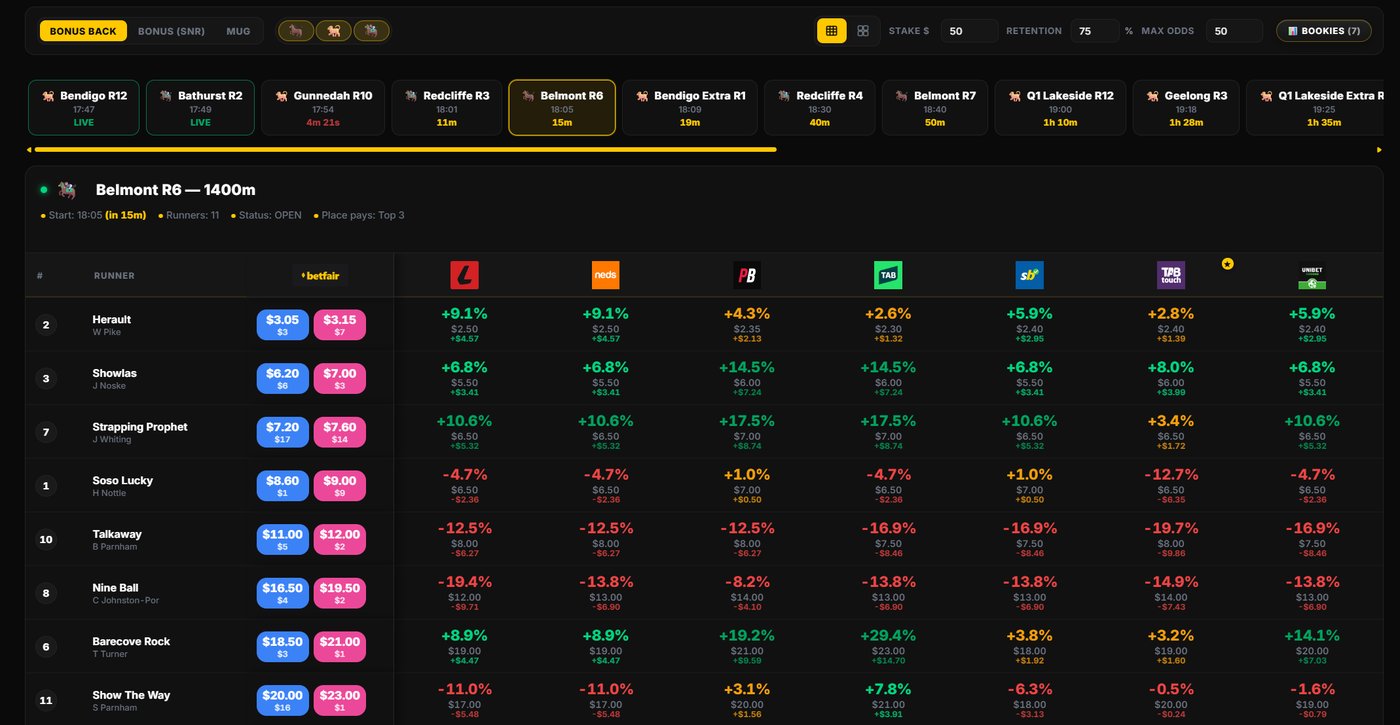
DegenToPro's racing software displays best-price comparisons across all major Australian bookmakers in real time, including best-tote tracking right up to the jump.
Fluctuations and Late Money
Racing markets move. Fixed odds open days before a race and shift based on track conditions, scratchings, barrier draws, weather, and bookmaker risk management. Tote approximations move continuously as money flows into the pool. Understanding these fluctuations is a core skill in finding value.
Early price movement is often driven by bookmakers and their modelling teams. When a bookmaker shortens a horse significantly without any obvious public news, it typically reflects internal intelligence: a stable report, a fitness indicator, or a sharp client's action. These moves are worth paying attention to.
Late money - the flow of bets in the last 15 to 20 minutes before the jump - is the most revealing. In Australia, the major pools and fixed-odds books settle most of their action in this window. A horse that drifts (lengthens) in the late market has had smart money either back the opposition or avoid it entirely. A horse that firms (shortens) in the late market has attracted professional attention.
Key signals to watch:
- A runner that opens at 6.00 and is still 6.00 five minutes before the jump while all other horses have moved is being deliberately left at that price by the bookmaker - often meaning it is shorter than it looks.
- A runner that drifts from 3.50 to 5.00 in the last ten minutes with no scratchings or track changes is often being avoided by those with information.
- Late steaming (rapid shortening) in the tote pool combined with a bookmaker who has not moved their fixed price creates a window where the fixed price is now significantly better than the tote and may represent positive EV.
Fluctuations alone do not guarantee value. A horse that drifts may simply be unloved by the public without any meaningful informational reason. But combined with your own form analysis and price comparison, movement data is a useful additional filter.
Betfair SP as a Fair-Odds Reference
For sports like AFL and NRL, the gold standard sharp reference market is Pinnacle. For horse racing, the best equivalent is Betfair Starting Price (SP).
Betfair Exchange operates as a peer-to-peer market. Bettors back and lay each other, and the exchange takes a commission on winnings rather than building a margin into the odds. The result is that heavily traded Betfair markets produce extraordinarily efficient prices. Betfair SP - the automated price at which unmatched bets are settled at race start - reflects the aggregate judgment of professional punters, syndicates, and algorithmic traders who wager far larger sums than the typical recreational bettor.
This makes Betfair SP an excellent proxy for the "true" probability of a runner winning. When you devig the Betfair SP market (strip out the approximate 5% exchange commission equivalent), you get a probability estimate that is among the most accurate available for Australian thoroughbred, harness, and greyhound racing.
The method is straightforward. If Betfair SP on a runner is 4.20, the implied probability is 1 / 4.20 = 23.81%. Adjusting for exchange commission (roughly 4.5% on average for Australian markets at normal liquidity), the fair probability estimate is approximately 23.81% / 0.955 = 24.93%, or fair decimal odds of about 4.01. If a bookmaker like BlueBet or Sportsbet is offering 4.50 on that same runner, the EV is:
EV% = (0.2493 x 4.50) - 1 = 1.1219 - 1 = +12.19%
That is a very strong edge. In practice, such large discrepancies close quickly as the bookmaker adjusts. But smaller gaps of 3-8% persist regularly, particularly on runners outside the top three in the market and in less-scrutinised race types like country harness and provincial thoroughbreds.
One important caveat: Betfair SP is most reliable as a reference in races with adequate liquidity. For very small races or exotic codes with limited exchange activity, the SP may reflect limited information and should be weighted accordingly.
Each-Way Value
Each-way (EW) betting is enormously popular in Australian racing, and it is also one of the most misunderstood areas when it comes to value. An each-way bet is two bets: a win bet and a place bet at a fraction of the win odds (typically 1/4 or 1/5 of the win price for a set number of places).
Value in each-way betting can exist even when the win portion of the bet is at fair odds or slightly below, if the place terms offered are generous relative to true place probability. This occurs in several situations:
- Large fields with short-priced favourites. When a 1.80 favourite dominates a 16-runner field, bookmakers often set place terms at 1/4 the win odds for four places. The place probability of each runner is skewed by the favourite's dominance. Mid-field runners priced at 8.00-15.00 often have place probabilities that make their each-way place component significantly positive EV.
- Racing's own "each-way sniping." Some bookmakers occasionally offer enhanced place terms (1/4 odds, five places in a field of 12+) on certain races as promotions. These can represent substantial edges on runners at 10.00-20.00.
- Comparing place-only odds. Betfair Exchange offers a dedicated PLACE market for most Australian thoroughbred races. Comparing the exchange's place price against a bookmaker's implied place price (win price divided by terms fraction) is a direct way to assess each-way value.
The maths on each-way betting requires you to evaluate the win and place components separately. Do not be drawn into an each-way bet where the win component has -8% EV on the basis that the place component is marginally positive. The combined EV must be positive for the overall bet to have edge.
Applying Value Assessment Across the Field
One of the most powerful habits in horse racing value betting is assessing every runner in the field, not just your fancied selection. This is called a field-wide review, and it frequently uncovers value on runners you would not have considered.
Here is a simple process:
- Obtain a probability estimate for each runner. This can come from a ratings model, Betfair SP (for historical analysis), tote approximations, or a combination. Ensure these probabilities sum to 100% after devigging.
- Compare each runner's fair odds against the best available fixed price across all bookmakers. This includes TAB, Sportsbet, Ladbrokes, Neds, and BlueBet as a minimum for Australian racing.
- Flag any runner where the best available price exceeds the fair odds. Calculate the EV% for each flagged runner.
- Consider each-way separately. A runner that shows -2% EV on the win may show +6% EV on the place component if the field configuration suits each-way terms.
- Filter for minimum edge and confidence. Most professional racing punters target a minimum 3-5% edge before placing. Below this threshold, variance is too high relative to the information quality.
The challenge is that doing this manually across multiple races each day is extremely time-consuming. A Saturday metropolitan card across Sydney and Melbourne alone might involve 50+ runners across eight races. Doing a proper field-wide EV assessment on each runner at each bookmaker manually is practically impossible at scale.
This is exactly what DegenToPro's dedicated racing software is built to solve. The platform covers thoroughbreds (thoro), harness, and greyhounds, compares best-tote vs fixed in real time, performs field-wide price comparison across all major Australian books, and surfaces the highest-EV opportunities live as markets update right up to the jump.
Worked Win-Market Example
Let's walk through a concrete win-market example showing how to calculate edge across a field using Betfair SP as the fair-odds reference.
Race: metropolitan thoroughbred, 1400m, eight-runner field. We will look at the three most-fancied runners and calculate edge across major Australian bookmakers.
| Runner | Book Price (Best AU Book) | Betfair Fair Odds (devigged) | Edge% |
|---|---|---|---|
| No. 1 (Favourite) | 2.60 (Sportsbet) | 2.75 | -5.45% |
| No. 3 | 4.80 (BlueBet) | 4.50 | +6.67% |
| No. 5 | 7.00 (Ladbrokes) | 6.20 | +12.90% |
| No. 7 | 9.50 (Neds) | 9.80 | -3.06% |
| No. 2 | 13.00 (TAB) | 11.50 | +13.04% |
| No. 4 | 19.00 (BlueBet) | 22.00 | -13.64% |
In this example, the favourite (No. 1) looks like the natural selection but actually returns -5.45% EV at the best available price. The punter taking Sportsbet's 2.60 is giving away money relative to the fair price. No. 3 at 4.80 with BlueBet shows +6.67% EV, No. 5 at 7.00 with Ladbrokes shows +12.90%, and No. 2 at 13.00 with TAB shows the largest edge in the field at +13.04%.
Without a field-wide assessment, a punter might back the favourite out of habit. With a field-wide review referenced against Betfair fair odds, the value is clearly elsewhere. No. 2 and No. 5 are the bets, not No. 1.
This kind of analysis is most powerful when applied consistently across every race, every day. A single race might not be representative. But over 500+ bets, consistently finding and backing horses with a genuine 5-10% edge produces meaningful profits.
Note: the "best AU book" price in the table above reflects the best available price across all major Australian bookmakers at the time of comparison. Finding that price manually across Sportsbet, TAB, Ladbrokes, Neds, and BlueBet for every runner in every race is the problem DegenToPro solves automatically.
DegenToPro's Racing Software Surfaces Best Price and Value Across Books
DegenToPro is Australian-built software designed specifically for serious punters. Its dedicated racing module covers thoroughbreds, harness, and greyhounds, and it is built around one core idea: automatically finding the best price and best value across all major Australian bookmakers in real time, live to the jump.
- Covers all three Australian racing codes: thoroughbreds, harness, and greyhounds
- Compares best-tote vs fixed in real time across Sportsbet, TAB, Ladbrokes, Neds, BlueBet, and more
- Field-wide price comparison for every runner in every race - automatically
- Uses Betfair Exchange as a fair-odds reference to calculate EV% on every runner
- Live market updates right up to the jump, including fluctuation tracking
- Surfaces the highest-EV runners across the entire day's card, ranked by edge
- Includes best-tote alerts and late-money movement signals
- Integrates with the full DegenToPro platform: +EV finder across 100+ bookmakers, bet tracker with verified CLV, daily tips, and race alerts
Instead of opening five or six browser tabs, manually checking prices, doing overround calculations in a spreadsheet, and comparing each runner's implied probability against Betfair - you get a ranked list of today's best racing value opportunities, updated in real time, ready to act on immediately.
DegenToPro also includes a full bet tracker that records your performance and calculates Closing Line Value across every bet. This is the professional standard for knowing whether your edge is real. If you are consistently finding positive CLV in the racing market, you are doing something right, regardless of short-term results.
Over 6,000 members across Australia and New Zealand use the platform. Member profits are tracked live within the platform, verified against CLV, and not cherry-picked from a selective sample.
Stop settling for the wrong price in racing
DegenToPro's racing software compares best-tote vs fixed, calculates EV% on every runner, and surfaces the best value across all major Australian books - live to the jump. Start free, no credit card needed.
Start Free →Pricing
DegenToPro offers a free tier with no card required, so you can explore the racing software and full platform before committing. Paid plans unlock all live EV tools, the full Pro Odds Screener, and every racing feature:
- Weekly: $59.99 AUD
- Monthly: $299.99 AUD
- Lifetime: $699.99 AUD
There is currently a World Cup Offer - 20% off running across all paid plans. Head to the pricing page to lock it in before it closes.
Key Takeaways
- A value bet exists when a bookmaker's price exceeds the true probability of a runner winning. You will lose individual bets. Value betting is a long-run, process-driven strategy.
- The overround is the bookmaker's built-in profit margin. Understanding it allows you to identify which runners are priced below their true probability and which are overpriced by the market.
- Best-tote vs fixed comparison is a free value signal. When a fixed price is significantly above the tote approximation, smart money has gone fixed. When tote is higher, best-tote provides protection and potential upside.
- Late market movement reveals information. Horses that firm in the last 15 minutes are attracting professional attention. Horses that drift without obvious reason are often being avoided by those with knowledge.
- Betfair SP is the best fair-odds reference for Australian racing. Devigging Betfair SP gives you a probability estimate refined by professional punters, syndicates, and algorithmic traders.
- Each-way value requires separate win and place analysis. The place component can be positive EV even when the win component is not, particularly in large fields with dominant short-priced favourites.
- Field-wide review finds value you would otherwise miss. The favourite is often not the best bet. Systematic price comparison across all runners regularly reveals the real value in a race.
- DegenToPro automates the entire process - best-tote vs fixed comparison, Betfair SP reference pricing, EV% calculation on every runner, and field-wide price comparison across all major Australian bookmakers, live to the jump.
Ready to find horse racing value bets automatically?
Join 6,000+ members using DegenToPro's racing software to find best price and positive EV across thoroughbreds, harness, and greyhounds. Free tier available, no card required.
Start Free →