
In this guide
The four real risks
“Is it safe?” is too broad to answer. There are four distinct risks and they have completely different answers:
- Credential risk. Someone other than you gains control of your bookmaker accounts.
- Account risk. Your bookmaker restricts or closes you.
- Financial risk. The strategy loses money, or a bug stakes something it should not.
- Vendor risk. The company disappears, or was never what it claimed.
Most articles on this topic only address the second one. The first is the one that can actually cost you everything.
What happens to your logins
Any bot that places bets on your accounts must be able to log into them. There is no way around that. The question is where those credentials live and who can use them.
The standard worth insisting on has four parts:
- Encrypted at rest, not stored in a form the vendor’s staff can read.
- Delivered only to your authorised device, over TLS, and only for your own accounts.
- Never written to logs. No passwords, no tokens, no session cookies in any diagnostic output.
- Instantly revocable. You can cut a device off, and rotate your key, without emailing anybody.
That is how BetPilot is built — credentials encrypted centrally and delivered only to your authorised device, with the app never holding the master decryption key, and an API key you can rotate or revoke yourself from the dashboard at any moment.
The test: ask a vendor “if one of your engineers wanted to read my bookmaker password, could they?” A good vendor answers immediately and specifically. A bad one changes the subject.
Hosted bots and shared footprints
A hosted bot runs on the vendor’s servers. That creates two exposures at once.
First, credentials must be usable by that infrastructure continuously, which is a materially larger attack surface than credentials that are only ever decrypted on one device you own.
Second, every customer’s bets originate from the same place. A bookmaker risk team that identifies the pattern on one account has, by definition, identified it on all of them. Your account safety becomes correlated with strangers’ behaviour, which is not a risk most people realise they are taking.
How local execution changes it
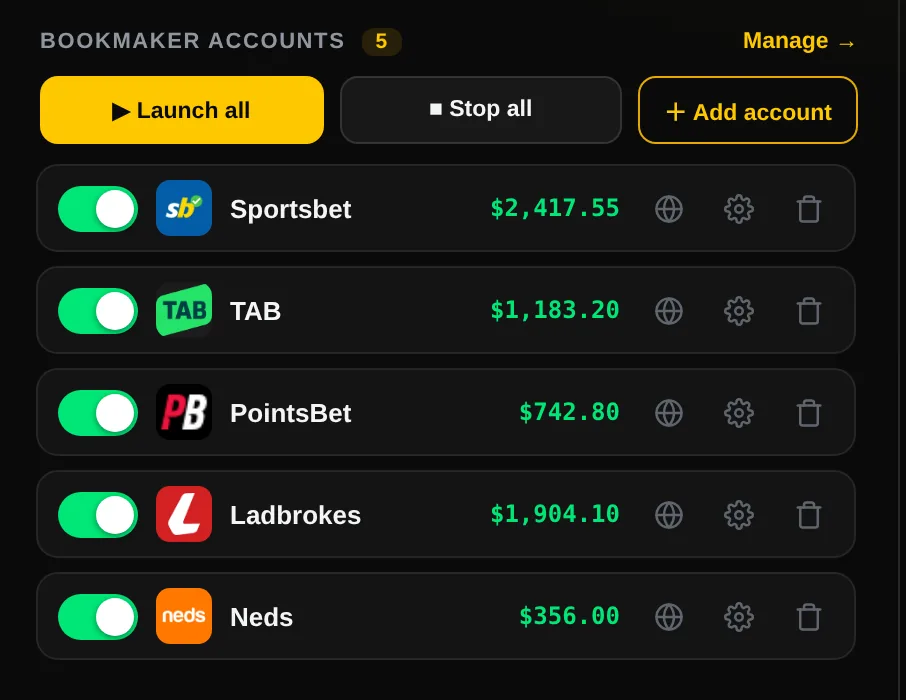
A local executor moves placement onto your own machine, IP and logged-in session. Credentials are decrypted only on your device, and your betting footprint is yours rather than pooled.
It does not make you anonymous and we would not claim it does. What it does is remove an entire category of correlated risk, and shrink the window in which your credentials exist in usable form.
Account restriction risk
This is real, and honesty serves you better than reassurance. Australian bookmakers reserve broad rights to restrict, limit or close accounts, and they exercise them.
The dominant trigger, though, is not automation. It is winning — specifically, consistently beating the closing line. Punters get limited for that whether they place by hand or by software. Automation raises volume, which can surface the pattern faster, but the underlying cause is profitability.
What you can control: sensible stake caps, not running every account at maximum aggression, keeping a plausible betting mix, and never operating an account that is not yours. The full picture is in our guide to automated betting and Australian law.
Financial risk
Two flavours. The strategy can lose — every strategy has losing stretches, and a bot will work through one faster than you would by hand. And software can misbehave: a bad adapter, a mispriced market, an unbounded stake.
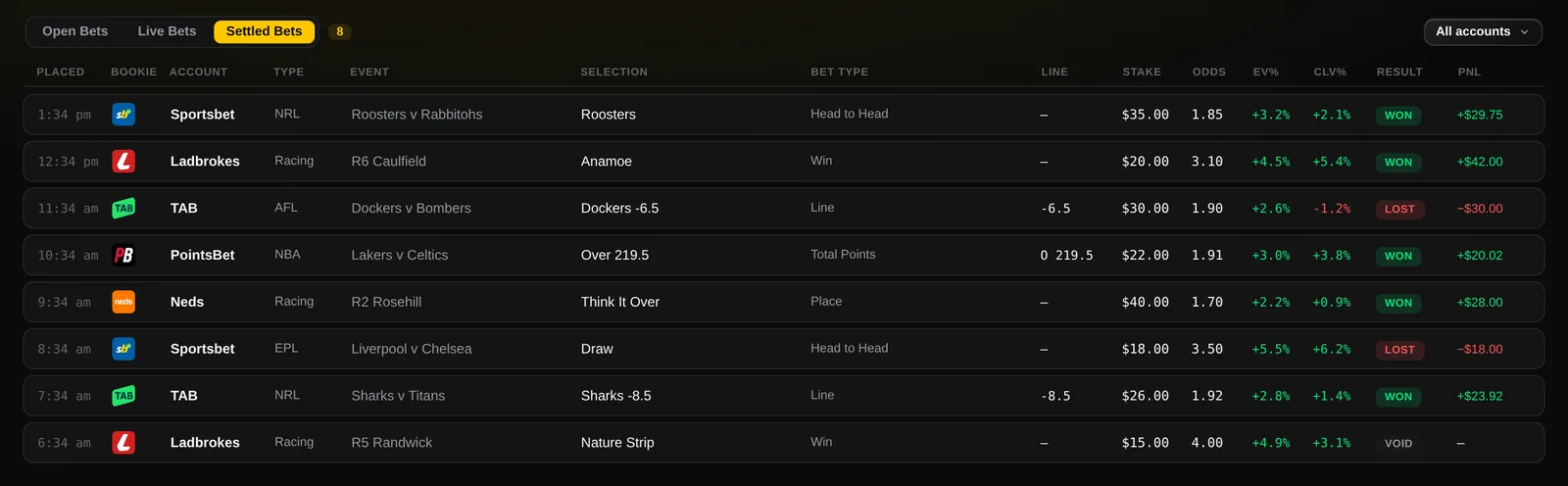
The defences are unglamorous and they matter: hard stake caps, minimum-edge thresholds, per-account arming so you can dry-run before going live, and a live activity log so you can see what is happening rather than discover it later in a balance. Start with one account and conservative settings. Do not turn everything on at once.
Questions to ask any vendor
- Where are my bookmaker credentials stored, and in what form?
- Can your staff decrypt them?
- Whose machine and IP places my bets?
- Can I revoke a device instantly, myself?
- What stops the bot firing at a price that has already moved?
- What stake caps and per-account limits can I set?
- Can I see every action as it happens, or only outcomes?
- Is closing-line value reported per bet?
- What happens to my data if I cancel?
- Who is behind this, and can I find them?
Every one of those is answerable in a sentence or two by a vendor with nothing to hide.
Red flags
- Guaranteed returns. There is no such thing. This alone is disqualifying.
- No named people. An anonymous team holding your bookmaker logins is not a risk worth taking.
- Vague credential answers. If they cannot describe the handling precisely, assume the worst.
- No stake controls. A bot you cannot cap is a bot that can hurt you.
- Outcomes only, no per-bet detail. You cannot audit what you cannot see.
- Pressure to buy now. Countdown timers on a product that will hold your bookmaker credentials should end the conversation.
- Asking for accounts in other people’s names. Walk away immediately.
Frequently asked questions
Is it safe to give a betting bot my bookmaker login?
It depends entirely on how the vendor handles it. The standard to insist on is encryption at rest, delivery only to your own authorised device over TLS, no passwords or tokens in logs, and the ability to revoke device access instantly. Anything less and you should walk away.
Can a betting bot steal my money?
A bot with your bookmaker credentials can in principle do anything you can do in that account, including withdrawing to a linked account. This is why credential handling, device authorisation and revocation matter more than any feature.
Will using a bot get my account banned?
It can breach bookmaker terms, and accounts do get restricted. In practice the dominant trigger for restriction in Australia is consistent profitability rather than automation itself.
Automation with the boring parts done right
Encrypted credentials, device-scoped delivery, instant revocation, and local placement from your own machine.
Apply for BetPilot →