
In this comparison
The right way to frame it
Most people compare bots and manual betting on effort. That is the least interesting axis. The interesting one is this:
Both approaches place the same bets. A bot does not find better opportunities than the tool feeding it — it is fed by the same pricing engine you would be reading yourself. The difference is entirely in how many of those opportunities survive the gap between identified and placed, and at what price.
So the question is not “is the bot smarter than me?” It is not smarter than you. The question is what fraction of your strategy you are currently throwing away, and whether that fraction is worth more than the cost of the tool.
Capture rate is the whole game
Call it capture rate: of every opportunity your strategy generates in a week, what proportion do you actually get on?
Very few people have measured this honestly, and the estimates they give before measuring are always high. Then you count. Opportunities do not arrive politely spaced through your waking hours; they cluster around market opens, price moves and the pre-jump window. They arrive while you are asleep, at work, driving, or eating dinner. They arrive four at once across three different books.
A dedicated person who is genuinely at a screen for large parts of the day, with alerts on, working a handful of accounts, tends to capture somewhere around a third of what their strategy generates. Someone with a full-time job captures considerably less. A bot with a machine left running captures the large majority — everything that is still fresh when the instruction arrives and still clears the threshold.
Putting numbers on it
Work an illustrative example. Say your strategy generates 300 qualifying opportunities a month at an average edge of 3%, and you stake $100 a bet.
| Manual (working full time) | Manual (at a screen all day) | Automated | |
|---|---|---|---|
| Opportunities generated | 300 | 300 | 300 |
| Realistically captured | ~45 | ~100 | ~260 |
| Turnover at $100 | $4,500 | $10,000 | $26,000 |
| Expected return at 3% | $135 | $300 | $780 |
| Average edge actually taken | Lower — you get the leftovers | Slightly lower | At or near the priced edge |
Illustrative arithmetic to show the shape of the problem, not a projection. Your own numbers depend entirely on your strategy, staking and account mix, and results vary. Nothing here is a guarantee of returns.
Notice that the gap is not 20% better. It is multiples, and it comes almost entirely from bets that simply never got placed. That is the actual argument for automation, and it is a boring, arithmetic one rather than a technological one.
The hidden cost: price degradation
There is a second effect that does not show up in a bet count and quietly makes manual betting worse than the capture-rate maths suggests.
When you place by hand, you arrive late by definition. The alert fires, you pick up your phone, you unlock it, you open the app, you find the market, you enter a stake, you confirm. Ninety seconds is a good result. In that time the price has often moved — and it has moved against you, because the same factors that made it valuable made it valuable to other people too.
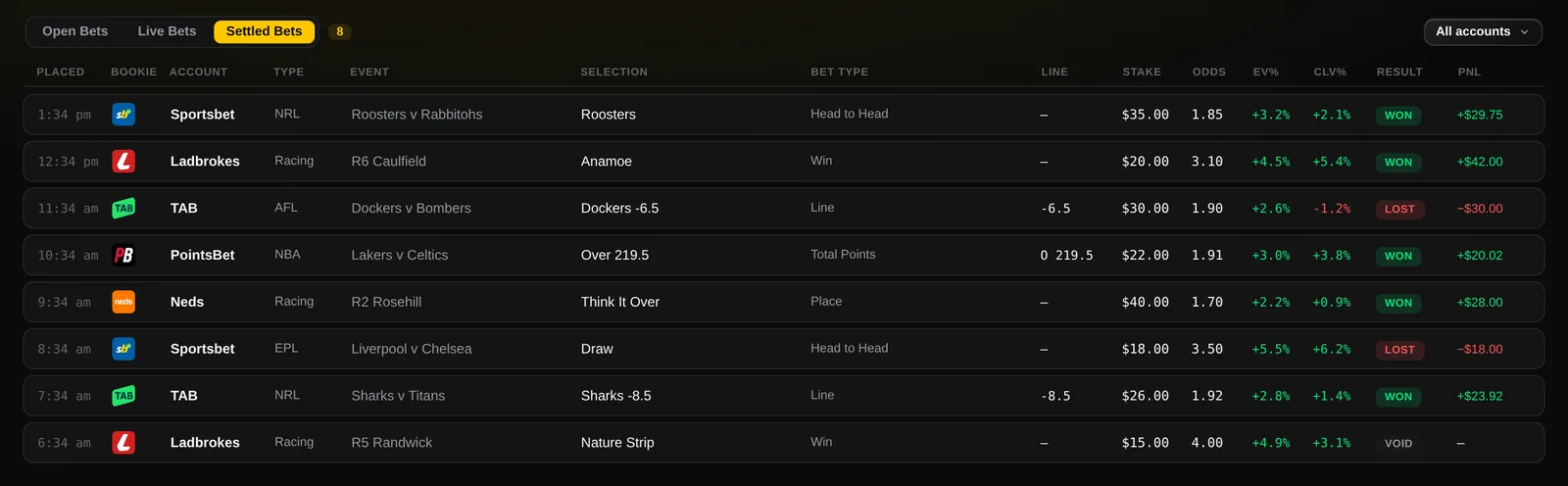
So the bets you do capture manually are systematically the ones taken at a worse price than the one that triggered the alert. Your recorded EV says 3%; your realised edge is lower. Over a year that difference is substantial, and it is invisible unless you track closing-line value per bet.
Where manual still wins
It would be dishonest to present this as one-sided. Manual placement is genuinely better in several situations:
Learning. If you cannot yet explain why a bet is good, automating it means you will not notice when it stops being good. Place a few hundred by hand first. This is not a formality — it is the difference between operating a tool and trusting a black box.
Judgement calls. Late mail, a scratching, track condition, a team-news wrinkle the market has not absorbed yet. If you have real information a model does not encode, you will beat the model.
Small bankrolls. Under about $1,000, stake caps and per-book minimums mean automation places trivial amounts and the overhead is not worth it. Use the free tier and place by hand.
Anything unusual. Exotics, novelty markets, anything where the price is thin and a machine firing a standard stake is more likely to move the market than beat it.
Head to head
| Manual | Automated (BetPilot) | |
|---|---|---|
| Capture rate | Low to moderate | High |
| Price taken | Systematically degraded by delay | At or near the priced number |
| Overnight and pre-jump windows | Mostly missed | Covered |
| Scaling across accounts | Gets harder, fast | One switch launches every book |
| Record keeping | Manual, usually incomplete | Automatic, per bet, with CLV |
| Judgement calls | Strong | Only what is encoded |
| Learning value | High | Low — do this first, by hand |
| Effort | Constant | Setup, then monitoring |
| Cost | Free | Subscription plus a machine left on |
The honest break-even point
Automation costs money, so it has to clear a bar. Roughly, it starts making sense when the bets you are currently missing are worth more per month than the tool costs — which in practice means some combination of a bankroll around $1,000 or more, several bookmaker accounts, and a strategy you have already validated by hand.
Below that, automation is a cost with a story attached. Above it, the missed-bet arithmetic gets lopsided quickly, and it gets more lopsided the more accounts you hold.
Verdict
For a validated strategy at reasonable scale, automation wins clearly, and the reason is unglamorous: it places the bets you were always going to miss, at prices you were never going to get.
For learning, for judgement-heavy markets, and for small bankrolls, place by hand — and do that first regardless, because a bot operated by someone who does not understand the underlying strategy is not an advantage. It is just a faster way to be wrong.
Frequently asked questions
Do betting bots make more money than betting by hand?
Against the same strategy, yes - not because the bets are better, but because far more of them get placed, and at better prices. A bot typically captures the large majority of a strategy output where a working human captures a fraction.
Is manual betting still better for anything?
Yes: learning, anything requiring judgement a model cannot encode, very small bankrolls, and any market where you have genuine information the price does not reflect.
Stop leaving bets behind
BetPilot places the ones you are currently missing — overnight, mid-shift, and in the minutes before a jump. Applications reviewed by a human.
Apply for BetPilot →