
Most punters spend hours researching selections and almost no time thinking about how much to bet. That is a mistake. A sharp bettor with a poor staking plan will bleed out their bankroll just as surely as a recreational punter chasing losses. And a mediocre selection process paired with smart staking can still turn a long-run profit - because the staking plan controls risk, manages drawdown and ensures you stay solvent long enough for your edge to express itself.
Betting staking plans are not one-size-fits-all. The right plan depends on whether you have a genuine mathematical edge, how much variance you can stomach, and how disciplined you are willing to be in execution. This guide covers every major plan in use by serious Australian punters in 2026, with an honest assessment of where each one shines and where it will hurt you.
Throughout, we will show you how DegenToPro - Australia's leading EV betting and bet-tracking platform - gives you the data to compare staking plans against your own real results, not just theory.
Why Your Staking Plan Matters as Much as Your Selections
Consider two bettors with identical selections over 500 bets at an average edge of +3%. Bettor A uses flat staking at 1% of bankroll per bet. Bettor B uses inconsistent sizing, staking more after wins and more when they "feel confident." After 500 bets, Bettor A's bankroll has grown steadily. Bettor B has likely busted, or at best, massively underperformed their expected return.
The reason is simple: without a consistent staking plan, psychological biases destroy the mathematical edge. Overconfidence leads to oversizing. Chasing losses leads to ruin. Even with +EV selections, undisciplined staking converts a winning strategy into a losing one.
A good staking plan does three things:
- Controls risk per bet so a losing run does not wipe out your bankroll.
- Sizes bets in proportion to edge so your capital grows efficiently when you are right.
- Removes emotion from the equation by making stake size a mechanical calculation, not a gut call.
The right plan for you also depends on what data you have. Some plans require edge estimates. Others just need a bankroll figure. Understanding what each requires - and what each demands in discipline - is the starting point for choosing well.
Flat Staking
Flat staking is the simplest staking plan available: you bet the same fixed dollar amount on every selection, regardless of odds, confidence or edge. If your unit is $50, every bet is $50.
Despite its simplicity, flat staking is used by many professional bettors. It is easy to implement, easy to audit, and it removes sizing decisions from the betting process entirely. Because every bet is identical in dollar terms, your profit and loss in units translates directly to dollar returns without any adjustment.
| Parameter | Detail |
|---|---|
| Stake per bet | Fixed dollar amount (e.g. $50, $100) |
| Typical unit size | 1-2% of starting bankroll |
| Bankroll impact | Stake does not change as bankroll grows or shrinks |
| Best suited to | Punters who want simplicity and clean records |
| Main weakness | Does not adjust to bankroll size; can oversize after losses |
The key weakness of pure flat staking is that your unit becomes proportionally larger as your bankroll shrinks during a losing run. If you started with $5,000 and your flat stake is $50 (1%), a 20-unit losing run drops you to $4,000 - but now that same $50 stake represents 1.25% of your remaining bankroll. That is manageable, but it illustrates why some punters prefer percentage-based staking instead.
For punters who are new to structured betting or who do not yet have edge estimates for their selections, flat staking is the right starting point. It is clean, honest and easy to track - especially inside DegenToPro's bet tracker, which logs every flat-stake bet and displays your running unit profit automatically.
Percentage of Bankroll Staking
Percentage staking solves the main weakness of flat staking by recalculating your unit size as a fixed percentage of your current bankroll before each bet. If you use 1% and your bankroll is $5,000, your stake is $50. After a losing run that drops you to $4,000, your stake automatically adjusts to $40.
This approach means your bankroll never reaches zero through normal variance - each loss reduces future stakes proportionally. It also means your bankroll grows geometrically rather than linearly when you are winning, because your units scale up with your funds.
| Parameter | Detail |
|---|---|
| Stake per bet | Fixed % of current bankroll (recalculated before each bet) |
| Typical percentage | 1-3% for most +EV bettors |
| Bankroll impact | Mathematically cannot bust from losing run alone |
| Best suited to | Disciplined bettors with a consistent edge |
| Main weakness | Recovery from large drawdown is slow; requires recalculating before every bet |
The practical downside is friction: you need to know your current bankroll before placing every bet, and your stake changes constantly. In practice, many bettors recalculate weekly rather than before each individual bet - which is a reasonable compromise that DegenToPro's dashboard makes straightforward, since your running bankroll is always visible.
Percentage staking between 1% and 2% per bet is considered conservative and appropriate for most recreational-to-serious Australian punters. Anything above 3% per bet introduces significant drawdown risk even with a genuine edge.
Level Stakes to Odds (Profit-Based Staking)
Also called "to win" staking or profit-based staking, this method adjusts your stake so that you win the same fixed profit on every successful bet, regardless of the odds. If you want to win $100 per bet and the odds are 3.00, you stake $50. If the odds are 1.50, you stake $200.
The appeal is psychological: every winner feels equally rewarding in dollar terms. But the mathematics tell a different story for most punters.
| Desired Profit | Odds | Required Stake |
|---|---|---|
| $100 | 1.50 | $200 |
| $100 | 2.00 | $100 |
| $100 | 3.00 | $50 |
| $100 | 5.00 | $25 |
| $100 | 10.00 | $11.11 |
The problem with level-stakes-to-odds is that it stakes significantly more on short-priced favourites, where your edge per dollar bet is often lower. On longer-priced outsiders, where relative value can be higher, you are staking less. This is the inverse of what a mathematically optimal staking plan would prescribe.
Level-stakes-to-odds is not inherently bad - it suits punters who specialise in even-money markets and want predictable returns per winner. But for a diverse +EV betting portfolio across different odds ranges, it tends to underperform flat staking or percentage staking over the long run.
Kelly Criterion and Fractional Kelly
The Kelly Criterion is the mathematically optimal staking formula for maximising long-run bankroll growth when you have a known edge. Developed by John Kelly Jr. in 1956, it is widely used by professional gamblers, quantitative traders and sports bettors worldwide.
The Kelly formula is:
| Symbol | Meaning |
|---|---|
| f* = (bp - q) / b | The full Kelly formula |
| f* | Fraction of bankroll to stake |
| b | Decimal odds minus 1 (net odds) |
| p | True probability of winning (your estimate) |
| q | True probability of losing (1 - p) |
Worked example: You estimate a team's true win probability at 55% (p = 0.55). The best available odds are 2.10 (b = 1.10). Applying Kelly:
f* = (1.10 × 0.55 - 0.45) / 1.10 = (0.605 - 0.45) / 1.10 = 0.155 / 1.10 = 14.1% of bankroll
That is a substantial stake - and that is where full Kelly becomes dangerous in practice. The formula assumes your edge estimate is perfectly accurate. In reality, your probability estimate will often be slightly off, and full Kelly can produce catastrophic drawdowns when that happens. A common scenario: you estimate 55% but the true probability is 50%. Full Kelly recommends a large bet that actually has zero edge.
This is why virtually all serious bettors use fractional Kelly - typically half-Kelly (0.5x) or quarter-Kelly (0.25x). In the example above, half-Kelly would recommend a stake of 7.05% of bankroll. That is still aggressive, but far more forgiving of estimation errors.
| Kelly Fraction | Stake (from example) | Growth Rate | Drawdown Risk |
|---|---|---|---|
| Full Kelly (1x) | 14.1% of bankroll | Maximum theoretical | Very high |
| Half Kelly (0.5x) | 7.05% of bankroll | 75% of maximum | Moderate |
| Quarter Kelly (0.25x) | 3.5% of bankroll | 56% of maximum | Low |
| Eighth Kelly (0.125x) | 1.76% of bankroll | Close to flat staking | Very low |
For Australian +EV bettors using DegenToPro's edge percentage data, Kelly staking is a natural fit. DegenToPro's +EV finder displays the edge% for every opportunity - plug that directly into the Kelly formula to get your optimal fraction, then apply your chosen multiplier for safety. The bet tracker stores each stake and the edge at time of placement, so you can review whether your Kelly sizing was accurate over time.
Confidence-Based Staking
Confidence-based staking varies your stake size based on a subjective or semi-quantified measure of how confident you are in a selection - typically expressed in "units" on a scale. A common approach is a 1-5 scale: a "1 unit" bet is your minimum, a "3 unit" bet is your standard selection, and a "5 unit" bet is your maximum for your strongest plays.
This approach appeals to punters who have domain expertise and believe some selections genuinely deserve more weight than others. And in theory, if your confidence ratings correlate with actual edge, it can improve returns.
The problem is that human confidence is a poor predictor of actual edge. Research consistently shows that bettors are overconfident - the bets you feel best about are not systematically more profitable than your average selections. In fact, high-confidence selections are sometimes worse, because punters tend to "feel confident" when backing popular, well-known teams that the market has already priced efficiently.
| Confidence Level | Units Staked | Risk if Confidence is Miscalibrated |
|---|---|---|
| 1 (Low confidence) | 1 unit | Small downside |
| 2 | 2 units | Moderate downside |
| 3 (Standard) | 3 units | Moderate downside |
| 4 | 4 units | High downside |
| 5 (High confidence) | 5 units | Very high downside if miscalibrated |
If you do use confidence-based staking, the discipline required is to track your average return by confidence tier over at least 200 bets per tier. DegenToPro's bet tracker allows you to tag bets with notes and filter results by custom criteria - meaning you can genuinely test whether your higher-confidence bets outperform your lower-confidence ones. Most punters who do this honestly find little to no correlation, which is a strong argument for sticking to flat or Kelly staking.
The Dangers of Progressive and Martingale Systems
No guide to betting staking plans would be complete without addressing the Martingale system and its variants. The Martingale is seductive because the logic sounds airtight: double your stake after every loss so that the next win recovers all previous losses and returns a profit equal to your original stake. Keep doubling until you win, then reset.
Here is why it fails - and why it can destroy a bankroll very quickly.
The Martingale assumes you have unlimited capital and that bookmakers have no maximum stake limits. In practice, both constraints are hard limits. Consider starting with a $10 stake and doubling after each loss:
| Bet Number | Stake Required | Cumulative Outlay |
|---|---|---|
| 1 | $10 | $10 |
| 2 | $20 | $30 |
| 3 | $40 | $70 |
| 4 | $80 | $150 |
| 5 | $160 | $310 |
| 6 | $320 | $630 |
| 7 | $640 | $1,270 |
| 8 | $1,280 | $2,550 |
Eight consecutive losses from a $10 starting stake requires $2,550 in total outlay to recover a $10 profit. Eight-loss runs are not extreme - at even-money, the probability of losing 8 in a row is approximately 0.4% per sequence, which means in a 1,000-bet career, you would expect this to happen multiple times. Most punters hit their bankroll or book-limit ceiling long before they can recover.
Progressive systems like Labouchere, D'Alembert and Fibonacci share the same fatal flaw: they assume you will always get enough winning bets before a catastrophic losing streak exhausts your bankroll or hits a table limit. They do not create edge where none exists. They simply change the variance profile, concentrating losses into spectacular blow-up events in exchange for many small wins.
There is no staking system that can turn negative EV bets into a long-run profit. If the expected value of each individual bet is negative, no arrangement of bet sizes will make the sequence positive EV. Any system that claims otherwise is mathematically wrong - and the punter will pay the price.
This is also why DegenToPro focuses exclusively on identifying genuine +EV opportunities first. No staking plan is a substitute for edge. They are two separate problems, and you need to solve the edge problem before the staking plan has any value.
Know Your Edge Before You Size Your Bet
DegenToPro scans 100+ Australian bookmakers in real time, showing you the edge percentage on every +EV opportunity. Feed that edge directly into your Kelly formula - or use our bet tracker to compare staking plans on your own real data. World Cup Offer: 20% off all plans right now.
Start Free →Which Staking Plan Suits +EV Betting?
If you are betting with a genuine mathematical edge - identified through sharp-market comparison, devigging, or closing line value analysis - the staking plan question becomes much clearer. The goal shifts from "how do I manage risk on uncertain bets" to "how do I maximise bankroll growth given a known edge while controlling drawdown."
The short answer for most Australian +EV bettors is: start with flat staking at 1-2% of bankroll, then graduate to quarter-Kelly or half-Kelly once you have 500+ bets of data confirming your edge.
Here is the reasoning:
- Flat staking (1-2%): While you are building your track record, flat staking keeps risk controlled and makes your results easy to analyse. You can see your edge clearly in unit profit over time without Kelly sizing complicating the picture.
- Half-Kelly or quarter-Kelly: Once you have statistically significant data (500+ bets, positive closing line value, stable ROI), Kelly sizing lets you grow your bankroll faster in proportion to your proven edge. DegenToPro's edge% data is the direct input you need for this calculation.
- Avoid confidence-based sizing: Unless you have hard data showing your confidence tiers actually correlate with different ROI levels, replace subjective confidence with objective edge estimates from DegenToPro's +EV finder.
- Never use Martingale or progressive systems: These are incompatible with +EV betting because they distort your results, make it impossible to assess your true edge, and introduce catastrophic blow-up risk.
The edge% that DegenToPro displays for every opportunity is calculated from live sharp-market data and represents the most reliable input available for Kelly sizing. When the platform shows an opportunity at +4.5% edge on an NRL market at 2.00 decimal odds, you have everything you need to calculate a precise Kelly fraction and size your bet optimally.
Staking Plans Compared at a Glance
| Staking Plan | Risk Level | Bankroll Growth Potential | Complexity | Requires Edge Estimate? | Best For |
|---|---|---|---|---|---|
| Flat Staking | Low - Moderate | Linear | Very Low | No | Beginners, auditing selections |
| Percentage Bankroll | Low - Moderate | Geometric | Low | No | Long-term disciplined punters |
| Level Stakes to Odds | Moderate | Moderate | Low | No | Even-money specialists |
| Full Kelly | Very High | Maximum theoretical | Moderate | Yes | Not recommended in practice |
| Half-Kelly | Moderate | High | Moderate | Yes | Experienced +EV bettors with data |
| Quarter-Kelly | Low - Moderate | Moderate - High | Moderate | Yes | Conservative +EV bettors |
| Confidence-Based | Moderate - High | Moderate | Low | No | Domain experts with proven calibration |
| Martingale / Progressive | Extreme | Negative (long-run) | Low | N/A | Avoid entirely |
A few observations from this comparison:
- The plans with the highest growth potential all require accurate edge estimates. Without reliable edge data, Kelly-based staking is guesswork dressed up as mathematics.
- Flat and percentage staking are underrated. Professional bettors at scale often return to these because they are clean, auditable and require no assumptions about edge accuracy.
- Complexity is not the same as effectiveness. The simplest plan used consistently will outperform a complex plan applied inconsistently.
How DegenToPro Tracks Results Across Staking Plans
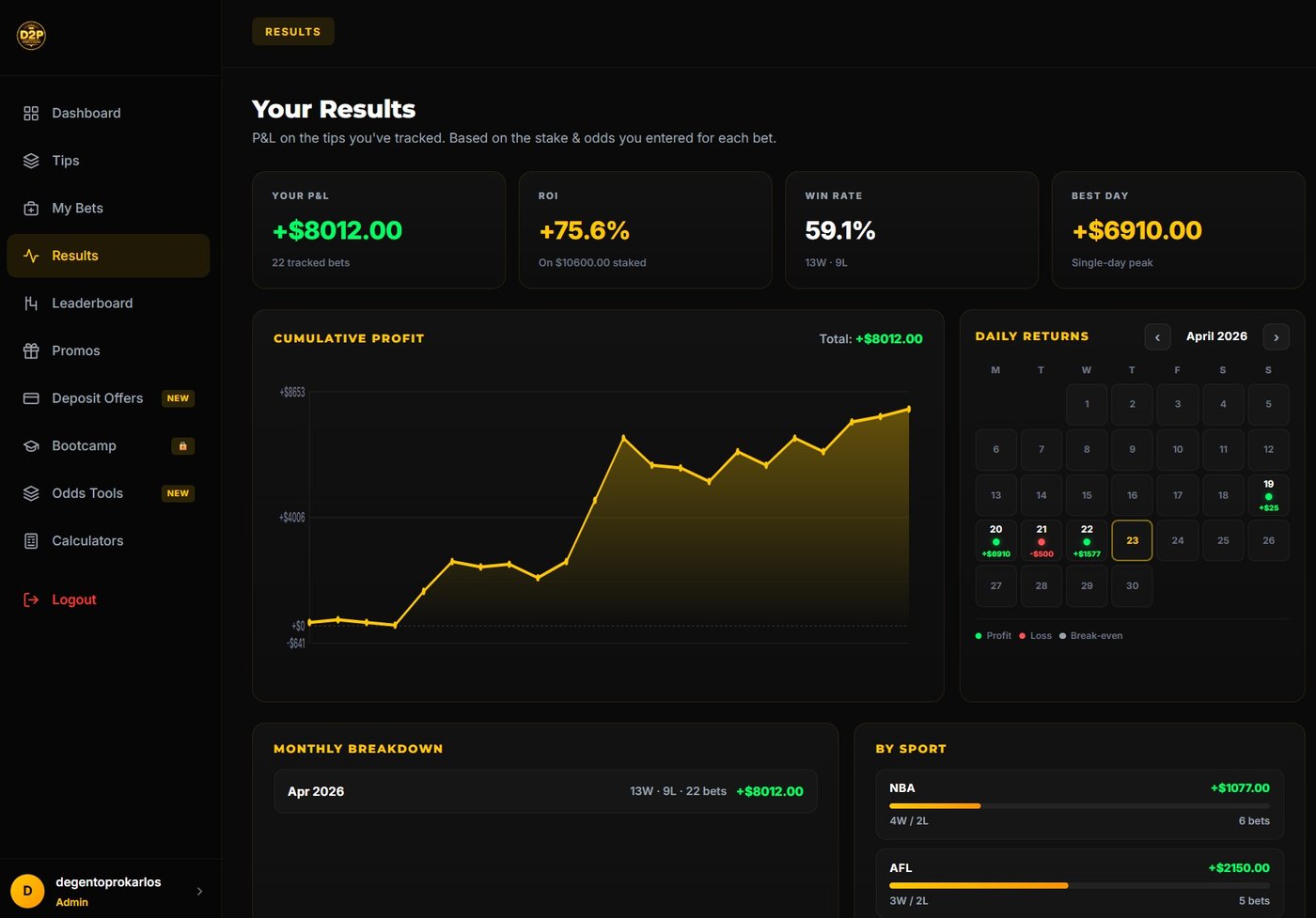
Theory is useful, but the only way to know which staking plan actually works for your specific betting style is to measure it against your own data. That is where DegenToPro's bet tracker becomes the most valuable tool in your arsenal.
DegenToPro is built for Australian punters who want to move beyond guesswork and run their betting operation like a business. The bet tracker logs every bet with the following data points:
| Data Point Logged | Why It Matters for Staking Analysis |
|---|---|
| Odds at placement | Calculate your actual returns per unit staked |
| Stake amount | Track total exposure and compare against bankroll % |
| Fair odds at placement | Determine the edge% at the time you bet |
| Closing line value (CLV) | Verify your process is genuinely +EV, not just running hot |
| Result (win / loss / void) | Calculate ROI, unit profit, running bankroll |
| Bookmaker | Identify which books give you the best edges |
| Sport / competition | Filter results by market to find where your edge is strongest |
With this data, you can run genuine staking plan comparisons. Want to know whether your results would have been better under half-Kelly compared to your actual flat staking? Export your bet history and apply the alternative staking formula to each bet retrospectively. The analysis is clear because the raw data is all there.
Critically, DegenToPro tracks verified CLV - the closing line value calculated against sharp reference markets, not just self-reported. This is the metric that separates genuine edge from a lucky run. If your CLV is positive over 500+ bets, your selection process is sound and upgrading from flat to Kelly staking is a logical next step. If your CLV is flat or negative, a different staking plan is not going to save you - you need to go back to your edge identification process first.
DegenToPro covers 100+ Australian and international bookmakers including Sportsbet, TAB, Neds, BlueBet, Unibet, Ladbrokes, Betfair and more. With 6,000+ members in the Discord community, you can compare your staking results against bettors using different approaches and learn from what the data actually shows.
Pricing is accessible at every level: the FREE tier requires no card and gives you a taste of the platform. Weekly plans are $59.99 AUD, monthly plans are $299.99 AUD, and the Lifetime plan is $699.99 AUD - all currently 20% off with the World Cup Offer. See all plan details here.
Frequently Asked Questions
What is the best betting staking plan for beginners?
Flat staking at 1% of your starting bankroll is the best staking plan for beginners. It is simple to execute, easy to review, and it protects your bankroll during the learning phase. Once you have 500+ tracked bets and confirmed positive CLV, you can consider moving to percentage staking or fractional Kelly.
Does the Kelly Criterion actually work in sports betting?
Full Kelly works in theory but is too aggressive in practice because it requires a perfectly accurate edge estimate. Fractional Kelly - using 0.25x to 0.5x of the Kelly-recommended stake - is the practical solution. It sacrifices some growth rate in exchange for significantly lower drawdown risk when your edge estimate is slightly off. DegenToPro's edge% data gives you the reliable input needed to apply Kelly sizing sensibly.
Can a staking plan turn a losing betting strategy into a winning one?
No. If your selections have negative expected value on average, no staking system can produce a long-run profit. This is mathematically provable. Staking plans manage risk and optimise growth when edge exists - they do not create edge where none exists. Fix your edge identification first, then optimise your staking.
How many bets do I need before I can assess my staking plan?
You need at least 200-300 bets before drawing any conclusions, and ideally 500+ for statistical confidence. With fewer bets, variance is too high to distinguish skill from luck. DegenToPro's bet tracker shows your rolling CLV and ROI so you can monitor trends as your sample grows.
Is Martingale betting illegal in Australia?
No, Martingale betting is not illegal in Australia. It is simply a mathematically flawed strategy that will result in significant losses over time for any bettor who applies it to negative-EV bets. Bookmakers do not prohibit it because it favours the house in the long run.
Should I use different staking plans for different sports?
Most professional bettors apply a consistent staking plan across all sports and markets, because the edge estimate - not the sport - should drive stake size. If you are using Kelly sizing, a 3% edge in an NRL market and a 3% edge in an EPL market should produce the same stake fraction. Varying your approach by sport introduces inconsistency that makes your results harder to interpret.
How does confidence-based staking compare to Kelly over a large sample?
For most punters, Kelly staking based on objective edge estimates outperforms confidence-based staking over a large sample. The key reason is that subjective confidence does not reliably correlate with actual edge. The only way to know whether your confidence ratings add value is to track results by tier over hundreds of bets - something DegenToPro's bet tracker makes straightforward.
The Bottom Line
Betting staking plans are not magic - they are risk management tools. The best plan in the world will not save you if your selections have no edge. And a poor staking plan will undermine even a genuinely profitable selection process. The two problems need to be solved together.
For most Australian punters in 2026, the optimal path is straightforward: identify genuine +EV opportunities using sharp-market data, apply flat staking at 1-2% of bankroll while building your track record, track every bet with verified CLV data, and graduate to fractional Kelly once your edge is confirmed over a statistically meaningful sample.
The Martingale and progressive systems are tempting because they appear to solve the problem of losing streaks. They do not. They convert steady losses into catastrophic losses. Avoid them entirely.
What separates the punters who build long-term profit from those who do not is almost always discipline and data. Discipline to stick to a plan even during a cold run. Data to know whether the plan is actually working or whether you are just lucky.
DegenToPro gives Australian punters both. The +EV finder surfaces genuine edge opportunities across 100+ bookmakers. The bet tracker logs every bet with verified CLV so you can see exactly how your staking plan is performing against real data - not just theory. More than 6,000 members are already using it to make better decisions about both their selections and their stakes.
The question is not which staking plan sounds best. The question is which one your own data supports. Start tracking and find out.
Test Your Staking Plan Against Real Data
Join 6,000+ Australian punters who use DegenToPro to find +EV bets, track verified CLV and compare staking plans on their own results. Start on the FREE tier with no card required - or unlock the full bet tracker, edge finder and Pro Odds Screener from $59.99/week AUD.
Start Free →