
Every punter knows the feeling: you back a team at $2.10, the game goes to the wire, they lose by a point and you chalk it up as bad luck. But was it? Or were you just gambling blind, hoping results would eventually swing your way?
Professional bettors measure success differently. They track closing line value - the gap between the price they locked in and the price the market settled on just before kick-off. Get that gap right consistently, and long-term profit follows almost inevitably. Get it wrong, and no hot streak will save you.
This guide breaks down exactly what CLV is, why it matters more than your profit and loss over any given month, how to calculate it precisely, and how DegenToPro makes the whole process automatic.
What is the closing line?
The closing line is the final odds a bookmaker offers on a market immediately before it is suspended for the event to begin. Once the last bet is accepted and the market locks, those are the closing odds.
Why does it matter? Because the closing line represents the collective wisdom of the entire betting market at the point of maximum information. By the time a game kicks off, sharp syndicates, professional traders, and thousands of informed recreational punters have all weighed in. The margin has been refined. Soft money has been washed out. What remains is as close to a true probability estimate as the market is capable of producing.
This is why sportsbooks themselves use closing odds as an internal benchmark. When a bookmaker reviews whether a punter is "sharp," one of the first things they check is whether that customer consistently bet into prices that later shortened. It is the same logic in reverse: if the market always moved against your bets after you placed them, you were getting value. If it always moved with you - or did not move at all - you probably were not.
The opening line, by contrast, is set with limited information and is often deliberately generous to attract action. Early markets are where value lives, but only for those who know how to find it before the professionals do.
What is closing line value (CLV)?
Closing line value (CLV) is the difference between the odds you obtained when you placed your bet and the fair odds implied by the closing line, expressed as a percentage edge. When your bet price is higher than the closing price (adjusted for margin), you have positive CLV. When it is lower, you have negative CLV.
Think of it this way: if you backed a team at $2.10 and the market closed at $1.90, the market moved toward your selection. The line shortened, which means the market collectively agreed you had the right side at a price that was too generous. That is positive CLV in action.
Positive CLV does not mean you will win every bet. It means you found an edge at the time of betting. Over hundreds and thousands of bets, positive CLV almost always converts into profit - because that is precisely what it measures: the systematic ability to beat the market's best estimate of probability.
Why CLV is the best long-term predictor of profit
Short-term profit is a terrible signal. You can win 60% of your bets for three months through pure variance and lose money in the fourth when the cards fall the other way. Conversely, a sharp bettor grinding a 3% CLV edge can go through a brutal 100-bet losing stretch that looks catastrophic but is completely within the bounds of normal statistical variation.
CLV cuts through the noise. Here is why it is the superior metric:
- It is sample-size efficient. Detecting a genuine edge from raw profit/loss requires thousands of settled bets. A statistically significant CLV signal emerges much faster - sometimes within a few hundred bets - because each individual data point is informative regardless of the result.
- It is result-independent. Your CLV is fixed at the moment you place the bet. A last-minute deflection that turns a win into a loss does not change the quality of your decision. CLV rewards the process, not the outcome.
- It is what the market respects. Bookmakers limit and restrict accounts based on CLV, not profit. They know that a punter winning consistently on CLV is a genuine threat to their margin. A lucky punter who happens to be up is noise. A punter with sustained positive CLV is signal.
- It is predictive, not descriptive. Historical profit tells you what happened. Historical CLV tells you what is likely to keep happening. It is a forward-looking metric dressed in historical data.
The research supports this. Academic studies of prediction markets and sports betting markets consistently show that closing odds are the most efficient available probability estimates - more accurate than tipsters, modellers, and the vast majority of recreational bettors. Beating those odds systematically is genuinely difficult, and demonstrating that you can is meaningful evidence of skill.
How to measure CLV (formula + examples)
The standard CLV formula compares your obtained odds to the fair closing odds - that is, the closing odds with the bookmaker's margin removed.
The CLV formula
First, convert the closing odds to an implied probability, remove the margin to get the fair probability, then compare your implied probability to the fair implied probability:
Fair closing probability = 1 / closing odds (de-juiced)

Your implied probability = 1 / your odds

CLV% = (Your implied probability / Fair closing probability − 1) × 100
For a two-outcome market (such as head-to-head), a simplified de-juice method takes the closing odds on both sides, converts each to implied probability, sums them (to get the overround), and divides each by the sum to get fair probabilities.
In practice, for a rough but useful single-line calculation where the closing line is already relatively sharp (close to fair), many practitioners simply use:
CLV% = (Your odds / Closing odds − 1) × 100This gives a directionally accurate result and is easy to apply quickly. The examples below use this approach.
| Event | Your Price | Closing Price | CLV% | Assessment |
|---|---|---|---|---|
| AFL - Collingwood H2H | $2.10 | $1.90 | +10.5% | Strong positive CLV |
| NRL - Brisbane -5.5 line | $1.95 | $1.95 | 0.0% | No CLV - market unchanged |
| A-League - Melbourne City Total Over 2.5 | $1.80 | $1.95 | -7.7% | Negative CLV - market drifted out |
| Horse Racing - Race 4 Randwick Win | $6.50 | $5.50 | +18.2% | Excellent CLV - beat the steam |
| NBL - South East Melbourne H2H | $2.25 | $2.30 | -2.2% | Slight negative CLV - line drifted slightly |
Looking at the Collingwood example in detail: you backed at $2.10 and the market closed at $1.90. That is a line move of 20 cents in your favour. Your CLV is ($2.10 / $1.90 − 1) × 100 = +10.5%. That is a substantial edge locked in before a single second of play. Whether Collingwood won or lost on the night is irrelevant to whether this was a good bet.
The horse racing example illustrates how CLV can be particularly pronounced in racing markets, where early prices are often set well before sharp money arrives and line movements can be dramatic.
Beating the close consistently vs short-term variance
The phrase "beating the close" refers to consistently obtaining prices that are better than where the market ultimately settles. It is the holy grail of sports betting, and it is what separates genuinely skilled bettors from everyone else.
Here is the crucial insight: variance does not affect CLV. A bettor who beats the close by an average of 4% across 500 bets will experience winning months and losing months. Their profit will swing wildly if they are betting on high-odds markets. But their CLV will remain a steady signal in the background, telling anyone who looks that this person has an edge.
Short-term results, by contrast, are dominated by variance. A 55% win rate on even-money markets has a standard deviation that means you can expect runs of 15 - 20 consecutive losses even with a genuine edge. If you are judging your process by monthly profit, you will constantly second-guess yourself, change strategies at the wrong times, and chase losses with suboptimal bets.
The professional approach is to set a minimum sample threshold - typically 200 to 500 bets depending on odds range - and track CLV throughout, treating monthly results as interesting but not conclusive. If your average CLV remains positive at sample, trust the process. If your CLV is flat or negative, no amount of lucky results should give you confidence in the strategy.
This is also why bet timing matters so much. Getting on early - before the market sharpens - is where retail punters can legitimately find edges. Tools that surface early value, before it gets hammered out by sharps, are doing real work. But you only know whether you got on in time if you are tracking CLV.
CLV vs profit - why they can diverge
Understanding the relationship between CLV and profit requires understanding variance. In the short to medium term, the two can diverge substantially. Here are the scenarios that trip punters up:
Positive CLV, losing money
This is the most common source of tilt among smart bettors. You are doing everything right - finding genuine edges, getting on at better prices than the market closes at - but results are running against you. This is entirely normal and is a function of the randomness in sports outcomes. The correct response is to continue the process and let the sample size grow. The CLV edge will eventually express itself in profit.
Negative CLV, winning money
This is the dangerous one. A punter backing heavy favourites, taking terrible prices, consistently betting into value-free markets - and yet running hot for a few months. Their bank is growing. Friends are asking for tips. They feel like geniuses. Then variance corrects, the inevitable losing run arrives, and they have no process to fall back on because they never built one. CLV would have told them the truth from the start.
Zero CLV
Betting into closing prices - getting roughly what the market closes at, consistently - means you are paying the bookmaker's margin and nothing more. Over time, this converges to a loss equal to the average margin across your bet history. You cannot beat a juice-charging bookmaker by matching their closing line. You need to beat it.
The divergence between CLV and profit shrinks as sample size grows. With 1,000 or more bets, a bettor with genuine positive CLV will almost certainly be profitable. With 50 bets, results and CLV can point in entirely opposite directions. This is why CLV matters most early - it is the signal you rely on before the sample is large enough for profit to become statistically meaningful.
Using CLV to validate your betting process
CLV is not just a number you calculate once and file away. It is an ongoing diagnostic tool for your entire betting operation. Here is how to use it systematically:
Segment your CLV by strategy
If you are betting across multiple sports, markets, and methods, your aggregate CLV will mask what is working and what is not. Break it down. You might find your AFL head-to-head bets have +5% average CLV while your NRL totals bets are running at -2%. That tells you exactly where to focus and where to stop.
Track CLV by bookmaker
Different bookmakers price markets at different times and with different sharpness. You may consistently find better prices at certain books for certain market types. CLV analysis by bookmaker reveals this systematically, rather than you relying on gut feel.
Monitor CLV trend over time
Is your average CLV improving, stable, or declining? A declining trend might indicate your edges are getting sharper - either the market has caught up to your information sources, or bookmakers have started restricting your accounts to limit your ability to take value. Knowing this early lets you adapt before your edge disappears entirely.
Use CLV as a stop-loss signal
If your CLV drops below zero and stays there for a significant sample - say, 200+ bets - it is a genuine signal that your process is broken. Not a losing streak. A broken process. That is when to pause, review, and rebuild, rather than grinding through with negative expectation.
Compare your CLV to benchmarks
A CLV of +1% to +2% is respectable for a retail bettor working hard to find edges. Consistently above +3% indicates either a systematic information advantage or excellent line shopping across many books. Above +5% is rare and tends to trigger bookmaker restrictions. Knowing where you sit relative to these benchmarks tells you how sustainable your edge is.
How DegenToPro automatically grades your CLV
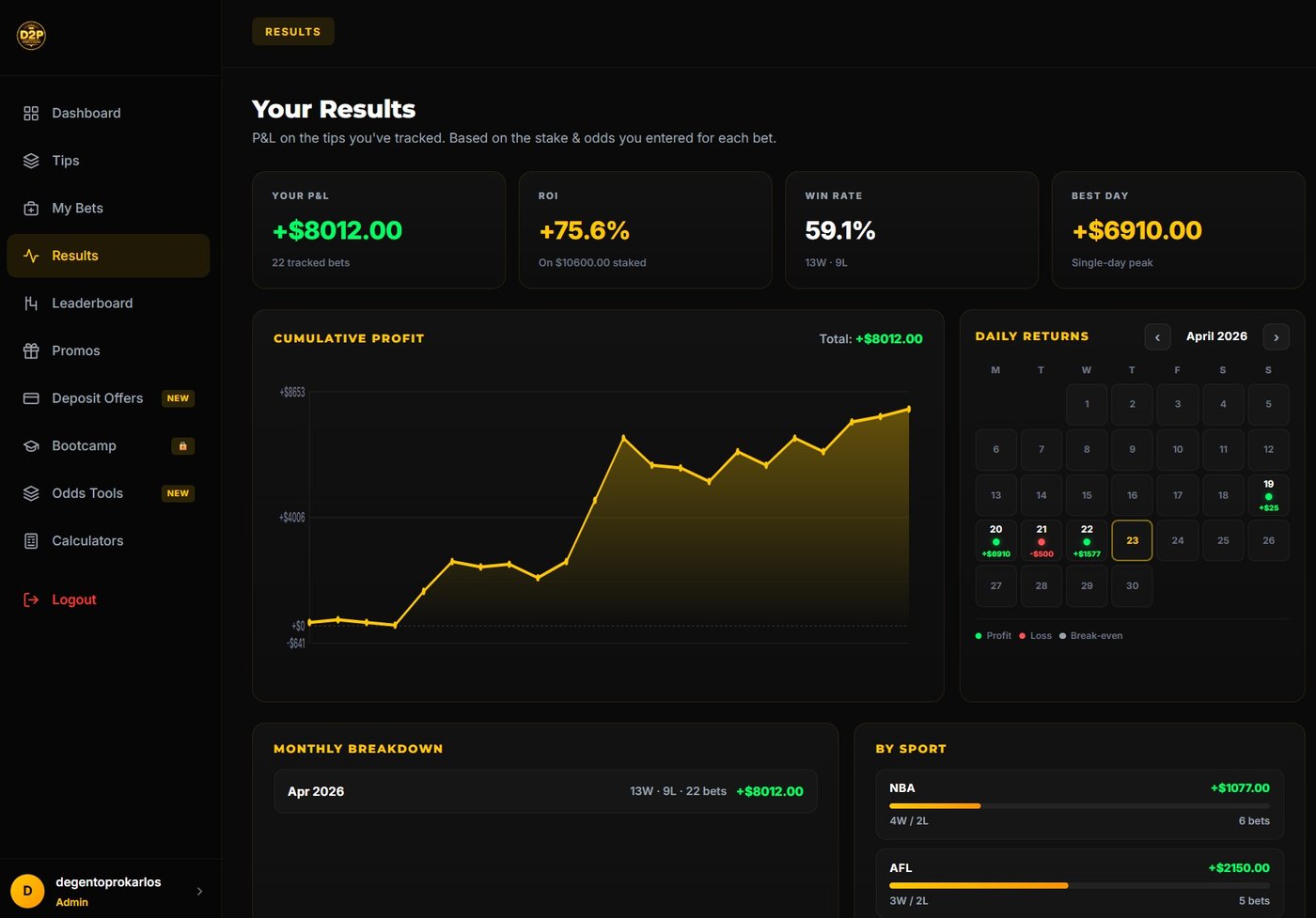
Calculating CLV manually is tedious, error-prone, and time-consuming enough that most punters simply do not do it. They might track wins and losses in a spreadsheet, but they never close the loop on whether their prices were good at the time of betting.
This is the gap that DegenToPro fills - and it is genuinely rare in the Australian market.
Here is what that means in practice. You back the Bulldogs at $3.40 on a Tuesday evening, log it in DegenToPro, and go to bed. By kick-off on Saturday, sharp money has moved the line to $2.90. DegenToPro picks up the closing price, calculates your CLV at +17.2%, and adds it to your running averages. You see it reflected in your dashboard the moment the game ends.
Multiply that across every bet you place - AFL, NRL, racing, soccer, tennis, basketball - and you start to build a genuinely meaningful dataset about your betting performance. Not just wins and losses. Not just profit and loss. But a verified record of whether you are consistently finding value before the market does.
DegenToPro covers 100+ Australian and international bookmakers, so your CLV data reflects real market prices across the books you actually use. The community dashboard shows live aggregate CLV across all tracked members - a signal of collective edge that is updated in real time. With over 6,000 members in the Discord community, the dataset behind these benchmarks is substantial.
This kind of automatic, verified CLV grading is rare. Most Australian bet trackers will record your results and show you a profit graph. Very few close the loop by pulling closing prices and grading each bet on quality of execution. That distinction matters enormously if you are serious about building a sustainable, long-term betting operation.
Track your CLV automatically - free to start
DegenToPro grades closing line value on every bet you log. See your real edge, not just your results. Plans from free, with weekly, monthly, and lifetime options available.
Start Free →The bottom line
Closing line value is not a concept reserved for professional syndicates or quantitative analysts. It is a metric that any serious punter can and should track - because it is the most honest answer to the question "am I actually good at this?"
Short-term profit lies. A hot month tells you almost nothing. A cold month tells you almost nothing. What tells you the truth is whether, bet by bet and market by market, you are consistently getting better prices than where the market ultimately settles. That is CLV. That is the signal.
If you are positive CLV over a meaningful sample, keep going. Tighten your process, expand your book access, and let the edge play out. If you are negative CLV, no amount of lucky results should convince you that you have found a sustainable edge. The market is pricing you out on every bet, and the losses will eventually arrive to confirm it.
Start tracking your CLV now. Log every bet. Let the data build. In three months you will have more useful information about your betting process than most punters accumulate in years - because you will have evidence, not anecdotes.
DegenToPro makes this automatic. Every bet you log gets graded. Your CLV builds in the background, verified against real closing prices, across every sport and book you use. World Cup Offer pricing is live now - 20% off all plans, including Weekly ($59.99 AUD), Monthly ($299.99 AUD), and Lifetime ($699.99 AUD) - with a free tier that requires no card to start.
Start tracking your CLV today - World Cup Offer: 20% off
Join 6,000+ members already using DegenToPro to track verified CLV, find +EV bets, and build a process that actually works long-term. No card needed to get started.
See Plans & Start Free →