
If you have ever wondered why betting a dollar on every outcome of a two-way market costs more than a dollar, you have already encountered the vig. Bookmakers shade every price so that their implied probabilities add up past 100%, guaranteeing a long-run edge for the house. A reliable fair odds calculator peels that margin away, leaving you with the "true" probability of each outcome - the essential input for every expected-value (+EV) and arbitrage calculation.
There is more than one way to strip the vig. The four methods below each make different assumptions about how bookmakers distribute their margin, and the right choice depends on the market type and the sharpness of the book you are referencing. We cover all four in depth.
What is the vig and why do odds sum to more than 100%?
Decimal odds encode an implied probability with a simple formula:
Implied probability = 1 ÷ decimal odds
In a perfectly fair coin-flip market each side would pay 2.00, implying 50% each - exactly 100% combined. Real bookmaker markets never do this. A typical two-way market might be priced at 1.87 / 1.87, giving implied probabilities of 53.48% each - a combined "overround" of 106.96%. That extra 6.96% is the vig (also called the margin, juice, or overround). For every $100 wagered across both sides, the bookmaker expects to keep roughly $6.96 regardless of the result.
To calculate fair odds you need to answer one question: exactly how was that 6.96% distributed across the two outcomes? Each devigging method below gives a different - and in some contexts, better - answer to that question.
Method 1 - Multiplicative (Proportional) Devigging
The multiplicative method assumes the bookmaker applied the margin proportionally - the same percentage markup on every outcome. It is the most widely used method and the default for most EV-betting tools.
The formula
- Convert each decimal odd to an implied probability: pi = 1 ÷ oddsi
- Sum all implied probabilities to get the overround O.
- Divide each implied probability by O to get the fair (no-vig) probability: fairi = pi ÷ O
- Convert back to decimal odds: fair decimal = 1 ÷ fairi
Worked example
A bookmaker prices a tennis match at Team A: 1.65 and Team B: 2.30.
| Outcome | Bookie Odds | Implied Prob | Fair Prob (No-Vig) | Fair Decimal Odds |
|---|---|---|---|---|
| Team A | 1.65 | 1 ÷ 1.65 = 60.61% | 60.61% ÷ 104.0% = 58.28% | 1 ÷ 0.5828 = 1.716 |
| Team B | 2.30 | 1 ÷ 2.30 = 43.48% | 43.48% ÷ 104.0% = 41.81% | 1 ÷ 0.4181 = 2.392 |
| Total | - | 104.09% | 100.00% | - |
The overround is 104.09%. Dividing each implied probability by 1.0409 distributes the margin equally in proportion to each outcome's weight. Fair decimal odds come out at 1.716 and 2.392 - meaningfully better than the listed prices.
Method 2 - Additive Devigging
The additive method assumes the bookmaker added a flat amount of margin to each outcome - the same absolute percentage points regardless of how likely the outcome is.
The formula
- Convert each decimal odd to an implied probability: pi = 1 ÷ oddsi
- Sum all implied probabilities to get the overround O.
- Calculate the excess: excess = O − 1
- Subtract an equal share from each: fairi = pi − (excess ÷ n) where n is the number of outcomes.
- Convert back to decimal odds: fair decimal = 1 ÷ fairi
Worked example
Using the same market - Team A: 1.65, Team B: 2.30 (overround 104.09%, excess 4.09%).
| Outcome | Bookie Odds | Implied Prob | Fair Prob (No-Vig) | Fair Decimal Odds |
|---|---|---|---|---|
| Team A | 1.65 | 60.61% | 60.61% − 2.045% = 58.56% | 1 ÷ 0.5856 = 1.708 |
| Team B | 2.30 | 43.48% | 43.48% − 2.045% = 41.43% | 1 ÷ 0.4143 = 2.414 |
| Total | - | 104.09% | 100.00% | - |
Each implied probability is reduced by exactly 2.045% (4.09% ÷ 2 outcomes). Notice how the additive method removes proportionally more margin from the favourite than the multiplicative approach does - a key difference when you are working with heavy favourites and long shots in the same market.
Method 3 - Power Devigging
The power method takes a more sophisticated approach. It raises each implied probability to the power of a parameter k (where 0 < k ≤ 1), then searches for the value of k that makes the adjusted probabilities sum to exactly 1.00. Because the power transformation has a non-linear effect, it naturally reduces the implied probability of long shots by a larger amount than that of favourites - correcting for the well-documented favourite-longshot bias (FLB).
The formula
- Convert each decimal odd to an implied probability: pi = 1 ÷ oddsi
- Find k such that: Σ (pi)k = 1 (solved iteratively).
- Fair probability: fairi = (pi)k
- Convert back to decimal odds: fair decimal = 1 ÷ fairi
Worked example
Same market - Team A: 1.65 (p = 60.61%), Team B: 2.30 (p = 43.48%). Solving numerically gives k ≈ 0.9617.
| Outcome | Bookie Odds | Implied Prob | Fair Prob (pk) | Fair Decimal Odds |
|---|---|---|---|---|
| Team A | 1.65 | 60.61% | (0.6061)0.9617 = 58.52% | 1 ÷ 0.5852 = 1.709 |
| Team B | 2.30 | 43.48% | (0.4348)0.9617 = 41.48% | 1 ÷ 0.4148 = 2.411 |
| Total | - | 104.09% | 100.00% | - |
In this relatively even market the power method produces results close to the additive method. The real difference emerges in multi-runner markets or when one side is a very heavy favourite - the power method penalises long shots more heavily, bringing the model closer to empirical reality.
Method 4 - Shin Method
The Shin method, developed by economist Hyun Song Shin in the early 1990s, is built on a fundamentally different assumption: bookmakers set prices to protect themselves against bettors with superior information (insiders). The fraction of the handle made up by these "informed" bettors - parameter z - drives the margin. A higher z implies a more efficient, sharper market; a lower z suggests a softer book.
For a two-outcome market, the Shin parameter z is solved from:
Σ √(z² + 4(1−z) · (pi / O)²) − z = 2(1−z)
This is typically solved iteratively. Once z is found, the fair Shin probability for each outcome is:
fairi = (√(z² + 4(1−z)(pi/O)²) − z) ÷ (2(1−z))
Worked example
Same market - Team A: 1.65, Team B: 2.30. Solving iteratively yields z ≈ 0.0390.
| Outcome | Bookie Odds | Implied Prob | Shin Fair Prob | Fair Decimal Odds |
|---|---|---|---|---|
| Team A | 1.65 | 60.61% | ≈ 58.34% | 1 ÷ 0.5834 = 1.714 |
| Team B | 2.30 | 43.48% | ≈ 41.66% | 1 ÷ 0.4166 = 2.400 |
| Total | - | 104.09% | 100.00% | - |
In this balanced market the Shin probabilities sit between the multiplicative and additive results. The method's value becomes more apparent in asymmetric markets with a clear insider-activity signal - for example, a horse racing market that tightened sharply just before jump time - where Shin's model attributes more of the margin to information rather than uniform profit-taking.
When to use each method
No single devigging method is universally correct, but research and practitioner experience point to clear situations where each shines:
| Method | Best suited for | Key assumption |
|---|---|---|
| Multiplicative | General-purpose; two-way sports markets; benchmarking against sharp books like Pinnacle | Margin is applied as a uniform percentage on each outcome |
| Additive | Markets where you suspect equal dollar amounts of margin per side | Margin is a flat absolute deduction from each outcome's probability |
| Power | Multi-runner markets (horse racing, futures); heavy favourite-longshot bias environments | Margin is non-linearly distributed; long shots are overpriced more than favourites |
| Shin | Sharp/exchange-adjacent markets; situations where insider-money activity is likely | Margin exists primarily to protect the book against informed bettors |
Practical rule of thumb: Start with multiplicative as your default - it is the most transparent method, widely accepted in the EV-betting community, and delivers robust results across most two-way sports markets. Move to Power when you are working with multi-runner horse-racing or futures markets where the favourite-longshot bias is well established. Apply the Shin method when you are referencing a known sharp book (Pinnacle, Betfair SP) and want a model that explicitly accounts for the information efficiency of that market.
The additive method is the least commonly used in modern +EV workflows because it mathematically treats heavy favourites more harshly than their true edge warrants - a known weakness in markets with highly asymmetric odds.
Let DegenToPro calculate fair odds automatically
DegenToPro is an Australian-built EV, arbitrage, and racing software platform that scans 100+ Australian and international bookmakers in real time. Rather than requiring you to open a spreadsheet and manually apply any of the four methods above, DegenToPro's engine handles the entire pipeline automatically:
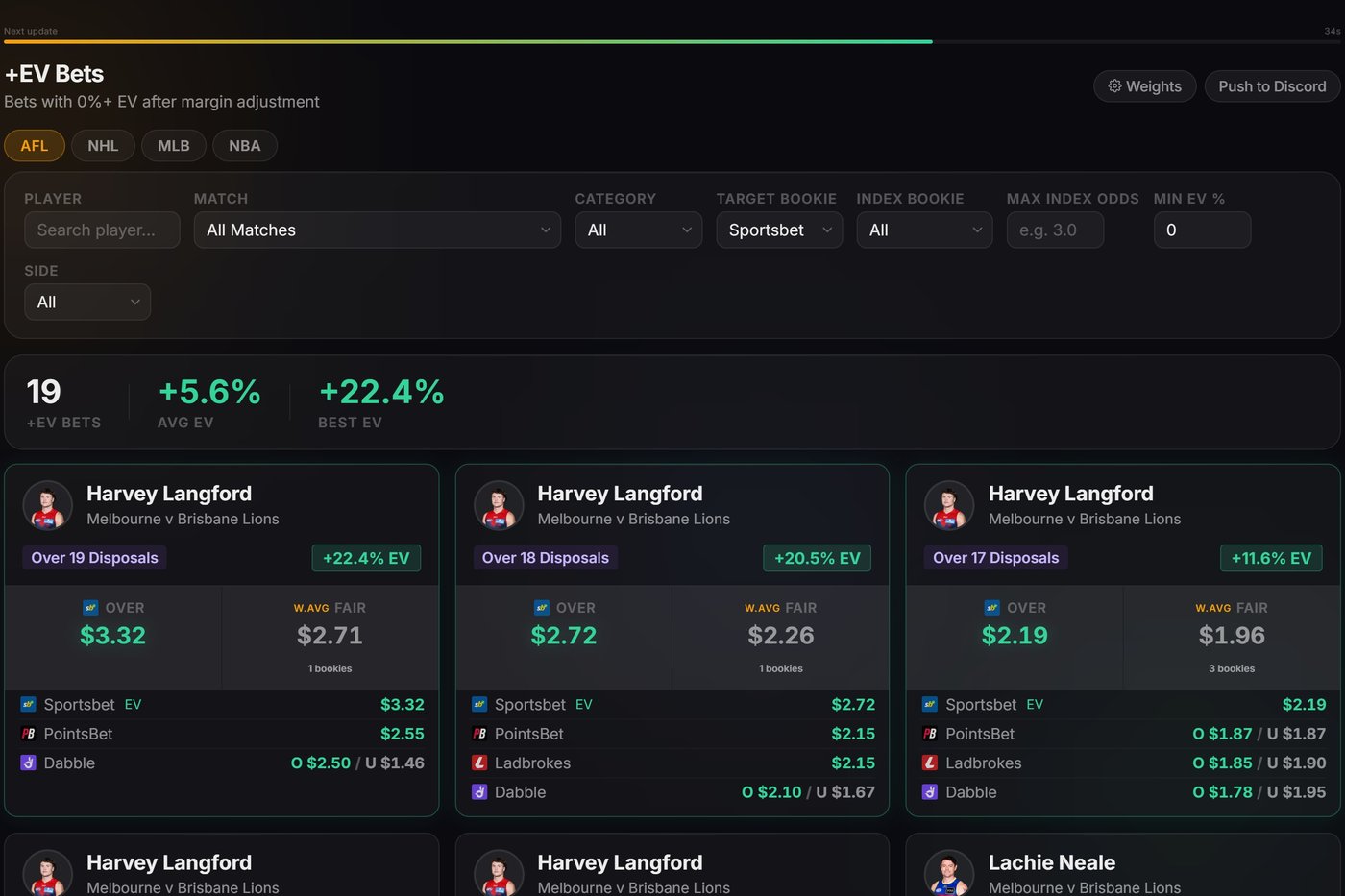
- Live fair-odds calculation: The platform ingests odds from every monitored book, selects the most appropriate devigging model for the market type, and outputs true no-vig probabilities continuously.
- Market EV displayed directly: Every line shows you the edge percentage versus the fair price - no mental arithmetic required. A positive number means a +EV bet.
- Arbitrage finder: Because fair odds are already computed, cross-book arbitrage opportunities surface instantly when two or more books disagree enough to guarantee profit.
- Bet tracker with verified CLV: Log your bets and DegenToPro calculates your closing-line value (CLV) - the most reliable indicator of long-term skill - against the same devigged benchmark.
- Racing software: Dedicated devig and EV engine for Australian thoroughbred, harness, and greyhound racing, where the power and Shin methods are particularly valuable.
The platform is used by more than 6,000 members in the DegenToPro Discord community, from recreational punters taking their first steps into +EV to full-time professionals tracking five- and six-figure annual profits against verified CLV.
Pricing starts with a FREE tier (no card required) - enough to explore the dashboard and see live fair-odds data across major sports. Paid plans unlock the full bookmaker scan, racing software, and the complete bet tracker. Plans are available on a Weekly ($59.99 AUD), Monthly ($299.99 AUD), or Lifetime ($699.99 AUD) basis. A World Cup Offer of 20% off is currently live - check the pricing page for the latest details.
Stop doing the maths by hand
DegenToPro calculates fair odds across 100+ bookmakers automatically - live, every few seconds, across sports and racing. See your edge before you bet.
Start Free →The bottom line
Calculating fair odds is the foundational skill of every profitable sports bettor. Without a fair-odds benchmark you cannot measure edge, verify whether a price represents value, or assess whether your long-term results reflect skill or luck.
The multiplicative method is the correct starting point for most two-way sports markets - it is transparent, mathematically sound, and widely used as the industry default. Shift to the power method for horse racing and multi-runner markets where the favourite-longshot bias is a measurable phenomenon. Use the Shin method when referencing a known sharp book where informed-money dynamics are likely at play. Reserve the additive method primarily for comparison or academic purposes.
Mastering the theory matters. But in practice, doing this manually for every market you want to bet is simply not feasible at the volume required to generate consistent profit. That is why DegenToPro exists - to automate the entire devigging pipeline so you spend your time finding and placing bets with real edge, not crunching numbers in a spreadsheet.
Ready to find +EV bets automatically?
DegenToPro scans 100+ AU bookmakers, strips the vig, and surfaces every +EV and arb opportunity in real time. Join 6,000+ members already using the platform - start for free today.
Start Free →