
Most greyhound punters rely on form, fitness and the occasional hot tip. The result, for the vast majority, is a slow leak of funds to the tote margin and the bookmaker's overround. The minority who profit long-term do something different: they build systems. They identify structural edges that repeat across meetings, apply consistent staking rules, and measure their results against a benchmark that tells them whether their process is actually working.
This guide is a systems-focused companion to greyhound value betting. It does not promise a magic filter. It does give you a complete framework - from draw bias analysis and sectional time modelling through to proportional staking and automated price comparison - that you can build on over hundreds of recorded bets. Combined with DegenToPro's dedicated racing software, which compares best-tote and fixed odds across the full field in real time, this is the closest thing to a professional greyhound betting operation that any Australian punter can build independently.
Why Greyhound Betting Requires a System, Not Just Tips
Greyhound racing is a high-frequency betting market. In Australia alone, there are hundreds of graded races run every week across Wentworth Park, The Meadows, Cannington, Sandown Park, Ipswich, Richmond, and dozens of provincial tracks. That volume is both the opportunity and the trap. Without a systematic approach, you are making dozens of decisions per week with no framework to judge whether those decisions have positive expected value.
A system has three components: a consistent selection criteria (your edge hypothesis), a consistent staking method, and a measurement framework. Each section of this guide addresses one or more of those components. The goal is not to win every race - it is to find bets where the price offered is consistently higher than the true probability of the outcome. That gap, compounded across a large sample, is how professional greyhound punters profit.
The single most important insight: the market is often wrong, but not randomly wrong. Draw bias, class drops, sectional time advantages and late market money all create predictable patterns that a disciplined punter can exploit systematically. DegenToPro surfaces those price discrepancies across 100+ bookmakers so you can act before the line corrects.
Box Draw Bias by Track
Box draw is one of the most discussed and most misunderstood edges in greyhound betting. Every track has a different configuration - width, curve geometry, starting box alignment, rail position - and those configurations produce measurable win-rate tendencies by box number. The key word is "tendencies": draw bias is a probabilistic edge, not a guarantee, and it varies significantly by distance and track condition.
The table below shows illustrative win-rate tendencies by box position for common Australian track configurations. These figures are indicative only and should be treated as starting hypotheses to test against your own track-specific data set. Real edges require at least 500 race samples per track and distance combination before they are statistically meaningful.
| Box | Tight Turning Track (e.g. short 300-350m) | Wide Track / Long Sprint (400-520m) | Classic Distance (500-600m) |
|---|---|---|---|
| 1 | High - rail advantage on tight first turn | Moderate - early advantage, less decisive | Moderate - rail run but more time to settle |
| 2 | High - near-rail, benefits if Box 1 slow away | Moderate - consistent performer across track types | Moderate |
| 3 | Moderate - slightly wide but still inside | Moderate | Moderate |
| 4 | Moderate - neutral draw | Moderate - near centre, open run | Moderate |
| 5 | Low to Moderate - wide first turn exposure | Moderate | Moderate to High - settling races suit wider draws |
| 6 | Low - widest turn exposure on short tracks | Low to Moderate - longer run to first turn helps | Moderate |
| 7 | Low - reserved for early-speed greyhounds | Low to Moderate | Low to Moderate |
| 8 | Low - requires exceptional early pace to overcome | Low | Low - widest draw, most disadvantaged on most tracks |
Disclaimer: These tendency ratings are illustrative only. Box win rates vary by track, distance, surface condition and era. Always validate against your own recorded sample before staking real money on any draw-based hypothesis.
How to use draw bias as a value signal: do not simply back Box 1 every race. Instead, look for situations where a dog with genuine early speed is drawn to a favourable box at a price that does not reflect the draw advantage. If the market has priced a strong early-pace greyhound at 4.50 from Box 2 on a tight turning track, and your analysis suggests that combination wins at roughly 30% (fair price 3.33), that is a potential greyhound value bet worth quantifying further.
The reverse edge is equally valuable: identifying short-priced favourites drawn wide on tracks where wide draws carry a significant penalty. A greyhound priced at 1.80 from Box 7 on a 300m sprint track may be significantly overbet relative to the true draw-adjusted probability.
Early Speed & Sectional Times
Sectional times - specifically the first-split time from box to the first turn marker - are the most underutilised data point available to Australian greyhound punters. Early speed is the single greatest predictor of rail position entering the first turn, and rail position at the first turn correlates strongly with finishing position on most Australian tracks.
Most Australian greyhound form databases now publish split times for participating tracks. The metrics to focus on:
- Box-to-20m time: A proxy for initial acceleration and starting ability. Greyhounds with consistently low box-to-20m splits are genuine early-speed dogs regardless of their draw.
- First-split time relative to field average: A greyhound running 0.3 seconds faster than the field average to the first split has a structural advantage that is often underpriced at retail bookmakers who use simple form-line models.
- Late sectionals vs early sectionals: Greyhounds who run faster late splits than early splits are typically closers - they suit longer distances and tracks with wider first turns where early congestion is less punishing.
- Consistency of sectional times: A greyhound with consistent sectional times across its last five runs is less risky than one with high variance, even if the average times are similar. Consistency reduces the variance in your probability estimate.
Sectional time analysis becomes most powerful when combined with draw information. An early-speed greyhound drawn to Box 1 or 2 on a track where its sectional profile clearly dominates the field is a high-confidence value hunting target. The question is always whether the current price reflects that edge. This is where comparing prices across all bookmakers simultaneously - rather than accepting the first price you see - becomes critical. DegenToPro's racing software handles that comparison in real time.
Grading & Class: The Hidden Edge
Greyhound racing in Australia operates on a grading system where dogs move up in grade after wins and can drop in grade after losses or extended periods without placing. Class changes - particularly drops in grade - are one of the most reliable sources of greyhound value betting edges available, and they are systematically underpriced by casual market participants who focus only on recent win-loss form.
The class drop edge works as follows: a greyhound that has been racing in Grade 4 or Grade 5 company and drops to Grade 6 after a series of placings-without-winning is often facing a significantly weaker field. If the market prices that dog based only on its recent unplaced results (which occurred in harder company), the class-adjusted true probability may be substantially higher than the implied probability in the price.
| Class Scenario | Market Tendency | Value Opportunity |
|---|---|---|
| Grade drop after unlucky runs in better grade | Market underestimates class advantage | High - back at current grade price |
| Grade drop after injury return | Market uncertain, prices often long | Moderate to High - if fitness confirmed |
| Grade rise after dominant win | Market may overweight recent win at wrong grade level | Fading value - can be worth laying or avoiding |
| Returning from spell, same grade | Mixed - trial form helps sharpen estimate | Moderate - trial sectionals critical |
| Consistent placings, no grade movement | Market often overestimates place probability vs win | Avoid win markets, consider each-way selectively |
Class analysis requires you to look beyond the grade label and assess the quality of runners in each specific field. Two Grade 5 races at different tracks can have very different quality levels. If a greyhound has been running consistently competitive sectional times against strong Grade 5 company at Wentworth Park and is now entered in a Grade 5 at a provincial venue with a noticeably weaker field on paper, the grade label is the same but the class advantage is real.
This kind of cross-track class assessment is time-consuming to do manually. It is exactly the type of analysis where having access to full field-wide data - including historical form across venues - through a platform like DegenToPro gives you an information edge over the average punter who is scanning a single form guide on a single bookmaker's app.
Market Reads & Late Money
Greyhound markets are relatively thin compared to major sport markets, which makes them more susceptible to price moves driven by informed money. Learning to read market moves - specifically the direction and timing of late-market price shifts - adds another layer to your value identification system.
There are two types of late market moves worth paying attention to:
Informed moves (sharp money): When a greyhound drifts from 5.00 to 7.00 in the final hour before a race without any obvious form-based reason, or when a runner shortens from 3.50 to 2.40 in the same window, you are likely seeing the footprint of informed money. Trainers, handlers and connections are the primary source of early information in greyhound markets - injury status, training performance and fitness signals that are not publicly available. Consistent late-money patterns on certain kennels or trainers are worth tracking over time.
Liquidity-driven moves (tote flow): On tote markets, large bets from casual punters or pool imbalances can distort prices temporarily. If you are comparing fixed odds to tote prices in real time and see the tote price significantly better than the fixed price on a particular runner, it may signal a tote-pool imbalance - a short-term arbitrage or value opportunity. DegenToPro's best-tote vs fixed comparison makes this visible across the full field instantly.
What to look for as part of your system:
- Greyhounds that drift significantly but whose sectional time profile has not changed - the drift may be liquidity noise, not genuine information.
- Short-priced favourites that hold their price through to jump despite the field being competitive on class - this often indicates sharp agreement with the favourite's price, suggesting less value elsewhere rather than fade opportunities.
- Middle-market runners (3.00-6.00) that firm from their opening price - often the best value spot, as informed moves in this range are more meaningful than moves on short-priced runners where even small volume creates big price changes.
Compare the Full Field in Real Time
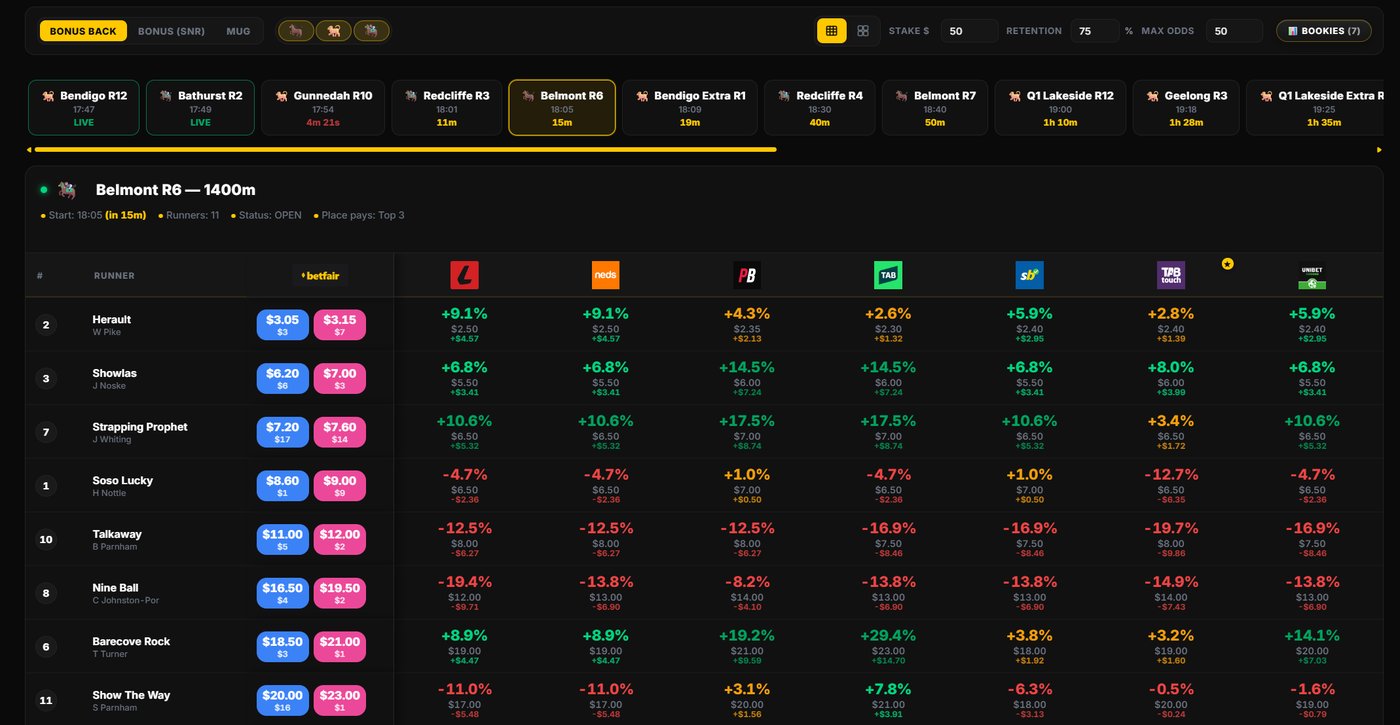
DegenToPro's dedicated greyhound racing software shows best-tote vs fixed odds across 100+ bookmakers for every runner in every field. See where the value sits before the market corrects. World Cup Offer: 20% off all plans right now.
Start Free →Staking Systems: Flat vs Proportional
No matter how strong your selection criteria, the wrong staking system will destroy your results. This is not a minor caveat - staking discipline is the difference between a profitable system and a blown bankroll. There are two approaches suited to systematic greyhound value betting: flat staking and proportional staking.
Flat Staking
Flat staking means betting the same dollar amount on every qualifying selection, regardless of price or perceived edge. It is the simplest approach, the easiest to execute under pressure, and surprisingly effective for punters who are still building their sample size and calibrating their selection criteria.
Recommended flat stake: 1-2% of your total bankroll per bet. At 1% flat stakes, you can survive a 50-bet losing run - which, at 3.00 average odds with a genuine 35% strike rate, will occur roughly once every 400 bets. That sounds painful, but it is normal variance for a legitimate edge.
Proportional Staking (Kelly Criterion)
Proportional staking sizes your bet based on the estimated edge of each individual selection. The Kelly Criterion formula is: f* = (b x p - q) / b where b is the decimal odds minus 1, p is your estimated true win probability and q is 1 minus p.
Full Kelly staking is mathematically optimal for bankroll growth but generates very high variance - drawdowns that feel psychologically intolerable even when the system is working perfectly. Most professional bettors use half-Kelly or quarter-Kelly, which reduces variance significantly while retaining most of the bankroll growth benefit.
| Staking Method | Best For | Risk Level | Key Trade-off |
|---|---|---|---|
| Flat (1% of bankroll) | Building sample, learning system | Low | Slower growth, easy to execute |
| Flat (2% of bankroll) | Established system, proven edge | Low to Moderate | Faster growth, higher drawdowns |
| Half-Kelly | Confident edge estimates, proven system | Moderate | Near-optimal growth, manageable variance |
| Full Kelly | Very accurate edge models only | High | Maximum growth, severe drawdown risk |
| Progressive (chase) | Not recommended | Very High | Mathematically destructive long-term |
One staking approach to avoid entirely: chasing losses by increasing stake size after a losing run. This is the single most common way that punters with genuine selection edges eliminate their advantage. The losing run you are trying to recover from is normal variance - increasing stakes converts it into a bankroll-ending event.
Start with flat staking at 1% per bet. After 500+ documented bets with a positive CLV result, consider moving to half-Kelly proportional staking where your edge estimate is most reliable. DegenToPro's bet tracker calculates edge percentage and CLV on every bet automatically, giving you the data you need to make that transition confidently.
Record Keeping & Sample Size
Record keeping is the least exciting part of greyhound value betting and the most important. Without a detailed log of every bet, you cannot distinguish between a losing run caused by bad luck and a losing run caused by a broken system. That distinction determines whether you should stay the course or change your approach - a decision that has a dramatic impact on long-term results.
Every bet record should include at minimum:
- Date and race details (track, race number, distance)
- Dog name, box number, grade
- Your odds taken and which bookmaker
- The fair odds estimate at time of bet (your devigged reference price)
- Edge percentage at time of bet (odds taken divided by fair odds, minus 1)
- Stake amount
- Result and return
- Closing odds (for CLV calculation)
- Notes on the selection rationale (draw, class, sectional advantage)
The minimum meaningful sample size for evaluating a greyhound betting system is 500 bets. At typical meeting volumes for an active punter, this represents two to four months of disciplined betting. Before reaching 500 bets, your results are dominated by variance and you cannot draw statistically valid conclusions about your edge. Many punters abandon genuinely profitable approaches during the variance window before they have collected enough data to know the system works.
The key metric to track beyond raw profit and loss is Closing Line Value (CLV). If you are consistently betting at prices better than the closing price on the same race, you are acting on information or analysis that the broader market has validated as correct. Positive average CLV over 500+ bets is the clearest signal that your greyhound value betting system has genuine edge, independent of the short-term results variance.
DegenToPro's bet tracker logs CLV automatically for every bet and builds your cumulative performance dashboard over time. Instead of maintaining a spreadsheet manually, you get verified, timestamped records you can review at any time - the same standard of record keeping used by professional betting operations.
Automating Price Comparison with DegenToPro
The final pillar of a systematic greyhound value betting operation is automation. Every manual step in your process - opening multiple bookmaker tabs, comparing prices, calculating edge percentages, logging bets - is time you are not spending on analysis, and it is an opportunity for human error to enter the system. At any meaningful betting volume, automation is not a luxury. It is what separates hobbyist punters from operators.
DegenToPro's dedicated racing software is built specifically for Australian greyhound and thoroughbred punters. Here is what it does that is relevant to the system described in this guide:
| DegenToPro Feature | What It Does for Greyhound Punters |
|---|---|
| Field-Wide Price Comparison | Compares best-tote and fixed odds for every runner across 100+ bookmakers simultaneously - no tab-switching required |
| Best-Tote vs Fixed Indicator | Shows at a glance whether the best available price on each runner is tote or fixed, and by how much |
| +EV Finder (Racing) | Flags runners where the best available price exceeds the devigged fair odds - your greyhound value betting signal |
| CLV Tracking | Logs your bet price and the closing price automatically, calculating verified CLV for every greyhound bet |
| Bet Tracker | Full bet history with edge %, stake, return and cumulative profit dashboard - no spreadsheets |
| Race Alerts | Daily alerts for high-value greyhound markets identified by the DegenToPro team |
| Discord Community | 6,000+ members including dedicated greyhound punters sharing edges, track notes and live results |
To illustrate how this works in practice: imagine you have identified a class-drop value hypothesis on a greyhound at Sandown Park. The runner has competitive sectional times from its last two Grade 5 races and is now entered in Grade 6. Your estimated fair probability is 28% (fair price 3.57). Without DegenToPro, you would need to check Sportsbet, TAB, Neds, BlueBet, Unibet, Ladbrokes and a dozen others manually to find the best available fixed price. With DegenToPro, you see the full field price board in one view. If one bookmaker is offering 4.20 while the rest are at 3.60-3.80, that 4.20 represents a 17.6% edge over your fair price estimate - a clear greyhound value bet that you would have missed or taken at an inferior price without the field comparison.
That difference - systematically capturing the best available price on every qualifying bet - compounds significantly over a full season. At a 15% average improvement in price capture across 300 annual bets, you are adding tens of units to your annual result purely from price discipline, before your selection edge even comes into play.
DegenToPro also helps you manage the account longevity problem. Australian bookmakers limit or restrict accounts that consistently bet at value prices. With access to 100+ bookmakers through a single platform, when one book tightens your limits another remains open. Your greyhound value betting operation stays alive longer.
The Bottom Line
Profitable greyhound value betting is a systems game. The punters who make it work long-term are not the ones with the best form-reading instincts - they are the ones who have built a repeatable process: a draw bias hypothesis tested against track data, a sectional time filter that identifies genuine early-speed advantages, a class assessment framework that looks beyond grade labels, a market reading approach that separates informed money from noise, a staking system that keeps them solvent through variance, and a record keeping discipline that tells them whether their process actually has edge.
Every one of those components requires the same thing: accurate, complete data, processed faster than you can do manually. That is the gap DegenToPro fills for Australian greyhound punters. Field-wide price comparison across 100+ bookmakers, best-tote vs fixed tracking, automated CLV measurement and a 6,000-strong Discord community of serious punters - it is the infrastructure a professional greyhound betting operation requires, available from the FREE tier upwards with no card required.
The structural edges in Australian greyhound racing are real. Box draw bias on tight turning tracks is measurable. Class drops from informed trainers are consistently underpriced. Late market money on thin tote pools creates tote-fixed arbitrage windows that disappear in minutes. These edges do not require insider information. They require a system, the discipline to execute it, and the tools to find the best price before the window closes.
Build the system. Trust the sample. Capture the best price on every bet. That is the complete greyhound value betting formula - and DegenToPro is how you automate the part that matters most.
Build Your Greyhound Edge with DegenToPro
Join 6,000+ Australian punters using DegenToPro's dedicated racing software to compare best-tote vs fixed across 100+ bookmakers, track CLV on every greyhound bet and find +EV opportunities before the market corrects. Start on the FREE tier - no card required - or unlock the full platform from $59.99/week AUD. World Cup Offer: 20% off all plans.
Start Free →