
There is one question every serious punter eventually asks: "Am I actually good at this, or have I just been lucky?" The answer is not in your profit and loss statement. It is not in your win rate. It is in whether you consistently beat the closing line.
Beating the closing line means getting a better price than where the market ultimately settles before an event begins. Do that repeatedly across hundreds of bets, and the mathematics of sports betting will work for you rather than against you. Fail to do it, and no hot streak will save you from the long-run grind of the bookmaker's margin.
This guide covers what the closing line is, why beating it is the most reliable path to sustained profit, how to do it in practice across Australian and international markets, how to measure the quality of your execution, and how DegenToPro makes the whole process automatic so you are never betting blind.
What the closing line is and why beating it equals long-term profit
The closing line is the final price a bookmaker offers on a market before it is suspended at the start of an event. Once the last bet is accepted and the market locks, those are the closing odds. The closing line on Pinnacle for an AFL head-to-head is one of the most efficient probability estimates available anywhere in the world.
Why is the closing line so important? By the time a market closes, it has absorbed the bets of sharp syndicates, professional trading desks, and thousands of informed punters. Early-market softness has been hammered out. Mispriced lines have been corrected. The closing price is as close to a true probability estimate as any publicly available information source is capable of producing.
This creates a powerful benchmark. If you consistently get better prices than where the market closes, you are systematically doing one of two things: either you are finding value that the market later recognises and corrects, or you are accessing prices at books that are slower to react than sharp reference markets. Either way, you have an edge.
If you consistently get worse prices than where the market closes, or prices that roughly match the close after margin, you are paying for the privilege of the bookmaker's overround on every bet. Over time, that converges to a predictable loss.
Professional bettors understand this intuitively. Sharp operations like Pinnacle and Betfair set their prices to attract sharp action precisely because the closing line is their best protection against being beaten. When a punter consistently beats those closing prices, it is the clearest evidence that exists of genuine betting skill.
The key insight is this: beating the closing line is not just a nice-to-have metric. It is the metric. If your average closing line value (CLV) is positive over a meaningful sample, you have a mathematical expectation of profit regardless of short-term results. If your CLV is negative, no winning streak will change your long-run trajectory. The close is the market's verdict on your bets, and it is almost always right.
How to consistently beat the closing line
There is no single trick to beating the close. It is a combination of discipline, access, timing, and process. Here are the four strategies that reliably produce positive CLV for Australian punters.
1. Bet early off soft opening prices
Opening lines are the best opportunity most retail punters will ever have. Bookmakers set early markets with limited information and often deliberately generous prices to attract volume. Sharp money has not yet arrived. The line has not been refined. The market is, in a word, soft.
If you can identify a genuinely mispriced opening line and get on before the sharps move it, you will almost always beat the close by a significant margin. The trick is identifying which opening prices are soft and which are already sharp. This requires either a pricing model, access to early sharp reference markets like Pinnacle, or a tool that flags prices that are out of line with the broader market.
Timing matters enormously. A price that is value at 9 am on a Monday may be 10 cents shorter by 10 am and 20 cents shorter by Wednesday. Early action on genuinely mispriced lines is the single most reliable source of positive CLV for retail punters in Australia. The window is real but it is short.
2. Line shop across multiple bookmakers
Different bookmakers price the same market differently. On a given AFL game, Sportsbet might have the favourite at $1.72 while TAB has $1.78 and a minor book has $1.81. Getting the $1.81 instead of the $1.72 is not trivial. Over a sample of hundreds of bets, consistently taking the best available price adds up to several percentage points of CLV that you would otherwise leave on the table.
Line shopping is not glamorous, but it is one of the most reliable and consistent sources of CLV improvement available. It requires accounts at multiple bookmakers, a systematic way to compare prices across them quickly, and the discipline to always take the best available price rather than the most convenient one.
Australian punters have access to a large number of bookmakers, from the major corporate books through to smaller international operations that take price from Pinnacle. Learning which books tend to be sharp (and therefore useful as a reference) versus which tend to have soft lines (and therefore useful for getting on early) is a significant edge in itself.
3. Follow sharp money moves
When sharp money hits a market, it moves the line. A Pinnacle line that shortens from $2.10 to $1.90 in a few hours has absorbed substantial sharp action. The question for retail punters is whether to follow that move or fade it.
Generally, following sharp moves means getting on at a price worse than what the sharps received. But it also means getting on before the market at large has fully repriced. If a sharp move on Pinnacle has not yet been reflected in the softer Australian books, there is an arbitrage window where you can get on at the old price before local books catch up.
Monitoring sharp reference markets and acting quickly on unhedged moves is a legitimate and effective strategy. It requires constant attention to line movement across markets, which is why tools that surface these moves automatically are valuable. The CLV you capture by getting on after sharp money but before the soft books adjust can be substantial.
4. Take +EV bets systematically
Positive expected value (+EV) bets are bets where the implied probability of your price is lower than the true probability of the outcome. Finding them requires either a model, a comparison to sharp reference markets, or access to tools that do the calculation for you.
The connection between +EV and CLV is direct. A bet that is +EV at the time of placement will almost always beat the closing line, because the market will correct the mispricing before the event. If you consistently take +EV bets at the moment they appear, you will systematically accumulate positive CLV.
The discipline required is to stick to the process even when individual bets lose. A +EV bet that loses is still a correct decision. A -EV bet that wins is still a mistake. The closing line is the referee that tells you which is which, independently of the result.
DegenToPro flags +EV opportunities in real time across 100+ bookmakers, surfacing mispriced lines before they close. That is the practical application of this principle for Australian punters who do not have the time or resources to run their own pricing models.
Measuring your CLV
Understanding how to beat the closing line requires knowing how to measure whether you are doing it. CLV is calculated as the percentage difference between your obtained price and the fair closing price.
The standard formula for a quick calculation:
CLV% = (Your odds / Closing odds - 1) x 100This gives a directionally accurate result for most purposes. A more precise calculation removes the bookmaker's margin from the closing odds before comparison, converting the closing line to fair probabilities first.
For the de-juiced version on a two-outcome market:
Fair closing probability (side A) = (1 / closing odds A) / ((1 / closing odds A) + (1 / closing odds B))

Fair closing odds (side A) = 1 / fair closing probability (side A)

CLV% = (Your odds / Fair closing odds - 1) x 100
The difference between the two methods is usually small when the closing line is already sharp, but it becomes meaningful when comparing against books with significant overround. For a benchmark like Pinnacle (typically under 2% margin), the simple formula is accurate enough for practical use.
What matters more than the formula is consistency. Measure every bet the same way, against the same closing price source. Pinnacle or Betfair are the standard reference markets. Closing prices from soft recreational books are less useful as benchmarks because they are less efficient.
Track CLV by sport, by market type, and by bookmaker. Your aggregate CLV masks what is working. A +4% CLV on AFL head-to-head markets combined with a -2% CLV on NRL totals means you should be betting more of the former and stopping the latter. You cannot see this without segmented CLV data.
Worked CLV example
The table below shows five bets with their obtained price, the Pinnacle closing price used as the benchmark, and the resulting CLV. All calculations use the simple formula for clarity.
| Event | Market | Your Price | Pinnacle Close | CLV% | Assessment |
|---|---|---|---|---|---|
| AFL - Collingwood v Sydney | Collingwood H2H | $2.20 | $1.95 | +12.8% | Strong positive CLV - beat early line before sharp move |
| NRL - Brisbane v Penrith | Brisbane +6.5 line | $1.92 | $1.88 | +2.1% | Modest positive CLV - line shopped to best available |
| EPL - Arsenal v Chelsea | Over 2.5 goals | $1.78 | $1.85 | -3.8% | Negative CLV - market moved away from selection |
| Horse Racing - Randwick R5 | Win - Horse A | $7.00 | $5.80 | +20.7% | Excellent CLV - early price before steam hit |
| NBA - Lakers v Warriors | Lakers H2H | $2.05 | $2.08 | -1.4% | Slight negative CLV - line drifted marginally away |
Looking at the five bets: two are strong positive CLV, one is modest positive, and two are negative. The aggregate CLV across this sample is approximately +6.1% (average of the five individual figures). That is a strong signal, driven largely by the horse racing bet and the AFL game where early prices were taken before sharp money arrived.
Notice that the EPL over bet has negative CLV. The market moved away from the selection after the bet was placed, meaning the broader market disagreed. Whether that bet wins or loses on the night is irrelevant to the CLV verdict: at the time of placement, relative to where the market settled, this was not a value bet. Over a large sample, consistent negative CLV bets will erode the edge built by the positive ones.
The horse racing example illustrates a key point about Australian racing markets. Early fixed prices are frequently set well before sharp money arrives, and the steam can be dramatic. Getting on at $7.00 before a horse firms to $5.80 represents a 20.7% CLV edge. You could lose 15 such bets in a row and still have generated enormous value from the process.
This is why serious Australian racing punters prioritise early market access. DegenToPro monitors early prices across 100+ bookmakers and alerts users to lines that are moving, giving you the window to act before prices correct.
Common mistakes that stop you beating the close
Most punters who are not beating the closing line are not failing because of bad luck. They are making systematic errors in process. Here are the most common ones.
Betting too late in the market
By the time a game is a day away, most of the soft money has already been extracted from the market. Prices have tightened. The easy edges are gone. Punters who only bet on game day, or who wait for confirmation before pulling the trigger, are consistently taking prices that are already sharp. They will rarely beat the close by a meaningful margin.
The fix is to build a habit of checking markets early, acting when you have information rather than when you feel confident. Confidence often comes too late to be useful in betting markets.
Using a single bookmaker
If you only bet with one or two bookmakers, you are leaving CLV on the table on every bet. The best available price across a broad range of books is almost always better than any single book's price. This is not a minor inefficiency. Across hundreds of bets, it can be the difference between positive and negative aggregate CLV.
Building accounts with a wide range of bookmakers takes time and requires some administrative effort, but the return in CLV is consistent and compounding. This is non-negotiable for serious Australian punters who want to beat the close systematically.
Chasing results rather than process
After a losing run, many punters abandon strategies that have positive CLV because the results are painful. After a winning run, they double down on strategies with negative CLV because the results feel good. Both responses destroy long-term edge.
CLV gives you the data to resist this temptation. If your CLV is consistently positive and you are just running bad, the data tells you to keep going. If your CLV is negative and you are running hot, the data tells you to stop. Without CLV, you are navigating by feel in the dark.
Ignoring market timing on +EV opportunities
A +EV bet flagged at 8 am may not still be +EV at 2 pm. Markets move. Early value evaporates. Punters who see an alert but wait hours before acting often find the price has already corrected. The window for positive CLV is real but it closes fast, particularly in liquid markets and on popular events.
Treating +EV alerts as time-sensitive is not optional. It is the entire point. The value is in acting before the market corrects, which is precisely when it feels most uncomfortable to bet.
Not tracking CLV at all
This is the most fundamental mistake. Punters who do not track CLV are operating without their most important diagnostic tool. They cannot tell whether they are beating the close or not, so they cannot improve their process, identify what is working, or know when to stop a losing strategy.
Tracking CLV manually is tedious. It requires recording every bet, pulling closing prices after settlement, and doing the calculations. Most punters who intend to do this eventually stop. The solution is automation, which is exactly what DegenToPro provides.
How DegenToPro flags +EV early and auto-grades your CLV
DegenToPro is built specifically for Australian punters who want to beat the closing line systematically. It does two things that most betting tools do not: it surfaces +EV opportunities early, and it automatically grades your CLV on every bet after settlement.
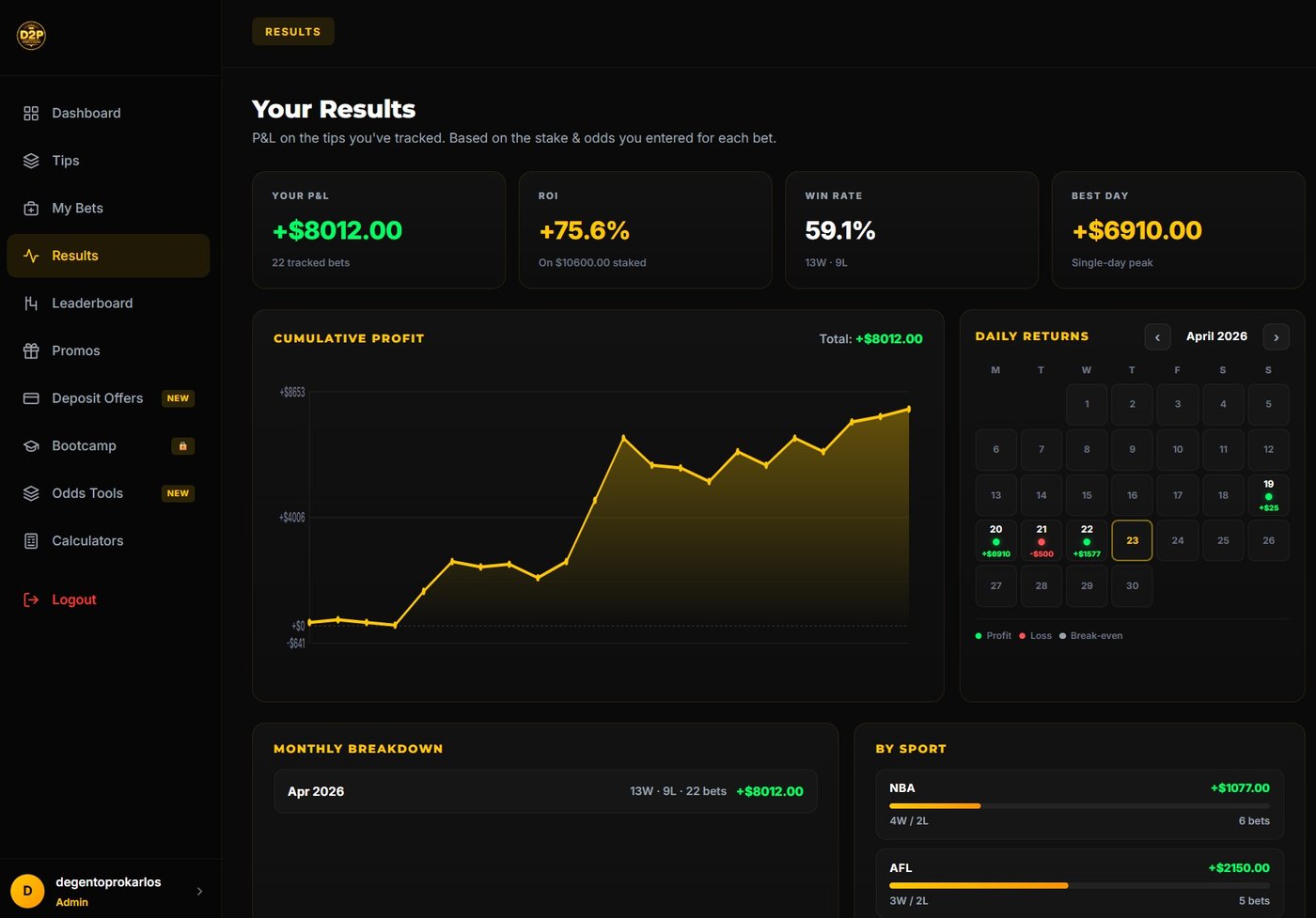
Here is what that looks like in practice. You open DegenToPro on a Wednesday morning and the Odds Screener has flagged an AFL line at TAB that is 12 cents longer than Pinnacle's equivalent price. The tool shows the implied probability gap, the estimated CLV if you act now, and how the line has moved in the last hour. You place the bet. By game day on Saturday, the line has corrected and the two prices are in line. After the game settles, DegenToPro pulls the closing price and logs your CLV at +8.4%. No spreadsheet. No manual calculation. No hunting for closing prices after the fact.
Multiply that across every sport you bet on, every bookmaker you use, every market type you target. Your CLV dashboard builds automatically in the background. Over weeks and months you have a verified, data-rich picture of exactly where your edge comes from and where it does not.
The community dimension adds another layer. DegenToPro's Discord has over 6,000 members, and the platform dashboard shows live aggregate profit from verified tracked bets across the community. This is not curated highlight reels. It is real performance data from real tracked bets. When you are assessing whether a strategy is working or deciding whether to act on an alert, that community signal is genuinely useful context.
For Australian racing punters specifically, DegenToPro covers early fixed-price markets across the full range of domestic bookmakers. Racing is where early CLV opportunities are often most pronounced, and the platform is designed to surface them before the steam hits and the window closes.
The free tier requires no card and lets you explore the platform before committing. Paid plans unlock the full Odds Screener, verified CLV grading, and the complete suite of tracking tools. The World Cup Offer has 20% off all plans right now: Weekly at $59.99 AUD, Monthly at $299.99 AUD, and Lifetime at $699.99 AUD. For Australian punters who are serious about building a process rather than just chasing results, the Lifetime plan in particular represents a once-off investment in infrastructure that pays dividends indefinitely.
Start beating the closing line with data behind you
DegenToPro flags +EV bets early and auto-grades your CLV on every bet you track. No spreadsheets. No manual closing price lookups. Just verified data on whether your process is working. Free to start, no card needed.
Start Free →The bottom line
Beating the closing line is not a strategy in itself. It is the outcome of a set of disciplined habits applied consistently over time: acting on early prices before markets sharpen, line shopping to always take the best available price, following sharp money moves before soft books adjust, and taking +EV bets systematically rather than chasing results.
The punters who beat the close reliably are not smarter than everyone else. They are more systematic. They have better access to early prices. They act faster when opportunities appear. And critically, they measure their performance against the closing line rather than against their bank balance in any given month.
Measuring CLV requires closing prices, and closing prices require infrastructure. Doing it manually is possible but it will not last. The habit breaks down the moment it becomes inconvenient. Automation is the only way to build a genuine long-run dataset without it consuming hours of your week.
This is the practical problem DegenToPro solves for Australian punters. The Pro Odds Screener surfaces early +EV opportunities before they close. The bet tracker records closing prices at settlement and grades every bet automatically. The community dashboard shows live verified profit from 6,000+ members. The result is a complete system for beating the closing line, built for the Australian market, covering the 100+ bookmakers you actually use.
You do not need to be a professional to beat the closing line. You need a process, the right tools, and the discipline to follow the data rather than your gut. Start with the free tier, track your first 50 bets, and see what your CLV tells you. If it is positive, you have a foundation to build on. If it is negative, you have found out early - before it cost you a year of losing bets to learn the same lesson the hard way.
World Cup Offer pricing is live now: 20% off Weekly ($59.99 AUD), Monthly ($299.99 AUD), and Lifetime ($699.99 AUD) plans. Free tier available with no card required. See all plans and start free today.
Join 6,000+ Australians already tracking CLV - World Cup Offer: 20% off
DegenToPro is Australia's leading +EV and CLV platform. Early alerts, auto-graded closing line value, 100+ bookmakers, and a live community profit dashboard. No card needed to get started.
See Plans & Start Free →