
Most Australian bettors have heard of arbitrage - back every outcome across different bookmakers at prices that add up to less than 100% implied probability and lock in a guaranteed profit. But there is a related strategy that often gets overlooked, and in many real-world situations it is actually more useful: low hold betting.
Low hold betting does not guarantee a profit on the bets themselves. What it guarantees is that your combined loss across both sides of a market is predictably small - a known, controllable number - while you use those bets to achieve something more valuable on the side: clearing a bonus bet wagering requirement, satisfying a promotional turnover condition, or qualifying for a deposit match. Once you understand the mechanics, low hold opens up a whole layer of opportunity that pure arb hunters routinely miss.
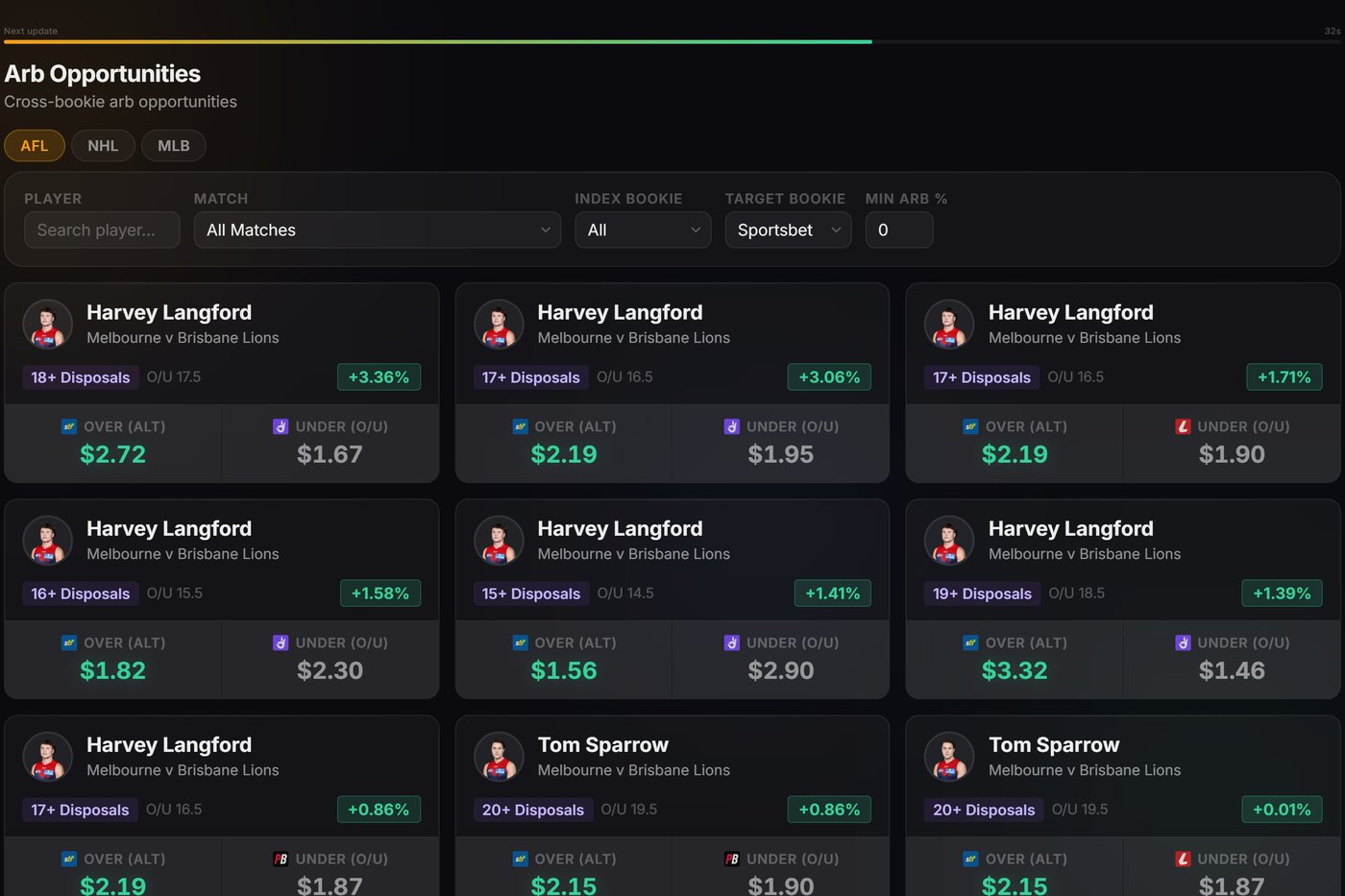
DegenToPro's screener calculates the hold across books automatically, flagging low-hold opportunities alongside pure arbs so you always know exactly what you are walking into before you place a single bet.
What "hold" means in betting
Before getting into low hold betting, you need to understand what "hold" means in the context of a betting market.
Every bookmaker builds a profit margin into their odds. Take a simple coin flip: a fair market would price both heads and tails at $2.00 (50% each). Add those implied probabilities together and you get exactly 100%. A bookmaker pricing the same market might offer $1.90 for each side - the implied probabilities become 52.63% each, adding to 105.26%. That 5.26% excess above 100% is the bookmaker's margin, also called the overround or vigorish (vig).
The "hold" is a closely related concept. In simple terms, it is the combined margin built into a two-sided market when you consider the best available price on each outcome - but instead of looking at a single bookmaker's market, you look at the best price available for each side across multiple bookmakers.
Here is the key distinction:
- Single-bookmaker overround: The margin baked into one bookmaker's prices across all outcomes. Typically 3-8% for competitive sports markets on Australian books.
- Multi-book hold: The combined implied probability when you take the best available price on each outcome from different bookmakers. This number is lower than any single book's overround because you are cherry-picking the best price from the full competitive field.
When the multi-book hold drops below 100%, you have an arbitrage opportunity - a genuine profit guarantee. When it sits between 100% and roughly 103%, you are in low-hold territory: not a profit guarantee, but a very small known loss that can be worth absorbing for the right reason.
What low hold betting is
Low hold betting is the practice of deliberately backing both sides of a market - using the best available price for each side from different bookmakers - when the combined hold is not quite low enough to generate a profit, but is low enough to make the total cost of covering both outcomes worth paying.
That might sound counterintuitive. Why would you deliberately lose money on a bet? The answer is that the loss is not the whole picture. In most low-hold situations, you are using those bets to achieve a secondary objective that is worth more than the small loss you are incurring. The most common objectives for Australian bettors are:
- Clearing wagering requirements on a bonus bet. A bookmaker gives you a $50 bonus bet with a 1x turnover requirement before you can withdraw any winnings. You need to place $50 in qualifying bets. Betting both sides of a low-hold market at minimal cost lets you meet that requirement while minimising how much of your own money is at risk.
- Meeting deposit match rollover conditions. Deposit matches often require you to turn over the deposit amount a certain number of times before withdrawal. Low-hold betting lets you cycle through that turnover at a known, small cost per cycle.
- Qualifying for a recurring promotional offer. Some bookmakers require a minimum number of qualifying bets per week to unlock a "bet and get" promotion. Low-hold bets satisfy the qualifying conditions while minimising your exposure.
- Reducing variance while waiting for a pure arb. In quieter markets where genuine arbs are rare, a low-hold position lets you stay active and keep funds churning rather than leaving capital idle.
The critical difference between low hold betting and simply placing two losing bets is precision. With low hold betting, you know the exact cost before you place either bet. The loss is not a surprise - it is a calculated fee you are choosing to pay to access something of greater value.
The maths behind low hold
Understanding the numbers is what separates disciplined low-hold bettors from those who bleed money without realising it. The maths is straightforward once you know the formula.
Step 1: Calculate the combined implied probability (the hold)
For each outcome, convert the best available decimal odds to an implied probability using: 1 divided by the decimal odds. Add all implied probabilities together. This total is the hold.
- If hold is below 1.00 (100%): you have an arb. Place both bets and guarantee a profit.
- If hold is between 1.00 and 1.03 (100-103%): low-hold territory. Small controllable loss.
- If hold is above 1.03 (103%+): the market is too juicy in the bookmakers' favour. Not worth covering both sides unless you have a very specific reason to do so and the promo value far outweighs the cost.
Step 2: Calculate the cost (the guaranteed loss)
The guaranteed loss as a percentage of your total stake is: (hold - 1) multiplied by 100. So a hold of 1.015 means you will lose 1.5% of your total outlay no matter which side wins.
Step 3: Calculate the optimal stake split
To minimise the range between your best-case and worst-case outcome, split your stakes so that each outcome returns the same amount. For a two-way market with total bankroll B:
- Stake on Outcome A = B x (1 divided by Odds A) divided by hold
- Stake on Outcome B = B x (1 divided by Odds B) divided by hold
This is exactly the same stake-split formula used for pure arbs. The only difference is that with a low-hold bet, the return on each outcome is less than your total outlay rather than more.
Step 4: Compare the cost to the promo value
Once you know your guaranteed loss in dollar terms, compare it to the value of the promotion you are clearing. If a 1.5% hold on a $1,000 total stake costs you $15, but you are clearing a $50 bonus bet, the net position is +$35 before any conversion on the bonus. That is a strong positive expected value outcome, even though the bets themselves lost money.
Worked Australian example
Let us walk through a realistic low-hold scenario using Australian bookmakers and an AFL market.
Scenario: You have just claimed a $100 bonus bet on Ladbrokes that requires 1x turnover before you can withdraw winnings. You need to place $100 in qualifying bets. You find the following prices on an AFL head-to-head market:
| Outcome | Bookmaker | Decimal Odds | Implied Probability | Stake (on $200 total) | Return if this wins |
|---|---|---|---|---|---|
| Geelong Cats win | Sportsbet | 2.05 | 48.78% | $96.10 | $197.00 |
| Carlton Blues win | Neds | 1.88 | 53.19% | $103.90 | $195.33 |
| Total | 101.97% | $200.00 | $195.33 - $197.00 |
Hold calculation: 0.4878 + 0.5319 = 1.0197. The combined hold is 101.97%.
Guaranteed loss: (1.0197 - 1) x 100 = 1.97%. On a $200 total stake, that is a maximum loss of approximately $3.00 to $4.67 depending on which side wins.
Net position: You spent $200 (split across two bookmakers), your worst case return is $195.33 - a loss of $4.67. But you have now satisfied the $100 bonus bet turnover requirement on Ladbrokes using just one of those legs ($96.10 on Sportsbet does not count toward the Ladbrokes requirement - in this scenario you would structure the Ladbrokes leg to clear the requirement specifically). The $100 bonus bet, once converted at a realistic 50-60% extraction rate, is worth $50-$60 cash. Your net position for the exercise is roughly +$45 to +$55 after the guaranteed loss.
This is the core logic of low hold betting: a small, known, controlled loss in exchange for a much larger promotional gain. DegenToPro's screener flags these opportunities automatically, showing you the hold percentage and the dollar cost before you commit.
See low-hold opportunities across 100+ Australian bookmakers
DegenToPro calculates the hold across books in real time, so you always know your exact cost before placing a bet. Start on the free tier - no card needed.
Start Free →When low hold beats a pure arb
This is the question that most guides on this topic skip over entirely, but it is important. Pure arb betting - where you lock in a guaranteed profit on the bets themselves - is obviously preferable in isolation. But low hold betting is often the better choice in practice for several reasons.
Pure arbs are rarer and close faster
A genuine positive arb (hold below 100%) on major Australian sports markets is a fleeting opportunity. The window between the price appearing and bookmakers adjusting is often measured in minutes or even seconds. If you miss it, the opportunity is gone. Low-hold opportunities, by contrast, are far more plentiful. The gap between a 101.5% hold market and a 99.5% hold arb market is small in pricing terms but enormous in frequency. Low-hold markets are available throughout the day, across dozens of sports and races, giving you far more opportunities to action bets when you have turnover to clear.
Promo value can exceed the arb margin anyway
A typical arb yields 0.5-3% profit on total stakes. A $500 arb might earn you $5-$15 net. A $500 low-hold position that clears a 1x turnover requirement on a $100 bonus bet might cost you $7.50 but return $50-$60 in converted cash value - a net outcome of +$42.50 to +$52.50. In this common scenario, the low-hold bet significantly outperforms the pure arb in dollar terms.
Account health considerations
Placing bets on both sides of markets across multiple bookmakers at perfectly calculated stake splits is a well-known trigger for account restrictions on Australian books. Doing this consistently when you always win (arbing) is even more of a flag. Low-hold bets, by contrast, result in losses on the bets themselves - which actually resembles recreational betting behaviour more closely. A disciplined low-hold strategy mixed with promo extraction can extend the life of bookmaker accounts more effectively than pure arbing in some cases.
You cannot always find a same-event arb and a qualifying market simultaneously
Many promo offers specify that qualifying bets must be placed on specific markets, minimum odds, or market types. A pure arb opportunity might not exist in those qualifying parameters at the moment you need to place the bet. A low-hold opportunity, because they are far more common, almost always exists within those parameters - giving you the flexibility to clear the promotion at the time of your choosing rather than waiting and hoping for a rare pure arb to appear in exactly the right market.
Using low hold for promo turnover
Promo turnover clearing is where low hold betting really earns its place in a disciplined Australian bettor's toolkit. Here is how to think about it systematically.
Understanding the cost per dollar of turnover
If you are operating in low-hold markets with a typical hold of 101.5%, every dollar of turnover you complete costs you 1.5 cents in expected value. On a $500 turnover requirement, that is a $7.50 cost to fully clear the requirement. Compare that cost to the value of what you are clearing and you have a simple decision framework: if the promo value exceeds $7.50, proceed. If not, do not bother.
Stacking promo clearing across multiple books
With access to 100+ bookmakers through DegenToPro, the number of promotions available to clear at any one time is significant. A systematic approach to low-hold promo clearing might involve:
- Check the DegenToPro promo calendar for active bonus offers across AU books
- Calculate the turnover required and the dollar cost at the current hold level
- Identify a low-hold market where both legs meet the qualifying criteria
- Place both legs and log the bets in the DegenToPro bet tracker
- Repeat for the next promotional offer
Bonus bet conversion after clearing turnover
Once you have cleared the turnover requirement on a bonus bet, the next step is converting it to real cash. This is where the bet tracker and the bonus bet finder come in. Bonus bets typically cannot be withdrawn directly - you need to place them on an outcome and only the winnings (not the stake) can be withdrawn. The standard conversion strategy is to place the bonus bet on a high-odds outcome and simultaneously hedge the other side with real money - again, a low-hold or arb setup. A well-executed conversion typically yields 50-75% of the bonus bet's face value in cash. On a $200 bonus bet, that is $100-$150 in withdrawable profit from a bonus you extracted at a small, known cost.
Tracking your actual return
The single most important habit for anyone running a low-hold promo clearing strategy is meticulous record keeping. Without it, you cannot distinguish between a working strategy and one where the costs are quietly exceeding the promo value. DegenToPro's bet tracker logs every bet, calculates your verified closing line value (CLV), and shows your net position across all bookmakers in real time. If your low-hold costs are creeping up or you are picking markets with higher holds than you realise, the tracker will surface it immediately.
How DegenToPro surfaces low-hold opportunities
Finding low-hold opportunities manually is even harder than finding pure arbs. With pure arbs, you are looking for markets where the combined implied probability drops below 100% - a clear binary signal. With low hold, you need to assess a much larger universe of markets, evaluate the hold on each, and decide which ones are worth using given your current promotional situation. Doing that across 100+ bookmakers and dozens of concurrent markets is not feasible without dedicated software.
DegenToPro's Pro Odds Screener and arbitrage finder both feed into the low-hold detection system. For every market the screener monitors, it calculates the combined hold using the best available price on each outcome from across the 100+ bookmakers in the network. Markets that fall into the low-hold range (hold between 100% and approximately 103%) are flagged and displayed alongside pure arbs, with the hold percentage clearly labelled so you immediately know the cost per dollar of turnover before you act.
- The combined hold percentage across the two best-priced books
- The guaranteed loss in dollar terms for your nominated stake size
- The optimal stake split to equalise your worst-case and best-case return
- Which specific bookmakers hold the best price on each outcome
- Real-time alerts when a low-hold opportunity appears in your preferred markets
The screener covers all major Australian bookmakers - Sportsbet, TAB, Bet365, Ladbrokes, Neds, Dabble, Picklebet, Betr, Unibet, PointsBet, BlueBet, and more - as well as international books available to Australian residents. This breadth is what makes the low-hold detection meaningful: the gap between the best price at Book A and the best price at Book B is almost always larger than the gap you would find by comparing any two books in isolation.
Low-hold detection also works alongside DegenToPro's promo calendar. When you can see the active promotions on each bookmaker alongside the current hold in each market, matching the right low-hold opportunity to the right promo requirement becomes a fast, systematic process rather than a guessing game.
The entire DegenToPro ecosystem is built for Australian bettors: the bookmakers covered are the ones Australians actually have accounts with, the promotions tracked are the ones active on AU books, and the pricing is in AUD. Whether you are clearing your first bonus bet turnover or running a professional-level promo stacking operation across a dozen accounts, the platform scales with you.
Pricing is in Australian dollars and starts at nothing: the FREE tier requires no card and gives you access to core tools to see what the platform does. From there, Weekly access is $59.99 AUD, Monthly is $299.99 AUD, and Lifetime access is $699.99 AUD. A World Cup Offer of 20% off is currently active - check the pricing page to lock in the discount before it expires.
More than 6,000 members in the DegenToPro Discord community are using these tools right now, with member profits tracked live on the dashboard. Low-hold betting is consistently one of the most discussed strategies in the community, particularly for newer members who are working through their initial promotional offers and building their bookmaker accounts systematically before moving into higher-stakes pure arbing and +EV betting.
The bottom line
Low hold betting is not a consolation prize for when you cannot find a pure arb. It is a deliberate, mathematically precise strategy that delivers strong positive expected value in the right context - specifically when you have promo turnover to clear, bonus bets to convert, or qualifying requirements to meet on Australian bookmakers.
The core concept is simple: instead of needing the combined implied probability across your chosen books to drop below 100% (a pure arb), you accept a small, known loss when the combined hold sits just above 100%. That loss - typically 1-2% of your total stake - is the fee you pay to cycle money through the bookmaker's system in a controlled way. When the promotional value on the other side of that transaction is $50, $100, or more, the arithmetic is overwhelmingly in your favour.
The maths that underpins low hold is identical to arbitrage: implied probabilities, stake splits, and return calculations. The only difference is the direction of the net result on the bets themselves. That makes low hold betting easy to learn for anyone who already understands how arbs work, and a natural complement to pure arb hunting rather than a replacement for it.
What makes low hold betting genuinely powerful for Australian bettors in 2026 is the sheer volume of promotions on offer across 100+ licensed bookmakers - bonus bets, deposit matches, bet and get offers, cashback promos, and more. Each of those promotions has a turnover or qualifying requirement. Each of those requirements is an opportunity to deploy a low-hold position at a known cost and extract the promotional value at the other end. Stack that process across multiple bookmakers and multiple promos and the total returns are substantial.
The prerequisite for doing this well is the same as for arbing: you cannot scan 100+ bookmakers manually, calculate holds across all of them, match opportunities to your current promotional requirements, and track your results with enough precision to know whether your strategy is actually working. That is what DegenToPro's screener and tracker do for you - automatically, in real time, built specifically for the Australian market.
Start finding low-hold opportunities on Australian bookmakers today
DegenToPro calculates the hold across 100+ AU books in real time, matches opportunities to your promos, and tracks every bet with verified CLV. Join 6,000+ members on the free tier - no card required.
Start Free →