
Odds are not a neutral representation of probability. Every price a bookmaker publishes has been deliberately shaded to ensure the house collects more than it pays out on average. The size of that shade is the bookmaker margin - sometimes called the overround, the vig, the juice, or the take. Learning to measure it gives you a clear view of exactly how much ground you need to make up before a bet becomes profitable. It also tells you which bookmakers are worth betting with and which are quietly draining your bankroll regardless of your results.
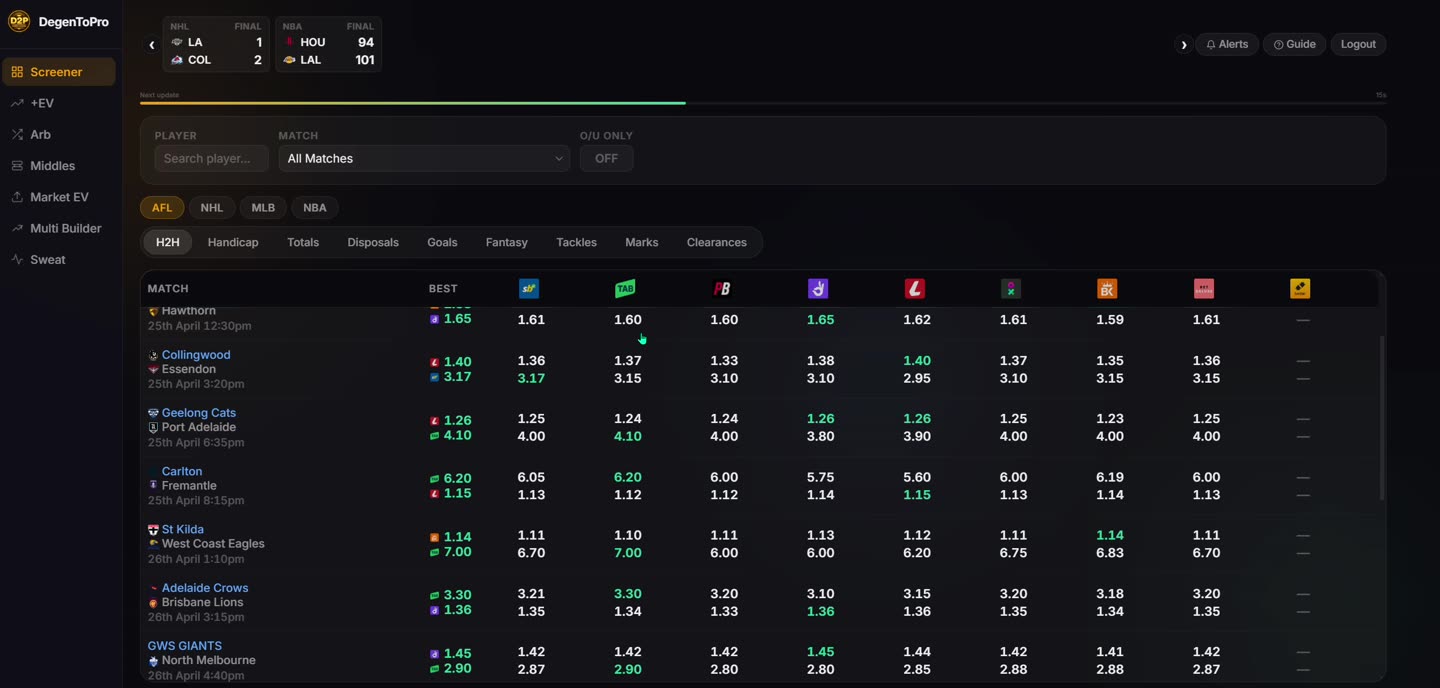
What is bookmaker margin, overround, and vig?
In a fair market, the implied probabilities of all outcomes in a given event would sum to exactly 100%. If a coin toss were priced fairly, both heads and tails would be offered at 2.00 decimal - implying 50% each, summing to 100%. No bookmaker operates that way.
Instead, a bookmaker prices that same coin toss at, say, 1.91 / 1.91. The implied probability of each outcome is 1 divided by 1.91, which equals 52.36%. Add both sides together and you get 104.72% - not 100%. That extra 4.72% above 100% is the overround. It is the bookmaker's built-in profit buffer.
The terms margin, overround, and vig all describe the same concept, just expressed slightly differently:
- Overround - the raw sum of all implied probabilities in a market (e.g., 104.72%). This number will always be above 100% in a commercial market.
- Margin - the bookmaker's profit edge expressed as a percentage above 100% (e.g., 4.72%).
- Vig (or juice) - American terminology for the same concept, commonly used in global betting communities.
All three are different ways of naming the same embedded cost that every bettor pays, on every bet, whether they win or lose.
How to calculate the margin from decimal odds
Calculating bookmaker margin from decimal odds is a two-step process:
- Convert each decimal odd to an implied probability: Divide 1 by each decimal odd. So 2.50 becomes 1 / 2.50 = 0.40, or 40%.
- Sum all implied probabilities: Add every outcome's implied probability together. The result is the overround. Subtract 100% and you have the margin.
Formula: Margin = (Sum of all implied probabilities) - 1
Or expressed as a percentage: Margin % = ((Sum of (1 / each decimal odd)) - 1) x 100
That is all there is to it. The worked examples below apply this formula to real market structures so you can see exactly what the numbers look like.
Worked example: two-way market
Consider an NRL match priced by a typical Australian soft bookmaker:
- Team A (Home): 1.72
- Team B (Away): 2.10
| Outcome | Decimal Odds | Implied Probability (1 / Odds) |
|---|---|---|
| Team A (Home) | 1.72 | 1 / 1.72 = 58.14% |
| Team B (Away) | 2.10 | 1 / 2.10 = 47.62% |
| Total (Overround) | - | 105.76% |
| Margin | - | 5.76% |
The overround is 105.76%, meaning the margin is 5.76%. For every $100 bet across both sides of this market, the bookmaker expects to keep $5.76 regardless of which team wins. Now compare the same match priced by Pinnacle, a sharp low-margin book:
| Outcome | Pinnacle Odds | Implied Probability (1 / Odds) |
|---|---|---|
| Team A (Home) | 1.84 | 1 / 1.84 = 54.35% |
| Team B (Away) | 2.22 | 1 / 2.22 = 45.05% |
| Total (Overround) | - | 99.40%... wait |
At Pinnacle the same match might be 1.84 / 2.22, giving an overround of roughly 101.7% - a margin of just 1.7%. That is the difference between a book designed to attract sharp money (Pinnacle) and a book that relies on recreational volume (most Australian TABs and agency bookmakers). More on why this matters for your +EV opportunities in a moment.
Worked example: three-way market
Margin calculation works identically across three-way markets - you simply add a third implied probability. Here is an AFL-season futures example across three outcomes: one team to win the flag, the field, and the draw (or in soccer terms: Home / Draw / Away).
Consider a soccer match priced at:
- Home win: 2.30
- Draw: 3.20
- Away win: 3.40
| Outcome | Decimal Odds | Implied Probability (1 / Odds) |
|---|---|---|
| Home Win | 2.30 | 1 / 2.30 = 43.48% |
| Draw | 3.20 | 1 / 3.20 = 31.25% |
| Away Win | 3.40 | 1 / 3.40 = 29.41% |
| Total (Overround) | - | 104.14% |
| Margin | - | 4.14% |
The overround here is 104.14% - a margin of 4.14%. Notice that the three implied probabilities sum to 104.14%, not 100%. That excess is the bookmaker's cut. For a punter backing any single outcome at these odds, the true cost of that margin depends on which side of the market they are on - which leads directly into the question of how to remove the margin and find the fair price for each outcome.
Typical margins by bookmaker and market type
Margins are not uniform across bookmakers or markets. Sharp books run tight margins to attract high-volume, sophisticated bettors. Soft books run higher margins because their customer base is less price-sensitive. Markets with high liquidity (main lines, major sports) tend to carry lower margins than exotic or niche markets where the bookmaker faces less competitive pricing pressure.
The table below shows indicative margins. Exact figures vary by match, time of day, and market dynamics - but these ranges are representative of what Australian bettors encounter in 2026:
| Bookmaker / Source | Market Type | Typical Margin Range | Classification |
|---|---|---|---|
| Pinnacle | Head to head (major sports) | 1.5% - 2.5% | Sharp |
| Betfair (exchange) | Head to head (post-commission) | 2.0% - 3.5% | Sharp |
| Sportsbet / TAB / Neds | Head to head (NRL / AFL / Soccer) | 4.0% - 6.5% | Soft |
| Sportsbet / TAB / Neds | Player props / Exotics | 7.0% - 15.0%+ | Soft |
| Australian TAB (racing) | Win market (thoroughbred) | 14.0% - 20.0% | High-margin pari-mutuel |
| Corporate bookmakers (AU) | Racing win markets | 7.0% - 12.0% | Soft |
The contrast is stark. A Pinnacle head-to-head line at 2% margin versus a TAB racing win market at 18% margin are fundamentally different propositions. Betting into an 18% overround without a significant edge is a near-certain path to slow but consistent losses. Betting into a 2% overround - with even a modest pricing edge - is where long-term profitability becomes achievable.
How margin eats your returns over time
The margin does not just affect individual bets in isolation - it compounds against you with every bet placed. To understand the long-run cost, consider the concept of expected return per dollar wagered (also called the return-to-player, or RTP):
Expected return per bet = 1 / (1 + margin)
At a 5% margin, each dollar you bet returns an expected 1 / 1.05 = $0.952 on average. You lose $0.048 per dollar before accounting for any edge you might have. Across a year of betting $1,000 per week, that is a $2,490 annual headwind from margin alone - before a single result goes against you.
| Margin | Expected Return per $1 | Annual Cost on $1,000/week turnover |
|---|---|---|
| 1.8% (Pinnacle) | $0.9823 | -$936 |
| 3.5% (Betfair post-commission) | $0.9662 | -$1,772 |
| 5.5% (Typical AU soft book) | $0.9479 | -$2,704 |
| 10.0% (Props / exotics) | $0.9091 | -$4,727 |
| 18.0% (Pari-mutuel racing) | $0.8475 | -$7,988 |
The numbers make clear why sharp bettors obsess over where they take their prices. The bookmaker's margin is a structural cost embedded in every single bet - not a fee you can see on a statement, but one that quietly erodes your bankroll all the same. The only ways to overcome it are to find prices that beat the fair odds (positive expected value), or to bet at books where the margin is so low that a modest edge is enough to push the net into positive territory.
This is precisely why DegenToPro was built for Australian punters - to scan 100+ bookmakers in real time and surface the specific prices where your edge exceeds the margin you are paying.
Removing the margin to find fair odds
Once you know the overround, you can remove the margin to find the fair (no-vig) odds for each outcome. The most common approach is the multiplicative method: divide each implied probability by the overround to get the fair probability, then convert back to decimal odds.
Fair probability for outcome i = (1 / oddsi) / overround
Fair decimal odds = 1 / fair probability
Applying this to our NRL example (Team A: 1.72, Team B: 2.10, overround: 1.0576):
| Outcome | Bookmaker Odds | Implied Prob | Fair Prob (/ 1.0576) | Fair Decimal Odds |
|---|---|---|---|---|
| Team A (Home) | 1.72 | 58.14% | 58.14% / 1.0576 = 54.97% | 1 / 0.5497 = 1.819 |
| Team B (Away) | 2.10 | 47.62% | 47.62% / 1.0576 = 45.03% | 1 / 0.4503 = 2.221 |
| Total | - | 105.76% | 100.00% | - |
The fair odds are 1.819 and 2.221. If another bookmaker offers Team B at 2.30 - which is above the fair price of 2.221 - that represents a genuine positive expected value (+EV) bet. The edge on that bet is approximately (2.30 / 2.221) - 1 = 3.6% before any stake-sizing considerations. That is a real, mathematically verifiable edge. The critical point: you cannot identify this edge without first knowing the fair odds, and you cannot find the fair odds without removing the margin.
For a deeper dive into devigging methods beyond the multiplicative approach, see our guide on how to calculate fair odds.
Stop calculating margin by hand
DegenToPro automatically strips the margin from 100+ AU bookmakers in real time, calculates fair odds, and flags every price that beats the line. Australian punters use it daily to find genuine +EV bets across sports and racing.
Start Free →Why low-margin books mean more +EV opportunities
The relationship between bookmaker margin and +EV opportunity is direct: the lower the margin on the reference book you use to calculate fair odds, the more accurate your fair line will be - and the easier it is to spot genuine value at soft bookmakers.
Sharp books like Pinnacle operate at 1.5% to 2.5% margin on major markets. That tightness is not charity - it is a business model designed to attract sharp, high-volume bettors who act as a de facto price discovery mechanism. Because Pinnacle is willing to accept large bets from winning players, their line reflects the sharpest aggregate view of true probability available in the market. This makes Pinnacle's odds the most reliable fair-odds reference point for most sports markets.
The practical consequence for Australian punters: if you use Pinnacle's line as your fair-odds reference and a soft bookmaker (Sportsbet, Neds, TAB, PointsBet, etc.) offers a higher price on any outcome, you have identified a potential +EV bet. The soft book has either been slow to update its line, is running a promotion, or has simply priced the market less efficiently than the sharp book. All three scenarios represent an opportunity - and they occur dozens of times per day across a fully monitored market landscape.
This is why the combination of a sharp reference line (low margin) plus a wide scan of soft books (high margin, slow to move) is the core engine behind every professional +EV betting operation. The soft books are where you collect your edge; the sharp book is how you know you have one.
Betfair serves a similar reference function for racing markets in Australia. While Betfair charges commission (reducing the net odds), the exchange mechanism means prices reflect genuine market consensus rather than a single bookmaker's pricing decision. For thoroughbred racing in particular, Betfair SP (Starting Price) is one of the most reliable fair-line references available to Australian punters.
Understanding implied probability is the next step once you are comfortable with margin calculations - the two concepts work hand in hand.
How DegenToPro finds the value you are missing
DegenToPro is an Australian EV, arbitrage, and racing software platform. Every feature is designed around the workflow of finding and exploiting the gap between sharp fair prices and soft bookmaker margins:
- +EV Finder: Scans 100+ Australian and international bookmakers in real time, calculates fair odds using sharp reference lines (including Pinnacle and Betfair), and surfaces every market where a soft book's price beats the fair line. Each opportunity is displayed with the exact edge percentage so you can see precisely how much value is on offer before you place the bet.
- Market EV: Aggregated expected value data across full markets - not just individual outcomes. See at a glance which sports, leagues, and bookmakers are generating the most +EV opportunities at any given moment.
- Pro Odds Screener: Advanced filtering for serious bettors. Sort and filter opportunities by edge size, sport, bookmaker, odds range, and market type. Identify soft (high-margin) prices that still beat the fair line and isolate only the bets that meet your staking criteria.
- Soft price flagging: DegenToPro's engine explicitly flags situations where a bookmaker is running a high-margin market but has still managed to price one outcome above the fair line. This is the scenario where soft book + genuine edge coexist - the most common source of +EV bets for Australian recreational accounts.
- Bet tracker with verified CLV: Log every bet you place and DegenToPro tracks your closing-line value (CLV) - the most reliable measure of whether you are consistently finding real edge or just running hot. CLV is calculated against the same devigged benchmark used to identify the bet in the first place, so the measurement is consistent.
- Racing software: Dedicated margin-stripping and EV calculation for Australian thoroughbred, harness, and greyhound racing. Racing markets are notoriously high-margin (especially TAB pari-mutuels), making the ability to identify genuine fair-line beats especially valuable.
The platform is used by more than 6,000 members in the DegenToPro Discord community - from punters taking their first steps into +EV betting to full-time professionals managing verified six-figure annual profits against tracked CLV.
Getting started costs nothing. The FREE tier requires no credit card and gives you live access to the dashboard and fair-odds data across major sports. Paid plans unlock the full 100+ bookmaker scan, racing software, and the complete bet tracker with CLV verification. Available as a Weekly ($59.99 AUD), Monthly ($299.99 AUD), or Lifetime ($699.99 AUD) plan. A World Cup Offer of 20% off is currently live - see the pricing page for full details.
Understanding what EV betting is and how it works alongside margin awareness is the next step on your journey from recreational punter to data-driven value bettor.
The bottom line
Bookmaker margin - the overround, the vig, the juice - is the single biggest structural obstacle between a recreational punter and long-term profitability. It is not visible as a fee, it is not disclosed in the odds, and most punters never quantify it. But it is always there, compounding silently against your bankroll on every single bet.
Calculating margin is simple: sum the implied probabilities of every outcome in a market and subtract 100%. The result tells you how much ground you need to make up before a bet becomes positive expected value. Removing that margin via the multiplicative method gives you fair odds - the true no-vig price that serves as the benchmark for every +EV and arbitrage calculation.
The practical conclusion is straightforward: seek out low-margin reference books (Pinnacle, Betfair) to establish the most accurate fair line, then look for soft bookmakers that have priced one or more outcomes above that fair line. That gap is where genuine +EV lives. The challenge is finding it at scale, across 100+ bookmakers, across hundreds of markets, fast enough to bet it before the line moves.
That is exactly what DegenToPro does for Australian punters every day.
Ready to stop paying the margin and start collecting the edge?
DegenToPro scans 100+ AU bookmakers, strips the margin, calculates fair odds, and surfaces every +EV opportunity in real time. Join 6,000+ members already using the platform - start for free today, no card required.
Start Free →Related guides
How to Calculate Fair Odds (Devigging Guide 2026)
Strip the vig using all four industry-standard devigging methods - Multiplicative, Additive, Power, and Shin - with worked examples for each.
Read guide →What is EV Betting? A Beginner's Guide to Expected Value
Expected value is the foundation of every profitable betting strategy. Learn what it is, how to calculate it, and why margin awareness is the essential first step.
Read guide →Implied Probability Explained
Implied probability is what odds are really telling you. Understand how to convert decimal odds to probability and use that knowledge to identify genuine value bets.
Read guide →