
Every Saturday morning across Australia, barrier draws are published and punters immediately reach conclusions: "Drawn barrier one, he'll lead all day." "Drawn barrier fourteen, no hope." The truth is considerably more nuanced. A wide barrier at Flemington over 1,400 metres carries a very different implication to a wide barrier at Rosehill over 1,200 metres. Track shape, rail position, distance of the race, the likely pace scenario and a horse's natural running style all interact with the barrier to determine its actual influence on the outcome.
For Australian punters who want to bet with genuine edge, understanding barrier draw bias is not about finding a magic number. It is about knowing when the market has either ignored a meaningful draw disadvantage or punished a horse too heavily for a barrier that, in context, is perfectly manageable. That gap between reality and market perception is where barrier draw betting value lives.
This guide walks through everything: what the barrier is, why it matters, track-specific tendencies, how bookmakers and the tote price draws, and the practical process for turning barrier knowledge into profitable bets. Once you have your barrier read, DegenToPro helps you find the best price across 100+ Australian bookmakers in seconds.
What Is the Barrier Draw?
In Australian thoroughbred racing, all runners start from a starting gate (the "barrier"). Each gate is numbered from the inside rail outward: barrier 1 is the closest to the rail, barrier 2 is next, and so on to the widest barrier in the field. The starting positions are allocated by a random ballot conducted by Racing Australia or the relevant state racing authority, typically in the days before the race.
The barrier draw is significant because it determines a horse's starting position relative to the rail and relative to the rest of the field. Everything else being equal, a horse drawn closer to the inside rail travels a shorter distance around any bend than a horse drawn wider. Over a race of 1,200 metres with a right-angle turn, the additional ground covered by a horse in barrier 16 versus barrier 1 can be measurable. In tightly run fields, that extra ground is the difference between winning and running third.
The draw also shapes race tactics. A horse drawn on the inside with natural lead speed can slot to the rail and control the race at its own tempo. The same horse drawn wide must either push hard early to cross to the lead, burning valuable energy, or settle back and wide, losing ground on every bend. Neither option is ideal.
However, context is everything. A wide draw in a small field on a long straight track matters far less than a wide draw in a large field at a tight circuit with an early turn. Punters who apply a blanket "inside good, outside bad" rule to every race will miss enormous amounts of value in both directions.
Why the Barrier Draw Matters
Three structural factors determine how much the barrier draw matters in any given race: track shape, race distance, and leader bias.
Track Shape
Australian tracks vary enormously in their configuration. Flemington's long straight and wide turns mean draw bias is relatively muted compared to tighter, smaller circuits. Moonee Valley is a tight, 1,571-metre circuit with sharp turns where the inside rail is a significant advantage in most races. Randwick's Kensington track features a long run from the gates to the first turn, reducing the advantage of an inside barrier. Ascot in Perth has a pronounced lean toward low barriers on the tight corners. Schofields and provincial tracks often favour inside runners due to the combination of small circumference and early turns.
Race Distance
Distance magnifies or reduces draw bias through two mechanisms. First, shorter sprints (1,000 to 1,200 metres) are usually run on a straight or near-straight course where the barrier has little influence on ground loss. Second, at middle distances (1,400 to 1,800 metres) the relationship is most complex: horses must navigate at least one full turn and often a bend immediately out of the barriers, making gate position critical. At longer distances (2,000 metres and beyond), the field has more time to organise and individual positional disadvantages often wash out, reducing barrier influence.
Leader Bias and Pace
Track surfaces develop bias across a meeting or even across a week of racing. When the inside of the track has been cut up by heavy traffic, the rail can become a disadvantage. Conversely, on a dry, true track, rail runners benefit from the shortest ground. The pace of the race also intersects with barrier draw: a genuinely slow pace benefits horses that can control position from inside barriers. A hot pace often sees the leaders tire and wide, fresh horses run over them in the straight.
All three factors interact simultaneously. A horse drawn barrier 14 at Flemington in a 1,600-metre race on a soft track with a slow pace and a leader bias may actually have an acceptable draw. The same barrier at Moonee Valley over 1,200 metres in a sharp field is a genuine disadvantage. Collapsing all this nuance into a single rule is how punters lose money.
Inside vs Wide Draws by Track Type
Rather than memorise every track individually, it helps to understand the three broad categories of Australian racing circuits and their general draw tendencies.
Tight Circuits (Under 1,700 metres circumference)
Moonee Valley, Sandown Lakeside, Schofields and many provincial tracks fall into this category. The combination of small circumference and sharp turns makes wide draws at middle distances genuinely costly. A horse drawn barrier 10 or wider at Moonee Valley in a 1,200-metre race must travel noticeably more ground than its rivals or spend significant early energy crossing to the rail. Inside barriers are structurally preferred. When a quality horse draws wide here, the market tends to shorten it less than its ability warrants, creating potential overs.
Spacious Courses (Long Straights and Sweeping Turns)
Flemington, Randwick (both Kensington and Randwick course proper), Caulfield and Morphettville are this type. Wider barriers are more forgiving because the long runs to the first turn allow fields to settle before the bend disadvantage kicks in. At sprint distances on straight courses (Flemington's famous straight six), the barrier is almost entirely irrelevant to ground loss and matters only for rail position on a biased surface. Punters frequently over-penalise wide draws here, creating value on horses in barriers 10 to 14 at sprint and middle distances.
Provincial and Country Tracks
Tracks like Warwick Farm, Hawkesbury, Doomben, Sunshine Coast and Eagle Farm sit in the middle. Each has its own quirks. Warwick Farm's long straight from the 1,200 barrier helps wider draws, but the tight final bend favours rail runners. Eagle Farm after its redevelopment rewards horses that can settle in a good position. Track bias, often communicated in stewards' reports and post-race interviews, is as important as any statistical draw tendency at these venues.
Draw Tendencies by Track Type (Reference Table)
The figures below are illustrative tendencies based on historical patterns and public form analysis. They are a starting framework, not a betting system. Rail position, track condition, race distance and pace scenario should all modify your assessment. Always verify against current track reports before committing to a draw-based view.
| Track Type | Distance | Inside Draw (1-5) | Mid Draw (6-10) | Wide Draw (11+) | Key Modifier |
|---|---|---|---|---|---|
| Tight circuit (e.g. Moonee Valley) | 1,000 - 1,200m | Favoured | Neutral | Disadvantaged | Rail position, track condition |
| Tight circuit (e.g. Moonee Valley) | 1,400 - 2,000m | Strongly favoured | Slight disadvantage | Significant disadvantage | Field size and pace scenario |
| Spacious course straight (e.g. Flemington 1,000m) | 1,000m straight | Neutral | Neutral | Neutral | Surface bias only |
| Spacious course (e.g. Flemington, Randwick) | 1,200 - 1,400m | Slight advantage | Neutral | Slight disadvantage | Long run to first turn reduces penalty |
| Spacious course (e.g. Flemington, Randwick) | 1,600 - 2,000m | Moderate advantage | Neutral | Moderate disadvantage | Field organisation over longer trip |
| Provincial/country (e.g. Hawkesbury, Doomben) | 1,200 - 1,600m | Favoured | Neutral | Disadvantaged | Check post-race stewards notes for bias |
| Any track | 2,000m+ | Mild advantage | Neutral | Mild disadvantage | Class and fitness outweigh draw at staying trips |
How the Market Prices Barrier Draws
Australian betting markets - both the tote and fixed odds with corporate bookmakers - do price in draw bias, but they do so imperfectly. Understanding those imperfections is the foundation of barrier draw betting value.
The tote (TAB) is a pari-mutuel pool that reflects the aggregate of public opinion. Public opinion is heavily influenced by media coverage and "obvious" narrative. A horse drawing barrier 1 at Moonee Valley will attract disproportionate money from casual punters who have been told that inside is good, often shortening its price beyond what the draw genuinely warrants. Conversely, a horse drawing barrier 14 at Flemington over 1,600 metres will be overlooked by many punters, potentially lengthening its price despite the draw being less of a handicap on that course.
Fixed-odds bookmakers are more sophisticated than the tote, but their prices still reflect a combination of market sentiment and algorithmic adjustments. On major metropolitan meetings, early fixed odds are set by experienced traders who factor in draw bias. However, two consistent patterns create value opportunities:
- Crowd sentiment amplification: Even professional bookmakers build prices partly in response to expected betting patterns. If the crowd will back barrier 1 heavily, a book may shade that runner's odds slightly shorter in anticipation, compressing the value on wider draws.
- Context blindness in smaller fields or provincial races: Automated pricing systems apply general draw adjustments that may not account for specific conditions at a provincial venue on a given track condition. Manual form reading that incorporates those specifics can identify disconnects between the market price and the true probability.
The practical implication is that value in barrier draw betting comes most reliably from two scenarios: horses that are over-punished for a wide draw when context makes the draw manageable, and horses that are over-rewarded for a good draw when the track, distance or pace scenario reduces the inside advantage. Identifying those scenarios requires both an understanding of draw mechanics and access to accurate price comparison across multiple books - exactly what DegenToPro provides.
Finding Value When the Market Over or Under-Reacts to a Draw
Value from barrier draw analysis comes in two flavours, and you need to be looking for both.
Over-Reaction to a Wide Draw (Fading the Market's Fear)
This is the more common and more exploitable pattern. A horse is assessed as a genuine contender on form, but its wide draw at a track with a "known" inside bias has shortened the odds of its rivals and drifted its own price. If your contextual analysis suggests the wide draw is less punishing than the market believes - because the race distance provides a long run to the first turn, because the horse is a pure on-pacing runner who maps to a mid-field position anyway, or because track conditions have reduced the rail advantage - then a bet here carries positive expected value.
Practical check: compare the horse's fixed-odds price at two or three bookmakers before and after barrier draw publication. A significant drift post-draw that you believe is unwarranted is your signal. The market has over-adjusted for a factor you have contextualised differently. That is a candidate for a value bet.
Under-Reaction to a Good Draw (Fading the Market's Enthusiasm)
Less common, but important: a horse is given an inside draw but the draw advantage is overstated by the market. This happens when a horse that maps to a position wide of the fence anyway draws barrier 2, or when a horse lacks the gate speed to use a favourable barrier, or when pace analysis suggests a slowing pace will allow wide runners to run on fresh. Here, the horse's rivals in wider barriers may represent better value. The risk is being on the wrong side of a horse that genuinely uses the good barrier well.
Step-by-Step Value Process
- Assess the horse's form and class in isolation - would it be a genuine contender without the barrier question?
- Identify the track type and distance - refer to the tendencies table above.
- Check current rail position and recent track bias from stewards' reports or form guides.
- Map the likely pace scenario using the barrier draws of other runners.
- Determine whether the draw advantage or disadvantage materially changes the horse's winning probability by more than the market has adjusted for.
- Compare fixed odds across multiple bookmakers. A horse that one book has moved from $5.00 to $6.50 post-draw while another has only moved it to $6.00 presents both a value angle and a best-price opportunity.
Step six is where DegenToPro's racing software pays for itself. Manually checking ten bookmakers for every runner in every race is not realistic. Automated field-wide price comparison shows you in seconds which book is offering the best fixed price - and whether that price represents genuine value against the sharp market consensus.
Get the Best Price on Your Barrier Read
DegenToPro compares fixed odds and best-tote across 100+ Australian bookmakers in real time. Once you have identified a horse that the market has mispriced on the barrier draw, finding the best available price takes seconds. World Cup Offer: 20% off all plans right now.
Start Free →Combining Barrier Analysis with Speed Maps
Barrier draw analysis in isolation is incomplete. The most powerful framework is combining draw position with a speed map - a projection of where each runner is likely to settle in the early stages of the race based on their natural running style, their trainer's instructions and the barriers they have drawn.
A speed map answers the question: given the barriers drawn, who will be where after 400 metres? That positional projection, combined with an understanding of how pace shapes the race, allows you to assess which runners have tactical advantages beyond pure draw statistics.
Key Speed Map Concepts
Leader mapping: Identify every horse that will push forward early. If three horses with natural lead speed have drawn inside barriers and all want the front, the likely result is a contested pace. A fast pace benefits runners who are settled mid-field or off the pace - particularly if they have drawn wider barriers that kept them out of the early scrimmage.
Box seat mapping: The "box seat" position - one off the fence, one off the leader - is the safest tactical position in most Australian races. Identify which runners are likely to find that position easily given their barrier. A horse drawn barrier 3 with moderate gate speed that maps to the box seat in a ten-horse field is in an excellent tactical position regardless of whether inside barriers are statistically favoured at that track.
Wide-running horses in tactical races: If the pace map suggests the leaders will set a genuine tempo and tire in the straight, wide-drawn horses that settle back and run on late can be advantaged. Their wide barrier, rather than costing them ground, has kept them clear of the scrimmage in the first 600 metres. The market may have discounted them for the draw without recognising the pace scenario that neutralises it.
Crossing runners: A horse drawn wide with high gate speed that is likely to cross to the front adds energy cost to its race. Those runs are high-risk even if the horse reaches the lead, because the early effort leaves it vulnerable in the final stages. Be cautious about following wide crossers at short odds even if their form looks strong.
| Scenario | Barrier Position | Speed Map Implication | Value Angle |
|---|---|---|---|
| Strong lead speed, good barrier | 1 - 4 | Maps to lead or box seat cheaply | Check if market has already priced in tactical advantage |
| Genuine stayer, wide barrier | 10+ | Maps back comfortably, avoids pace war | Often over-penalised; value at distance |
| Leader, wide barrier, contested pace | 10+ | Must cross or use energy - high risk | Fade at short odds; back rivals |
| On-pacer, any barrier, slow pace | Any | Maps to lead or just off; tempo advantage | Draw matters less; pace advantage drives value |
| Backmarker, inside barrier | 1 - 3 | May get pocketed behind slow leaders | Inside advantage can become a trap; check run timing |
The best punters in Australia combine barrier data, speed mapping and track condition into a single probability assessment before touching a price. That assessment is what you then compare to the market - and the market's departure from your assessment, in either direction, is your betting signal.
Using DegenToPro to Lock In Your Barrier Edge
Knowing a barrier draw creates a value opportunity is only half the equation. The other half is getting the best possible price to maximise the return on that edge. This is where the economics of Australian racing betting become important.
Australian thoroughbred markets are offered by dozens of bookmakers, each with their own pricing models and risk appetites. On a given race, the fixed odds for a horse can vary by 10 to 20 percent between the best and worst book. If you have correctly identified that a wide-drawn horse has been over-punished by the market, you want to capture every basis point of that mispricing. Taking $7.50 when $8.50 is available elsewhere is leaving money on the table - money that directly reduces the expected value of your bet.
| Feature | How It Helps Barrier Draw Bettors |
|---|---|
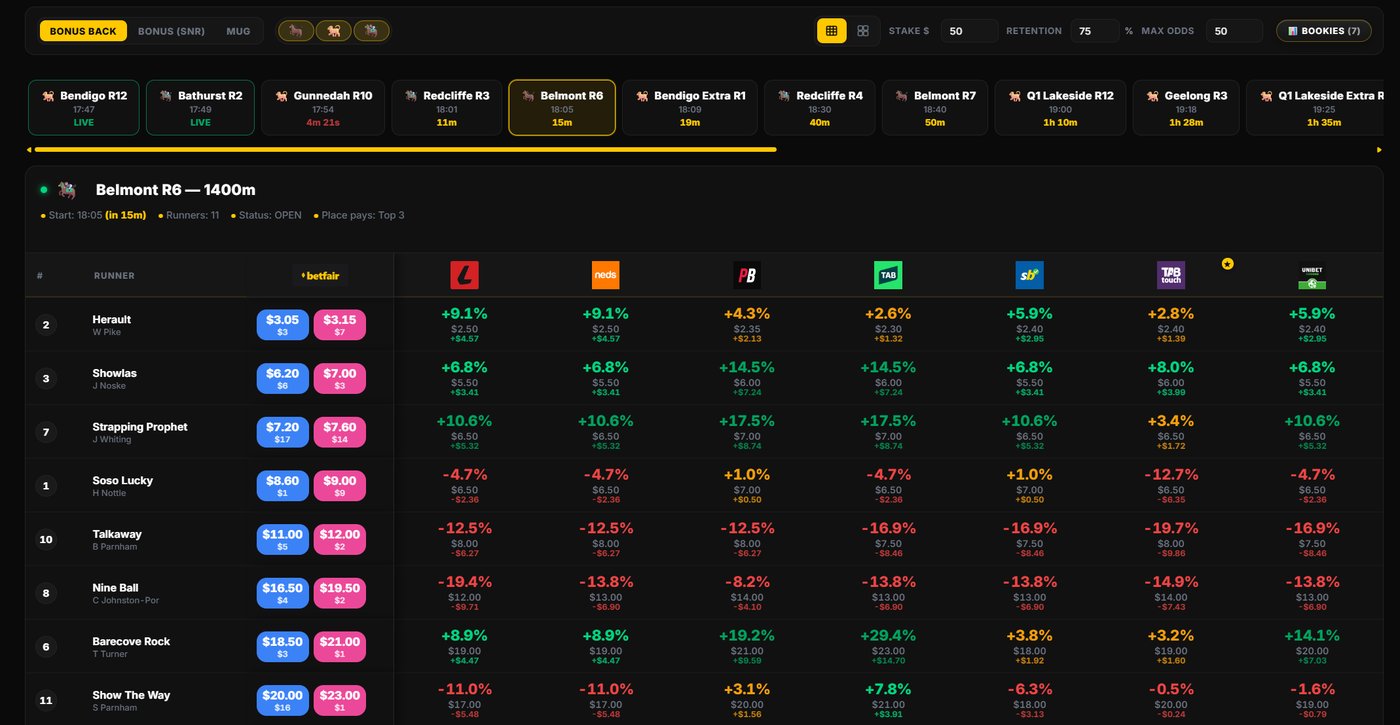
| Field-Wide Price Comparison | See every fixed-odd price for every runner across 100+ books instantly. Find who is offering the best on your value selection. |
| Best-Tote vs Fixed Comparison | Compare fixed odds to best-tote products so you always know which format gives you the better expected return. |
| +EV Finder | Identifies where a book's price exceeds the sharp market consensus - confirming or challenging your barrier value read. |
| Bet Tracker + Verified CLV | Log every barrier-based bet with the price taken and track whether the market moves in your favour after placement - the ultimate proof of edge. |
| Daily Racing Tips and Alerts | DegenToPro's team flags value races and notable draw situations daily, cross-referencing with price movements across books. |
| Discord Community (6,000+ members) | Real-time discussion of barrier draws, speed maps and price movements from serious Australian punters on every major racing day. |
The practical workflow is straightforward. You read the barrier draw, build your speed map, and identify a horse you believe the market has mispriced. You open DegenToPro and check the field-wide fixed odds. In seconds you can see whether Sportsbet, TAB, Neds, BlueBet or another book is offering the best price on your selection, and whether that price sits above the sharp market consensus - confirming your value read. You place at the best book. You log the bet in the tracker. Over time, your CLV on barrier-based bets tells you whether your draw analysis genuinely has edge.
This is not a complicated process. But it requires tools that work in real time across a wide range of bookmakers. Manual checking of ten websites before a race closes is neither practical nor accurate. DegenToPro exists precisely to close that gap for Australian punters.
The Bottom Line
Barrier draw betting is not about blindly following inside draws or avoiding wide barriers. It is a contextual skill that combines track knowledge, distance considerations, pace mapping and market analysis into a single probability judgement. Done well, it identifies genuine value in Australian racing markets that the broader public consistently misprices.
The most common and exploitable pattern is the over-punished wide draw: a genuine contender whose price has been lengthened by the market more than the actual disadvantage of the barrier warrants, given the specific race conditions. Those situations appear multiple times each weekend across Australian metropolitan and provincial racing, at every price range.
The two disciplines that transform barrier knowledge into consistent profit are rigorous contextual analysis - refusing to apply blanket rules that the market has already priced in - and disciplined price capture. Knowing a horse represents value at $7.00 does not help if you take $6.00 because you did not check across bookmakers. Across a season of betting, best-price discipline adds tens of percentage points to your effective return on investment.
DegenToPro handles the price-capture side automatically: field-wide fixed odds comparison, best-tote vs fixed, and a verified CLV tracker that tells you over time whether your barrier reads are genuinely sharp or just running lucky. The FREE tier gets you started with no card required. For serious volume, the Weekly ($59.99 AUD), Monthly ($299.99 AUD) and Lifetime ($699.99 AUD) plans unlock the full racing software suite - currently at 20% off with the World Cup Offer.
Australian racing rewards thoroughness. The punters who go deeper than the draw number alone - who understand track shape, pace dynamics and market pricing mechanics - are the ones who build a genuine long-term edge. DegenToPro is the tool that makes executing that edge as efficient as possible.
Turn Your Barrier Read into Best-Price Bets
Join 6,000+ Australian punters using DegenToPro to compare fixed odds across 100+ bookmakers, track verified CLV and find value in every race. Start on the FREE tier with no card required - or unlock the full racing software suite from $59.99/week AUD. World Cup Offer: 20% off right now.
Start Free →