
Every winning punter in Australian racing starts in the same place: the form guide. It is the raw data of the sport - a compact record of where a horse has been, what it has done, and the conditions it faced. Learn to read it properly and you have a head start on the majority of the market, which relies on tips, vibes and the morning line.
The form guide looks intimidating at first glance. Numbers, letters, slashes and symbols crowd together in a way that makes no sense until someone walks you through it. That is exactly what this guide does. We will take you from the basic form line right through to class ratings, then show you how to build a fair price from what you have read - and how DegenToPro's racing software lets you pit that price against every bookmaker and the tote simultaneously.
Whether you are just starting out or want to sharpen what you already know, this is the most complete breakdown of Australian form reading you will find in 2026.
What Is a Form Guide?
A form guide is a structured summary of a horse's recent race history, combined with details about its upcoming race conditions. In Australia, form guides are published by Racing Victoria, Racing NSW, Racing Queensland and the individual state TABs, as well as specialist media including Racing.com, Racing NSW and third-party form services.
The guide for a single runner typically includes:
- Finishing positions across recent starts (the form line)
- The date, track, distance and going of each run
- The weight carried and barrier drawn
- The jockey and trainer
- Margin to the winner and to the next horse
- Race class and prize money
- Speed ratings or performance ratings
- Sectional times (where available)
- Trainer and jockey statistics for the meeting
A full race-day form guide will list all of this for every runner in every race on the card. Experienced punters scan it quickly - almost by feel - but beginners need a systematic approach. Start with the form line and build outward.
Reading the Form Line (Finishing Positions, Margins, Class)
The form line is the string of numbers and symbols you see listed next to a horse's name. It is read from left (oldest) to right (most recent). A typical form line for an Australian thoroughbred might look like this:
| Character | Meaning |
|---|---|
| 1, 2, 3 ... 9 | Finishing position (1st, 2nd, 3rd, etc.) |
| 0 | Finished 10th or further back |
| x | Fell, unseated, refused or was withdrawn |
| / | Spelling break between seasons |
| - | Change of racing season (within same campaign) |
| W | Walked over (no other runners) |
| P | Placed (used in some form summaries for the previous season) |
A form line of 1x3/21 tells you: won its first start, then fell or was scratched, then ran third - came back from a spell, ran second and most recently won. That is the story of a horse in good nick, returning to form after a break.
Now let us look at a more detailed breakdown of a single form entry. Here is how a typical entry reads in an Australian form guide:
| Field | Sample Value | What It Tells You |
|---|---|---|
| Date | 01Jun26 | Run three weeks ago - reasonably recent |
| Track | Randwick | Metro-grade, high-quality surface |
| Distance | 1200m | Sprint distance - today is 1400m, stepping up |
| Going | Good 4 | Firm-ish surface, suits horses that handle pace |
| Class | BM88 | Benchmark 88 - strong metro maiden/open class |
| Barrier | 3 | Inside draw at Randwick, favourable |
| Weight | 57.0 kg | Top weight - conceding to most rivals |
| Jockey | J. McDonald | Leading Sydney hoop, form rider |
| Finishing position | 2 | Ran second |
| Margin | 0.8L | Lost by less than a length - competitive |
| Winner's name | Stratford Park | Check if winner has since won again (form franking) |
| Rating | 98 | Timeform/Brisnet performance figure for the run |
The margin column is particularly important. A horse that runs 0.3 lengths behind the winner at metro level is vastly different from one that loses by 6 lengths at the same track. Always read the margin alongside the finishing position - a "2" can mean anything from a photo-finish to a flogging.
Class matters just as much. A horse that wins a BM64 at Kembla Grange is not the same animal as one that wins a BM88 at Flemington. When comparing form across runners in today's race, always look at the class they ran in previously. Stepping up from provincial BM72 to metropolitan open class is a significant jump for most horses.
Weight and Barrier Draw
Weight is the great leveller in handicap racing. The Australian handicapping system assigns weights to horses based on their rating, with the aim of giving every runner an equal chance on paper. In practice, some horses carry weight better than others, and this is a genuine edge if you can identify it.
A horse asked to carry 60 kg in an open handicap is doing a different job than the same horse carrying 53.5 kg. The general rule of thumb in Australian racing is that every kilogram of weight is worth roughly one length over 1200m, increasing proportionally at longer distances. That said, this varies by horse, track and conditions - it is a guide, not a law.
Things to look for with weight:
- Weight-for-age (WFA) races: Horses carry set weights based on age and sex. No handicapper involved - the best horse usually wins.
- Winkers / tongue ties: Not about weight, but listed near equipment changes in good form guides - can signal a trainer is trying something new.
- Apprentice claim: If an apprentice jockey is aboard, they often ride with a weight allowance (1.5 kg, 2 kg or 3 kg depending on career wins). This can be a genuine advantage in a tight handicap.
- Weight rise after winning: After a win, a horse in a handicap series typically receives a rating rise, which translates to extra kilograms in future races. A big weight rise can neutralise recent good form.
Barrier draw is a track-specific factor. At Flemington's 1600m start, barrier one is considered a significant advantage due to the long straight run. At Eagle Farm or Doomben over sprint distances, wide barriers can be punishing because horses in double-figure gates must use early energy to cross to the fence. Research barrier statistics at each track before you assess draw impact - most form services publish seasonal stats.
Jockey and Trainer
The human factors in a form guide are often underweighted by recreational punters. Professional form readers give them serious attention.
Jockey: A change of jockey - especially the booking of a stable's number one rider - is one of the clearest intent signals in Australian racing. If a trainer upgrades from a provincial apprentice to James McDonald or Damien Lane for a specific race, it usually means they believe the horse is primed to win. Conversely, a star jockey jumping ship to another runner in the same race is worth noting.
Track win rates matter. Some jockeys win at 20%+ at certain tracks and have poor records at others. Trainers publish detailed statistics on sites like Racing.com and the various state racing authority websites. A jockey on a 6% win strike rate at Caulfield should be viewed differently from one striking at 19%.
Trainer: Stable form is a legitimate edge. If a trainer has had five runners this month and three of them won fresh-up (first start back from a spell), that is relevant data for today's freshen-up runner. Conversely, trainers who historically need a run or two before their horses reach peak fitness should be marked down on their first-up runners.
Trainer-jockey combinations are worth tracking. The Waller-McDonald and Snowden-Bowman combinations have historically posted strong win rates when they fire together. This is not superstition - it reflects communication, trust and the partnership of preparation and execution.
Track Condition and Distance
Australian tracks are rated on a 1-10 scale for turf and a separate scale for synthetic surfaces. The scale runs from Firm 1 (hardest) through to Heavy 10 (deepest). Each horse in the field has a record on different going types - and some are specialists.
| Going Rating | Description | Typical Conditions |
|---|---|---|
| Firm 1-2 | Hard, fast track | Summer, no recent rain |
| Good 3-4 | Ideal racing surface | Slight moisture, excellent footing |
| Soft 5-6 | Giving surface | Recent rain, slight give underfoot |
| Soft 7 | Noticeably soft | Significant rain, some horses struggle |
| Heavy 8-10 | Bog conditions | Wet winter racing, mud specialists thrive |
A horse's form guide will show the going rating for each past run. If today is rated Soft 7 and a horse in the field has three wins from four starts on heavy or soft going, while the favourite has never raced on anything softer than a Good 4, that is a meaningful edge to explore. Wet-track form - especially genuine Heavy 9/10 form - is one of the most underpriced factors in Australian racing because casual punters often ignore it.
Distance is equally important. Breeding gives you a guide (sprinter sires tend to produce sprinters; staying blood tends to stay), but form data is cleaner. Check:
- The horse's record at or near today's trip
- Whether it is stepping up or dropping back in distance
- Sectional times from previous runs - is it fast early and fading, or grinding home? A horse that runs fast last 600m sections is likely to appreciate longer distances
- Trainer comments on the program card if available
Recent Runs and Spell
Australian racing has distinct campaigning patterns. Most metro horses run in blocks of four to eight starts, then have a spell (rest period) of anywhere from a few weeks to several months. Reading the spell - and understanding how a trainer handles fresh horses - is a critical part of Australian form reading.
The "/" symbol in the form line marks a break between campaigns. A form line like 312/21 tells you the horse ran 3rd, 1st and 2nd in its previous preparation, had a break, and has come back to run 2nd and 1st this campaign. The consistency across both preparations is encouraging.
Key questions when assessing recent runs and spell:
- How long was the spell? A six-week freshen-up is different from a six-month spell. Longer breaks require more fitness work and some horses need more than one run to hit peak.
- What is the trainer's fresh record? Some stables fire their horses first-up with a high strike rate. Others consistently improve second, third or fourth run of a prep.
- What did the horse do before the spell? A horse that finished the previous campaign running 8th in a feature race at its preferred distance on the right going, then wins fresh-up, is more convincing than one that finished that same race running third.
- Trial form: Many Australian stables use private or jumpout trials in the lead-up to racing. Trial times and margins are published and are worth checking for horses resuming from longer breaks.
- Days since last run: For horses within an active campaign, the days since last start matters. A horse that ran four days ago in a hard-fought race is in a different situation to one that had an easy trial lead-up two weeks back.
Ratings and Class
Ratings are arguably the most important single number in a form guide for Australian racing. The two main rating systems you will encounter are:
Official Racing Ratings (ORR): The Australian Racing Board assigns every horse an official rating based on its performances. This is the number that determines what weight a horse carries in handicap races and what race classes it qualifies for. BM (Benchmark) ratings range from roughly 55 (maiden/lower grade) to 125+ (elite group runners).
Performance ratings (Timeform / Racing.com ratings / state equivalents): Third-party analysts assign their own figures to individual runs, accounting for time, margins, track variants and sectional data. A "98" from Timeform means roughly the same across different races - unlike finishing positions, which are context-dependent.
When you see a horse that produced a performance figure of 102 three starts ago but has been running 88-91 since, you want to know why. Did the rating run come on a track that suited perfectly? Was it a uniquely weak field? Or is the horse due to bounce back to that level? These are the questions good form reading forces you to ask.
Class assessment boils down to one core question: has this horse beaten horses of the quality it faces today? A horse stepping up from a BM72 win at Kensington to a BM88 at Rosehill may look like a rising star, but the jump in class is substantial. Check whether runners at today's grade consistently ran times and figures that overlap with what this horse has produced at its best.
Put Your Form Read to Work
DegenToPro's dedicated Australian racing software compares your fair price against best-tote, best fixed, and every major bookmaker in one view - so you know instantly whether the market is on your side. World Cup Offer: 20% off all plans right now.
Start Free →Turning Your Form Read into a Fair Price
Reading form is only half the job. The second half - and the part that separates profitable punters from everyone else - is converting your read into a fair price for every runner in the race. Only then can you assess whether the market is giving you value.
The process is called tissue making in Australian racing circles. A tissue is your estimated fair market probability for each runner, expressed as a percentage or decimal odds. Here is how to build one:
Step 1: Rank the field
After reading the form for every runner, rank them roughly from most likely to least likely to win, based on form, class, fitness and conditions. Do not think about odds yet - just relative merit.
Step 2: Assign win probabilities
Starting with your top pick, assign a win percentage. If you believe the favourite genuinely wins this race 40% of the time based on your form read, write 40%. Work through the field. Your probabilities must sum to 100% (unlike bookmaker markets, which sum to more than 100% due to the margin).
Step 3: Convert to fair odds
Divide 1 by each probability to get a fair decimal price. A 40% probability horse has a fair price of 1 divided by 0.40, which equals 2.50. A 10% chance horse has a fair price of 10.0.
| Runner | Your Win % | Your Fair Odds |
|---|---|---|
| Horse A (top pick) | 38% | 2.63 |
| Horse B | 22% | 4.55 |
| Horse C | 15% | 6.67 |
| Horse D | 10% | 10.0 |
| Horse E | 8% | 12.5 |
| Others (4 runners) | 7% combined | Various |
| Total | 100% |
Step 4: Compare to the market
Now check the actual bookmaker prices. If Horse B is available at 6.50 and your fair price is 4.55, that is a significant overlay - the market is offering you much better than what you assessed the horse is worth. That is a +EV bet. If Horse A is at 2.20 and your fair price is 2.63, the market is shorter than your assessment - skip it.
This is the moment where your form reading translates directly into betting edge. The quality of your tissue determines the quality of your edge identification. The more accurate your probabilities, the more reliably you identify value. And the more bets you take where price exceeds fair value, the more profit accumulates over time - this is the same expected value principle that underpins all serious Australian betting.
You do not need to be perfectly accurate. You just need to be better calibrated than the bookmaker often enough, on enough bets, to produce a positive long-run edge. Tools like DegenToPro help you cross-check your tissue against sharp market prices to validate your read before you bet.
Comparing Your Price to the Market with DegenToPro
Building a tissue from scratch is excellent practice and develops genuine form-reading skill. But when you want to bet profitably at scale across Australian racing every day, you need technology to do the heavy lifting.
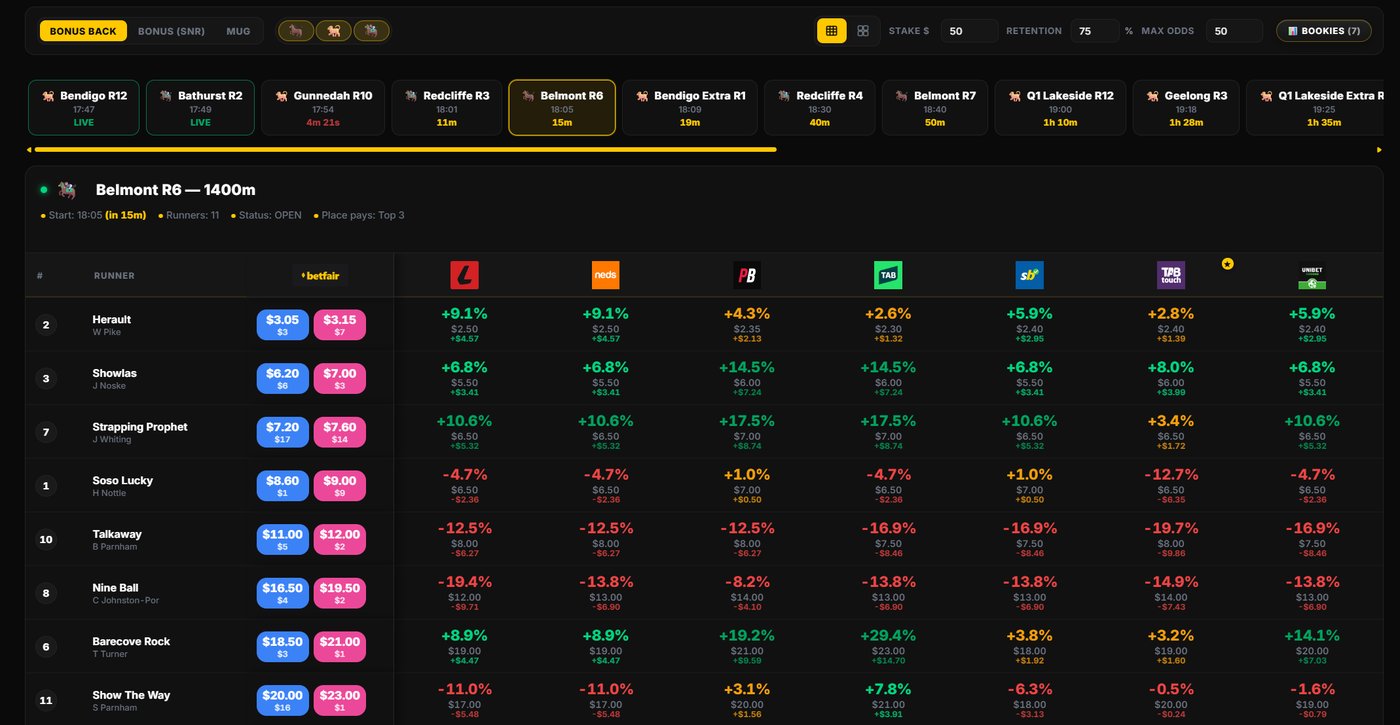
DegenToPro is Australian-built racing and betting software designed specifically for punters who take their betting seriously. Its dedicated racing module is built for exactly this workflow - you do the form reading, DegenToPro handles the price comparison and value identification across the full Australian bookmaker market.
| Feature | What It Does for Racing Punters |
|---|---|
| Best-tote vs fixed comparison | Shows you whether best-tote or the best fixed-odds price wins for every runner in real time |
| Field-wide price comparison | Lines up every bookmaker's price for every runner in a single view - no tab-switching |
| +EV Finder | Flags runners where the bookmaker price exceeds the sharp market's fair assessment |
| 100+ bookmakers | TAB, Sportsbet, Neds, BlueBet, Ladbrokes, Unibet, PointsBet and many more - all in one place |
| Daily racing tips and alerts | Curated +EV racing selections from the DegenToPro team, delivered before markets open |
| Bet tracker + verified CLV | Logs your bets and automatically tracks closing line value - the proof of long-term edge |
| Discord racing community | 6,000+ members sharing form notes, value picks and live results across Australian racing |
The racing software is particularly powerful because of the best-tote vs fixed-odds comparison. Australian punters have access to both corporate bookmaker fixed odds and the tote dividend (via TAB best-tote). Which one pays more varies race by race and runner by runner. DegenToPro shows you the answer in real time - meaning you never leave money on the table by defaulting to one without checking the other.
Once you have built your tissue and identified Horse B as a value bet at any price above 4.55, DegenToPro tells you instantly which bookmaker is offering the highest price on Horse B right now, whether that beats the tote, and what edge you are getting versus the sharp market consensus. The entire process that used to take 20 minutes of tab-switching across a dozen websites now takes seconds.
Professional punters are already doing this. The 6,000+ member community in DegenToPro's Discord is proof that systematic, form-guided, price-aware racing betting is possible at scale in Australia. The live profit dashboard shows verified community results - not hypothetical backtests, but actual member returns tracked in real time.
Frequently Asked Questions
What does the slash mean in a horse's form line?
The "/" symbol represents a spell - a rest period between racing campaigns. A form line of "312/21" means the horse ran 3rd, 1st and 2nd in its previous preparation, had a break, then came back and ran 2nd and most recently 1st. It is important to read either side of a slash separately to understand performance within each campaign.
How do I know if a horse handles wet tracks?
Check the going column in its previous form entries. If most of the horse's runs are on Good 3-4 surfaces, you have limited wet-track data. Any start on Soft 6 or heavier will have a going rating listed - if the horse ran well in those conditions, that is a meaningful signal. Also check breeding, as certain sire lines consistently produce wet-track performers in Australia.
How important is the barrier draw in Australian racing?
It varies significantly by track and distance. At a track like Flemington at 1600m (with the long straight run from the barrier), inside draws are a significant advantage. At a tight circuit over 1000m with an immediate turn, outside barriers are punishing because horses must use energy to cross to the fence. Research track-specific barrier stats before each meeting - most Australian form services publish season-to-date barrier win rates by track and distance combination.
What is the difference between BM and WFA races?
BM (Benchmark) races are handicap races where horses carry weights assigned by an official handicapper based on their rating. WFA (Weight-for-Age) races use a standard weight scale based on the horse's age and gender, with no handicapper involvement. WFA races are generally the most prestigious in Australian racing - they are the truest test of ability because the weight scale is set rather than adjusted to equalise the field.
How many recent starts should I read before making a judgment?
At minimum, read the last six to eight starts for metro horses and the full current preparation for any horse with fewer starts. Also look at the final two or three starts of the previous preparation to understand the horse's form cycle. For horses returning from a long spell (three months or more), recent trial form and the trainer's fresh strike rate are as important as the final runs of the previous prep.
What is form franking and why does it matter?
Form franking means the horse that beat yours has gone on to perform well, confirming the quality of your horse's run was genuine. If Horse A ran second to Stratford Park three weeks ago, and Stratford Park won again last Saturday, that second is franked - it was a genuine performance against a horse that is demonstrably in good form. Unfranked form - where the horse that beat yours has since run poorly - should be discounted accordingly.
Can I use DegenToPro for racing as well as sport betting?
Yes. DegenToPro includes dedicated Australian racing software alongside its Pro Odds Screener for sport. The racing module covers thoroughbred and harness racing across all Australian states, with best-tote vs fixed comparison, field-wide price display and +EV identification built in. The FREE tier gets you started with no card required.
How do I factor in jockey bookings when reading form?
A jockey booking - especially a last-minute upgrade - is one of the clearest intent signals in Australian racing. Check the first acceptances versus the final field: if a stable's regular provincial jockey has been replaced by one of the top-rated metro riders, take it seriously. Conversely, if a jockey who was booked for your selection has moved to a rival in the same race, that is worth noting. Most Australian form guides display the booking changes clearly in the jockey column.
The Bottom Line
Reading a form guide is a learnable skill. Start with the form line, understand the margins and the class, then layer in weight, barrier, jockey, track condition, distance and ratings. Every piece of information in a well-compiled Australian form guide is there for a reason - the art is knowing which factors to weight most heavily for the specific race in front of you.
But form reading alone is not enough to generate long-term profit. The final step - building a tissue and comparing your fair price to the market - is where the money is made. A horse you assess at 5.0 that is available at 7.0 is a value bet regardless of whether it wins today. Done consistently, across enough races, that approach produces a positive expected return. That is the entire game.
DegenToPro was built by Australian punters who understand this process inside out. The racing software handles the price comparison, the +EV identification, the best-tote vs fixed analysis and the CLV tracking - so once you have done your form reading, the technology does the rest. More than 6,000 members are already using it across racing and sport. The live profit dashboard shows verified community results in real time, so you can see exactly what disciplined, value-based racing betting looks like in practice.
Start reading form better today. Then let DegenToPro tell you where the market has priced it wrong.
Ready to Find Value in Australian Racing?
Join 6,000+ Australian punters using DegenToPro to compare best-tote vs fixed, find +EV runners and track verified CLV across 100+ bookmakers. Start on the FREE tier with no card required - or unlock the full racing software and Pro Odds Screener from $59.99/week AUD.
Start Free →