
Ask any honest sharp bettor what their biggest long-term enemy is, and very few will say bad odds or line movement. The real enemy is the six inches between their ears. Betting psychology - specifically the tendency to tilt - is responsible for more blown bankrolls than any losing streak, bad beat, or bookmaker restriction ever could be.
Tilt is not a sign of weakness. It is the natural output of a human brain that was never designed to absorb the random swings of probabilistic outcomes calmly. Understanding why your brain misbehaves under variance is the first step to overriding it. And in 2026, Australian bettors who pair that self-awareness with tools like DegenToPro have an enormous advantage over punters who still rely on gut feel.
This guide covers everything: what tilt is, the cognitive biases behind it, why variance makes even sharp bettors vulnerable, and the practical system-based approach that keeps emotions out of your staking decisions.
What Is Tilt in Betting?
The term "tilt" comes from poker, where it describes a player who has abandoned rational strategy in favour of emotional, impulsive decisions - usually after a bad beat. In betting, tilt works the same way: it is any deviation from your pre-planned, rational betting process driven by emotion rather than evidence.
Tilt does not always look dramatic. It is not always smashing your laptop after a last-minute goal costs you a parlay. More often it is quiet, subtle, and dressed up as logic:
- Placing a larger stake than usual to "get it back" after three losses in a row.
- Skipping a bet because you "don't feel good about it" even though the edge is clear.
- Betting on a sport you know nothing about because you're bored and want action.
- Doubling down on a team that "always comes good eventually" when the data says otherwise.
- Abandoning a profitable strategy after two bad weeks because you've convinced yourself it's broken.
Each of these behaviours sounds almost reasonable in the moment. That is what makes tilt so dangerous. It does not feel like tilting - it feels like adjusting, adapting, or trusting your experience. But every one of those decisions is driven by emotion and destroys expected value over time.
The good news is that tilt is predictable, measurable, and preventable - if you build the right system.
The Six Cognitive Biases That Cause Tilt
Human brains are pattern-seeking machines. That served our ancestors well on the savanna. It serves bettors terribly. The same mental shortcuts that help us make fast decisions in everyday life actively mislead us when processing the cold randomness of sports betting outcomes.
1. Recency Bias
Recency bias is the tendency to overweight recent events when forming expectations about the future. After five consecutive losing bets, your brain concludes that something is fundamentally wrong - with the strategy, the software, or your own judgement. After five straight winners, it concludes you are on a hot streak and encourages you to increase stakes.
Neither conclusion is warranted. A five-bet sample is statistically meaningless at any edge percentage below 30%. But recency bias makes those five bets feel like definitive evidence.
2. The Gambler's Fallacy
The gambler's fallacy is the mistaken belief that independent random events are somehow connected - that after a string of losses, a win is "due." In reality, each bet is independent. If you have genuinely identified a +3% EV bet, that edge does not change because you lost the last four times. The coin has no memory. The market does not owe you a winner.
Bettors who fall for this fallacy tend to increase stakes after losing runs - exactly the opposite of what disciplined bankroll management requires.
3. Chasing Losses
Chasing is one of the most destructive behaviours in all of gambling. It happens when a bettor responds to a loss by placing a larger, riskier bet to quickly recover the deficit. The psychological driver is loss aversion - the fact that losses feel roughly twice as painful as equivalent gains feel pleasurable (a concept from Kahneman and Tversky's prospect theory).
Chasing losses compounds variance, increases exposure at exactly the wrong time, and almost always involves taking bets with lower edge (or outright negative EV) just to generate action. A $500 loss becomes a $1,200 loss in a single session.
4. Overconfidence Bias
After a winning streak, many bettors develop an inflated sense of their own ability to read markets. They start ignoring the sharp reference odds and betting on feel. They start taking larger positions. They assume that their recent results reflect skill rather than variance running in their favour.
Overconfidence leads to under-sized edges being accepted, staking discipline breaking down, and the gradual drift from data-driven betting back to glorified punting.
5. Confirmation Bias
Confirmation bias causes bettors to seek out information that supports a position they have already decided to take. If you have made up your mind to back the Storm, you will focus on the injury news that helps them and mentally discount the form data that argues against it. This means that by the time you place the bet, you have convinced yourself it is a strong edge when the process was compromised from the start.
6. Sunk Cost Fallacy
The sunk cost fallacy causes bettors to make future decisions based on past losses that are already gone and unrecoverable. "I'm already down $800 this week so I need to keep betting to get back." The $800 is gone regardless of what you do next. Future bets should be evaluated purely on their current EV - not on what you need to recover.
Why Even +EV Bettors Tilt During Variance
Here is the part most betting guides skip over: variance is not just an abstract concept. It is a lived, visceral experience that can shake the confidence of even the most disciplined bettors. And the uncomfortable truth is that genuine +EV bettors face longer and deeper losing runs than most people expect.
Consider a bettor with a real 4% edge on every bet, staking $100 flat per bet. At that edge and stake size, losing runs of 10 or more consecutive bets occur regularly over a large sample. Losing runs of 15-20 bets are not statistically unusual over thousands of bets. The expected value is genuinely positive - but variance means that the path to long-term profit is not a smooth upward line. It is a jagged, lumpy, emotionally exhausting curve.
| Edge Per Bet | Expected Losing Run (over 1,000 bets) | Maximum Drawdown (95th percentile) |
|---|---|---|
| 2% | 14+ consecutive losses | ~35 units |
| 4% | 10+ consecutive losses | ~22 units |
| 6% | 8+ consecutive losses | ~16 units |
| 10% | 6+ consecutive losses | ~10 units |
If you are staking $100 per unit, a 22-unit drawdown means watching $2,200 disappear before your edge reasserts itself. That is a real amount of money. For most humans, that is enough to trigger every cognitive bias listed above simultaneously.
The bettors who come out the other side of those drawdowns profitably are not those with stronger willpower. They are the ones who have built systems that make emotional decision-making structurally impossible. Their staking rules, their bet selection criteria, and their record-keeping habits are fixed in advance - not negotiated in the heat of a losing streak.
This is exactly the gap that DegenToPro is designed to fill for Australian bettors. When your bet selection is automated by an algorithm comparing live soft-book odds to sharp reference prices, your brain does not get a vote on whether a given bet "feels right."
Common Tilt Triggers and Their Fixes
Tilt rarely comes from nowhere. There are common, predictable triggers that push bettors off their process. The table below maps the most common triggers to the specific fix that eliminates them.
| Tilt Trigger | What It Looks Like | The Fix |
|---|---|---|
| Losing run (5+ bets) | Increasing stake size or seeking lower-quality bets for action | Pre-set flat stake rule; bet selection algorithm decides, not you |
| Last-minute loss / bad beat | Placing an immediate revenge bet on the next available market | Enforce a mandatory 30-minute cooling-off rule after any bad beat |
| Winning run (overconfidence) | Accepting bets below your minimum edge threshold or increasing unit size | Lock minimum edge % in software settings; unit size tied to rolling bankroll only |
| Watching live and the bet is losing | Cashing out early, destroying EV to relieve anxiety | Place and walk away rule; disable live-betting notifications during events |
| Social pressure (mate's tip, Discord hype) | Following a tip without checking the EV independently | Only bet markets where you have verified the edge in DegenToPro yourself |
| Boredom / no active bets | Creating action in markets with no genuine edge | Only bet from the software's verified opportunity list; no manual override |
| Comparing results to others | Abandoning your strategy to copy a vocal "winner" online | Judge your process on CLV only, not outcome - and only your own CLV |
| Financial stress | Betting amounts you cannot afford to lose in order to solve a money problem | Never bet with funds earmarked for bills; bankroll must be completely disposable |
Print this table. Tape it above your monitor. The triggers are predictable - which means they are preventable.
Building a Process That Removes Emotion
The professional bettor's advantage over the recreational punter is not a superior feel for sport. It is a superior system. A process-first approach means that every decision point - what to bet on, how much to stake, when to stop - is governed by pre-set rules rather than in-the-moment judgement.
Rule 1: Define Your Betting Criteria Before Markets Open
Before a single line is posted, you need to know exactly what qualifies as a bet. For a DegenToPro EV bettor, this might look like: minimum edge of 3% above the devigged sharp reference, minimum odds of 1.60, maximum stake of 2% of current bankroll, sports limited to NRL/AFL/soccer during the week. Every bet that meets those criteria gets placed. Every bet that does not, does not. There is no further deliberation.
Rule 2: Flat Staking or Conservative Fractional Kelly Only
Flat staking - betting the same unit size on every qualifying bet regardless of how confident you feel - is the single easiest way to remove tilt from your staking decisions. If you use fractional Kelly (recommended for more advanced bettors), calculate the stake before you know the result of the previous bet, and never adjust it based on recent P&L.
Rule 3: Set Session Limits and Honour Them
Decide in advance the maximum number of bets per day and the maximum loss per session at which you will stop. These are not negotiable in the moment. A daily loss limit of 5 units means that once you are down 5 units, you close the software and walk away until the next day. No exceptions.
Rule 4: Separate the Process from the Outcome
This is the hardest mental shift for most bettors: you must evaluate the quality of each bet based on the process used to find it, not whether it won. A +5% EV bet that loses is still a good bet. A bet placed on gut feel that wins is still a bad bet. The bet tracker in DegenToPro makes this concrete - it logs the edge at placement time so you can review process quality independently of results.
Rule 5: Create Physical Friction Between Impulse and Action
If you feel the urge to deviate from your process, make yourself wait. A simple rule: any bet not generated by your software's opportunity scanner requires a mandatory 15-minute pause and a written justification. Most tilt-driven impulses evaporate before the 15 minutes are up. The ones that survive are worth reviewing but rarely warrant a bet.
How Tracking and CLV Keep You Grounded
The single most powerful antidote to tilt is data. Not anecdote, not memory, not the feeling that you have been running bad - actual records that tell you objectively whether your process is working.
This is where Closing Line Value (CLV) becomes essential to your psychological resilience. CLV measures whether you consistently bet at prices better than where the sharp market closes. If your average CLV across hundreds of bets is positive, you have genuine edge - regardless of short-term results. If your P&L is negative but your CLV is positive, you are running below expectation due to variance, and you should keep going. If your CLV is negative, the process is broken and it is time to diagnose why.
Without CLV data, you are flying blind. A losing run feels exactly the same whether it is normal variance or evidence that your edge has disappeared. Most bettors have no way to tell the difference - and that uncertainty is what triggers tilt. With tracked CLV, you have an objective answer.
| Scenario | P&L Result | Average CLV | Correct Response |
|---|---|---|---|
| Variance working against you | Negative | Positive (+2% to +5%) | Stay the course - edge is real, variance will correct |
| Process genuinely broken | Negative | Negative | Stop, diagnose, fix the edge identification process |
| Running hot above expectation | Positive | Positive | Maintain discipline - do not increase stakes based on short-term luck |
| Process broken but lucky short-term | Positive | Negative | Fix the process now - short-term luck will not last |
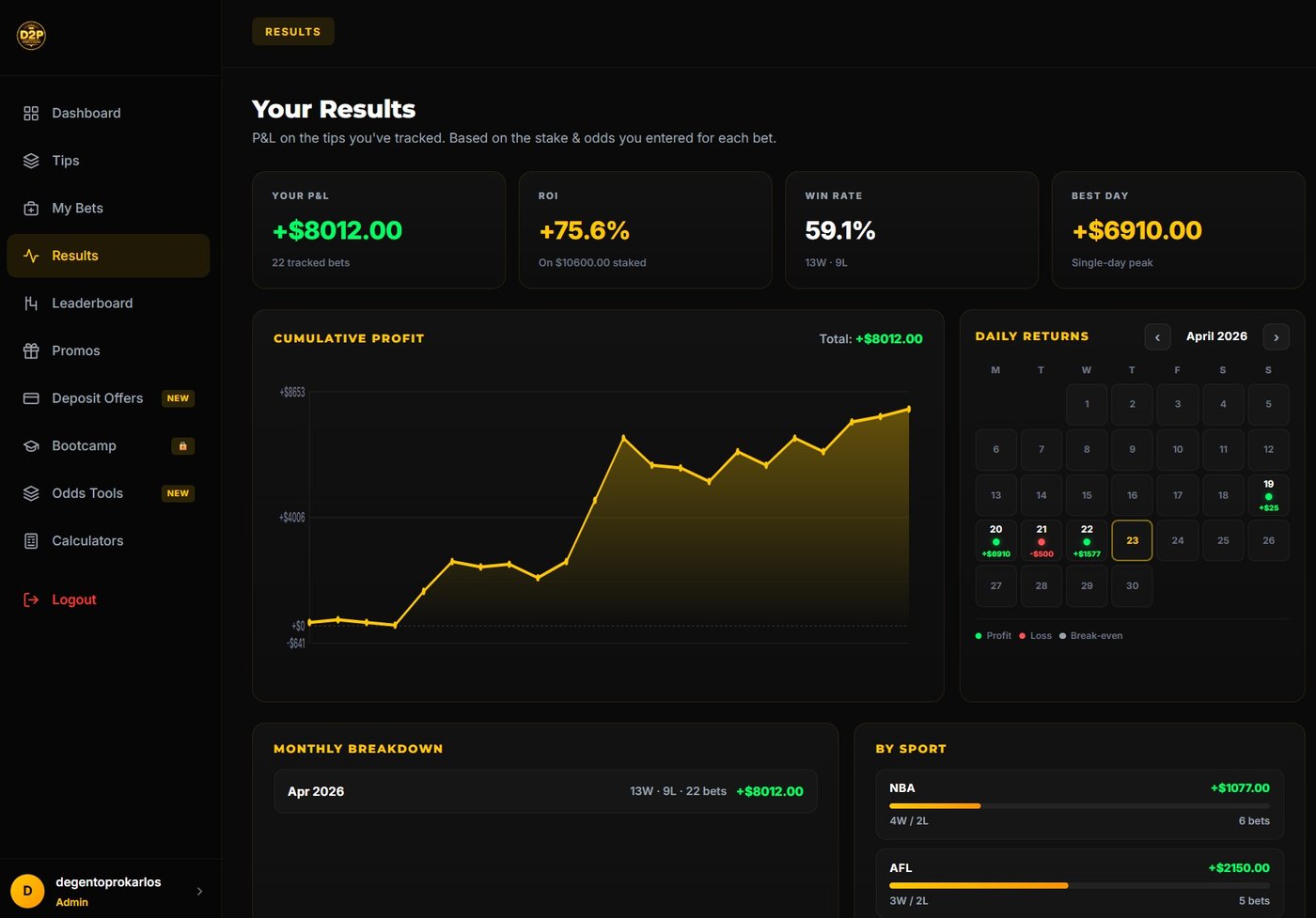
DegenToPro's bet tracker captures edge at placement time and closing line at settlement, automatically calculating your verified CLV for every bet. That running CLV average is your north star - it cuts through the emotional noise of daily results and tells you the truth about your process.
Beyond CLV, a good bet tracker lets you filter your history by sport, bookmaker, odds range, and time period. Patterns that were invisible to your emotional memory become obvious in the data. Maybe you have positive CLV on NRL but negative CLV on soccer - a clear signal to narrow your focus. Maybe your CLV is strongest in early-week markets and deteriorates closer to game day - another actionable insight that removes guesswork from your process.
The punters who beat the books long-term are not the ones who feel the market best. They are the ones who know their numbers cold. Start tracking every bet with DegenToPro and make the data do the work your brain cannot.
Replace Gut Feel with Verified Data
DegenToPro's bet tracker logs every bet with edge at placement and closing line at settlement - automatically calculating your CLV so you always know if your process is working. World Cup Offer: 20% off all plans right now.
Start Free →How DegenToPro Replaces Gut Feel with Data and CLV Proof
DegenToPro was built around a single philosophy: decisions that can be made by an algorithm should be made by an algorithm. The human's job is to set the criteria, manage the bankroll, and stay out of the way.
That philosophy is the structural answer to betting psychology and tilt. When the software is deciding which bets meet your minimum edge threshold, your recency bias does not get a vote. When the bet tracker is logging CLV automatically, you cannot convince yourself that you are running bad when the data says otherwise. When you can see 6,000+ Discord members' collective results on a live profit dashboard, you have context that prevents panic during your own temporary drawdowns.
| DegenToPro Feature | Tilt Risk It Eliminates |
|---|---|
| +EV Finder - live edge % across 100+ Australian books | Removes manual bet selection; eliminates confirmation bias and gut-feel betting |
| Bet Tracker + Verified CLV | Separates process from outcomes; eliminates panic during variance by proving edge is real |
| Pro Odds Screener - 10+ sports, real-time | Provides objective opportunity list; eliminates boredom betting and market-chasing |
| Arbitrage Finder | Removes opinion entirely - guaranteed profit regardless of outcome |
| Racing Software - EV analysis for AU racing | Replaces form-guide guesswork with hard EV calculation for racing markets |
| Live Profit Dashboard | Contextualises your drawdowns within community-wide variance; reduces panic |
| Discord Community (6,000+ members) | Peer accountability and shared process reinforcement during tough stretches |
The average Australian punter loses because they are betting with bookmakers who spend millions refining their margins and manipulating the user experience to maximise spend. The average sharp bettor loses to tilt because they lack the structural guardrails to keep emotion out of the process during inevitable downswings.
DegenToPro addresses both problems simultaneously. The +EV finder gives you the edge. The bet tracker with CLV proves the edge is real when variance is working against you. And the system-based approach to bet selection means you are always acting on data, not feeling.
Plans start free with no card required, and paid tiers from $59.99/week AUD unlock the full Pro Odds Screener, EV finder, and verified CLV tracker. The World Cup Offer currently applies 20% off all paid plans - Weekly ($59.99), Monthly ($299.99), and Lifetime ($699.99 AUD).
For Australian punters serious about long-term profitability, removing psychology from the equation is not optional. It is the whole game.
Responsible Gambling
Everything in this guide assumes that betting is a leisure activity funded entirely by disposable income - money you can afford to lose without affecting your financial security, relationships, or mental health. If that description does not apply to your current situation, this is the most important section in the article.
Tilt and the cognitive biases described above can, in some cases, be early indicators of problem gambling behaviour rather than just poor discipline. The key distinction is whether you are able to stop when your pre-set limits are reached. If you find yourself unable to stop, betting money you need for other things, or experiencing distress about your betting, please reach out for support.
- Gambling Help Online: 1800 858 858 (free, confidential, 24/7)
- Lifeline: 13 11 14
- Gambling Help Online: gamblinghelponline.org.au
All Australian bookmakers are required to offer self-exclusion, deposit limits, and time-out options. Use them proactively - setting a deposit limit before you need it is far easier than trying to enforce one during a tilt episode.
DegenToPro is a betting software and education platform. We are strong advocates for responsible gambling and do not encourage betting beyond your means. The tools and strategies in this guide are designed for disciplined, recreational bettors who treat their bankroll as a separate, ringfenced fund. If you ever feel that gambling is causing you harm, please stop and seek help.
The Bottom Line
Betting psychology and tilt are not soft concepts reserved for motivational posters. They are the primary reason why the vast majority of bettors - including many who genuinely understand EV and CLV - fail to convert a mathematical edge into long-term profit. The cognitive biases are hardwired. The variance is brutal. And the emotional pressure of real money moving in and out of your account is unlike anything you experience in theory.
The solution is not to try harder to be rational under pressure. The solution is to build a system that does not require you to be rational under pressure. Pre-set rules, automated bet selection, mandatory loss limits, and verified CLV tracking all work together to create a process where the most dangerous variable - your own psychology - is minimised at every decision point.
DegenToPro was built specifically for this. The +EV finder replaces the gut-feel decision. The CLV tracker proves the edge is real when your P&L disagrees. The live profit dashboard contextualises your results within a community of thousands. And the data trail you build over months gives you the conviction to stay the course when variance is making you doubt everything.
Stop betting on feelings. Start betting on proof. Join 6,000+ Australian punters who have already made the switch with DegenToPro.
Stop Tilting. Start Tracking. Start Winning.
Join 6,000+ Australian punters who use DegenToPro to find +EV bets, track CLV and build long-term profit with data - not gut feel. Start on the FREE tier with no card required, or unlock the full Pro Odds Screener and verified CLV tracker from $59.99/week AUD.
Start Free →