
Most Australian punters focus on the decimal number next to an outcome - 2.40, 1.75, 6.00. That number is useful, but it is only half the picture. The other half is what that number implies about probability: the bookmaker's embedded estimate of how often that outcome will occur. Once you can read odds as probabilities rather than just payouts, everything about sports betting clicks into place - value, edge, expected value, and why the house always wins without it.
This guide covers implied probability betting end to end: the conversion formula, the reason markets never add up to exactly 100%, how to find value by comparing your own estimates to the market's, and how to strip out the vig to see the true underlying probability. Every section includes a worked numerical example so you can verify the maths yourself.
What is implied probability?
Implied probability is the percentage chance of an outcome occurring that is baked into a set of betting odds. It is called "implied" because the bookmaker has not published a probability directly - they have published a price. You have to reverse-engineer the probability from that price.
Why does this matter? Because the only way to know whether a bet represents value is to compare what you think the probability is against what the bookmaker thinks the probability is. If you believe Team A has a 60% chance of winning and the bookmaker's odds imply only a 52% chance, there is a gap worth exploiting. If your estimate is lower than the bookmaker's implied probability, the bet is overpriced and you should skip it.
Implied probability is therefore the bridge between raw odds and genuine edge. Every +EV bettor, arbitrage trader, and professional punter in Australia uses this concept as their primary decision-making filter.
Converting decimal odds to implied probability
The conversion formula for decimal odds - the format used at all Australian bookmakers - is straightforward:
Implied probability = 1 ÷ decimal odds
That is it. Divide 1 by the odds and you have the implied probability as a decimal. Multiply by 100 to express it as a percentage.
Worked examples
| Outcome | Decimal Odds | Calculation | Implied Probability |
|---|---|---|---|
| Heavy favourite | 1.25 | 1 ÷ 1.25 | 80.00% |
| Mild favourite | 1.80 | 1 ÷ 1.80 | 55.56% |
| Even money | 2.00 | 1 ÷ 2.00 | 50.00% |
| Mild underdog | 2.50 | 1 ÷ 2.50 | 40.00% |
| Long shot | 8.00 | 1 ÷ 8.00 | 12.50% |
Notice the intuitive relationship: shorter odds (closer to 1.00) correspond to higher implied probabilities, and longer odds (further from 1.00) correspond to lower implied probabilities. A price of 1.01 implies a 99% chance; a price of 100.00 implies a 1% chance. The formula holds for any decimal odds regardless of sport or market.
This formula also explains why odds of 2.00 represent a 50/50 proposition - exactly even money. A fair coin flip, two equally matched opponents, or any outcome where each side has an identical chance will be priced at 2.00 in a perfectly fair market. Real markets, as we will see, are never perfectly fair.
Why a market's implied probabilities sum to more than 100%
Here is where implied probability betting gets interesting - and where the house edge hides.
In a truly fair two-outcome market, the implied probabilities of all outcomes should add up to exactly 100%. Heads plus tails equals 100%. Team A wins plus Team B wins equals 100%. That is just probability: all possible outcomes must account for the entire probability space.
Bookmakers do not offer fair markets. They deliberately set odds so that the implied probabilities of all outcomes add up to more than 100%. This excess above 100% is called the overround, the vig, the juice, or the margin - and it is the bookmaker's guaranteed profit engine.
A real-world example
Suppose a bookmaker prices an NRL match as follows:
| Outcome | Bookmaker Odds | Implied Probability |
|---|---|---|
| Team A to win | 1.85 | 1 ÷ 1.85 = 54.05% |
| Team B to win | 1.95 | 1 ÷ 1.95 = 51.28% |
| Total | 105.34% |
The two implied probabilities add to 105.34%. That extra 5.34% is the overround - the bookmaker's margin. If you bet $100 on each side ($200 total), one bet wins and pays back either $185 or $195. Either way you get back roughly $189.50 on average - losing roughly $10.50 of your $200, which is about 5.3%. That is the vig at work.
The overround is why you cannot simply find one side of a market that looks good and assume it is value. The bookmaker has already built in a profit margin on both sides. To find genuine value you need to know what the true probability is - not the inflated implied probability - and compare it against your own estimate.
A market overround of 5-6% is typical for major Australian two-way markets. Multi-way markets (racing, futures, same-game multis) often carry overrounds of 15-25% or more, because the bookmaker can embed the margin across many outcomes.
Converting implied probability back to decimal odds
The conversion works in both directions. If you know a probability and want to express it as decimal odds, simply invert the formula:
Decimal odds = 1 ÷ implied probability
This is useful when you have estimated the probability of an outcome yourself and want to know what "fair" decimal odds that probability corresponds to - so you can compare it to what a bookmaker is offering.
Worked examples
| Your Estimated Probability | Calculation | Fair Decimal Odds |
|---|---|---|
| 70% | 1 ÷ 0.70 | 1.43 |
| 55% | 1 ÷ 0.55 | 1.82 |
| 40% | 1 ÷ 0.40 | 2.50 |
| 25% | 1 ÷ 0.25 | 4.00 |
| 10% | 1 ÷ 0.10 | 10.00 |
So if you believe an outcome has a 40% chance of occurring, you need decimal odds of at least 2.50 to break even over the long run. Any price above 2.50 represents a positive-expected-value bet at that probability estimate. Any price below 2.50 means the bookmaker is giving you less than fair value.
Comparing your estimated probability to find value
This is where implied probability betting becomes a practical profit tool. The process is simple in theory:
- Form your own estimate of the true probability of an outcome.
- Convert the bookmaker's odds to an implied probability.
- Compare the two. If your estimate is higher than the implied probability, the bet offers positive expected value (+EV). If your estimate is lower, skip it.
Value bet example
You analyse a tennis match and estimate Player A has a 58% chance of winning. The bookmaker is offering 1.85 on Player A.
| Step | Calculation | Result |
|---|---|---|
| Bookmaker's implied probability | 1 ÷ 1.85 | 54.05% |
| Your estimated probability | - | 58.00% |
| Edge | 58% - 54.05% | +3.95% |
| EV per $100 bet | (0.58 x $85 profit) - (0.42 x $100 stake) | +$7.30 |
Your estimated probability (58%) is higher than the market's implied probability (54.05%), so the bet is +EV. At $100 per bet, you expect to make $7.30 profit on average each time you place this bet - provided your 58% estimate is accurate.
Negative value example
The same match, but the bookmaker has tightened the price on Player A to 1.65. Now:
| Step | Calculation | Result |
|---|---|---|
| Bookmaker's implied probability | 1 ÷ 1.65 | 60.61% |
| Your estimated probability | - | 58.00% |
| Edge | 58% - 60.61% | -2.61% |
Now the bookmaker's implied probability (60.61%) exceeds your estimate (58%). The bookmaker is pricing this outcome as more likely than you think it is. Placing this bet destroys value over time - even if Player A wins this particular match.
This is the core discipline of implied probability betting: the outcome of any single bet is irrelevant to whether it was a good bet. A bet is good if your estimated probability exceeds the implied probability at the time you place it. Whether it wins is a separate question decided by randomness.
Let DegenToPro do the comparison for you
DegenToPro converts odds to implied probabilities, strips the vig, and compares against sharp market lines across 100+ Australian bookmakers - automatically, in real time. See every +EV opportunity the moment it appears.
Start Free →Removing the vig to get true probability
There is a problem with using bookmaker odds directly as a probability reference: they are inflated by the overround. The implied probability you calculate from a bookmaker's odds is not the true probability of the outcome - it is the true probability plus a share of the bookmaker's margin.
To get the true underlying probability you need to remove the vig. The most common method is the multiplicative method:
- Convert each decimal odd to its implied probability: pi = 1 ÷ oddsi
- Sum all implied probabilities to get the overround O.
- Divide each implied probability by the overround: true probabilityi = pi ÷ O
Devigging a two-way market
Using our NRL example from earlier - Team A at 1.85, Team B at 1.95:
| Outcome | Bookie Odds | Implied Prob | True Prob (No-Vig) | Fair Decimal Odds |
|---|---|---|---|---|
| Team A | 1.85 | 1 ÷ 1.85 = 54.05% | 54.05% ÷ 105.34% = 51.31% | 1 ÷ 0.5131 = 1.949 |
| Team B | 1.95 | 1 ÷ 1.95 = 51.28% | 51.28% ÷ 105.34% = 48.69% | 1 ÷ 0.4869 = 2.054 |
| Total | 105.34% | 100.00% |
After removing the vig, the true probabilities are 51.31% and 48.69% - summing to exactly 100%. The fair decimal odds are 1.949 and 2.054. The bookmaker is offering 1.85 and 1.95 against these fair prices - both sides are priced below fair value, which is exactly how a bookmaker makes money on every market.
Why this matters for value hunting
When you use a sharp reference book - such as Pinnacle, Betfair's starting price, or a heavily bet exchange market - as your benchmark, the devigged probability from that reference becomes your best estimate of the true probability. You then compare that true probability against the implied probability at a softer bookmaker. If a soft bookie is offering odds that imply a probability lower than the true probability from the sharp reference, that is a +EV bet.
This is the exact workflow at the heart of every serious implied probability betting operation:
| Step | Action | Tool |
|---|---|---|
| 1 | Get sharp odds from a reference market | Pinnacle, Betfair, exchange |
| 2 | Strip the vig to get true probability | Multiplicative devig formula |
| 3 | Convert soft bookmaker's odds to implied probability | 1 ÷ decimal odds |
| 4 | Compare: if implied prob < true prob, bet is +EV | Simple subtraction |
| 5 | Place bet, track result, verify CLV | Bet tracker |
Steps 1 through 4 need to happen in seconds, across hundreds of markets simultaneously, for this to generate meaningful returns. Doing it manually for even a handful of markets per day is impractical. That is the problem DegenToPro was built to solve for Australian punters.
How DegenToPro converts and compares automatically
DegenToPro is an Australian-built EV, arbitrage, and racing software platform designed specifically for punters who want to apply the implied probability framework at scale. Rather than opening five browser tabs and doing mental arithmetic, the platform handles the entire pipeline automatically:
- Live implied probability conversion: Every set of odds across 100+ Australian and international bookmakers is converted to implied probability in real time, continuously updated as prices move.
- Automatic devigging: DegenToPro strips the vig from sharp reference markets using the multiplicative method, producing true no-vig probabilities for every monitored event.
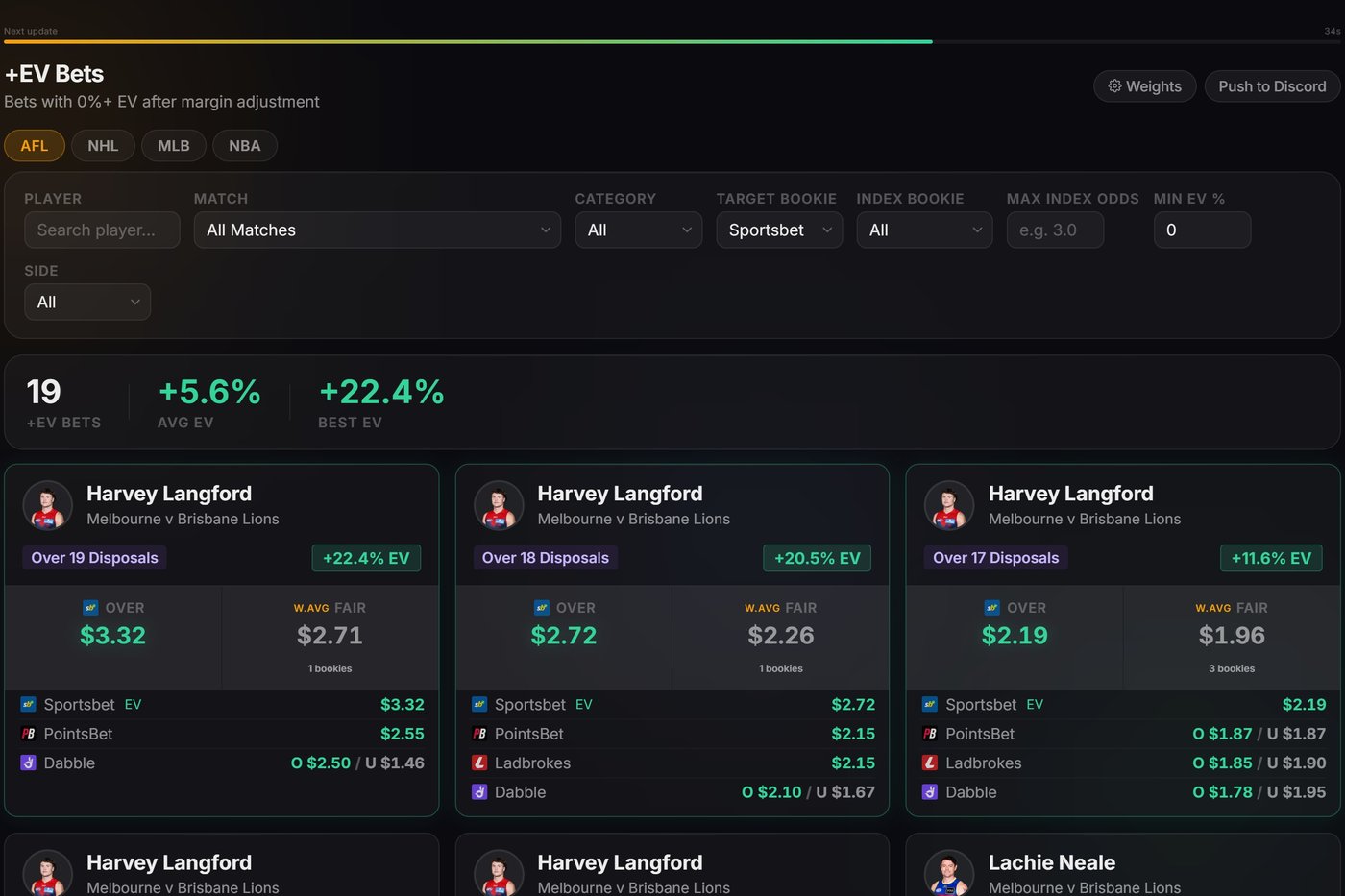
- +EV flagging: The platform compares each bookmaker's implied probability against the true probability from the sharp reference. Any outcome where the bookmaker's implied probability is below the true probability is flagged as a +EV opportunity, with the edge percentage displayed directly on screen.
- Market EV display: You see the expected value of every available bet without doing any calculations. Positive numbers indicate edge; negative numbers indicate you are paying the bookmaker's margin.
- Arbitrage detection: Because implied probabilities across multiple bookmakers are calculated simultaneously, the platform automatically surfaces arbitrage opportunities - combinations of bets across different bookmakers where the combined implied probabilities fall below 100%.
- Bet tracker with verified CLV: Log your bets and DegenToPro calculates your closing-line value (CLV) - how far your implied probability at time of bet differed from the devigged closing price. CLV is the most reliable measure of whether your probability estimates are genuinely better than the market's.
- Racing software: A dedicated implied probability and EV engine for Australian thoroughbred, harness, and greyhound racing - markets where multi-runner overrounds make manual devigging particularly laborious.
- Pro Odds Screener: Filter and sort every monitored market by edge percentage, sport, bookmaker, and time to event - so you can prioritise the highest-value bets across your book.
The platform is used by more than 6,000 members in the DegenToPro Discord community, from recreational Australian punters exploring +EV for the first time to full-time professionals tracking five and six-figure annual profits against verified CLV benchmarks.
Pricing starts with a FREE tier - no card required - which gives you access to the dashboard and live implied probability data across major sports. Paid plans unlock the complete bookmaker scan, racing software, the Pro Odds Screener, and the full bet tracker. Plans are available Weekly ($59.99 AUD), Monthly ($299.99 AUD), or Lifetime ($699.99 AUD). A World Cup Offer of 20% off is currently running - visit the pricing page to lock it in before it expires.
For Australian punters serious about implied probability betting, DegenToPro removes the two biggest barriers: the time required to monitor enough markets, and the speed required to act before sharp money moves the price.
Find +EV bets before the market moves
DegenToPro converts odds to implied probabilities, strips the vig, and flags every +EV opportunity across 100+ Australian bookmakers - live, every few seconds. Join 6,000+ members already profiting from the edge. Start free today.
Start Free →The bottom line
Implied probability is the single most important concept in sports betting. Every other framework - expected value, arbitrage, CLV, Kelly criterion staking - depends on it. If you cannot convert odds to probabilities and compare those probabilities against your own estimates, you are betting blind.
The core formula is simple: divide 1 by the decimal odds. The conceptual insight that makes it powerful is understanding why markets always sum above 100% - and what that overround tells you about the true probability hidden beneath the bookmaker's price. Strip the vig using the multiplicative method, compare the resulting true probability against any bookmaker's implied probability, and you have a systematic edge-detection process that scales with volume.
The challenge for Australian punters is not understanding the maths - it is applying it fast enough and broadly enough to matter. Markets move in seconds. Sharp money closes +EV gaps quickly. Monitoring ten markets by hand will not generate sustainable returns; monitoring hundreds of markets automatically, with the calculations done for you, can.
That is why DegenToPro exists: to take every concept covered in this guide and execute it automatically, across the full Australian bookmaker landscape, so you spend your time finding value rather than calculating it.
Related guides
How to Calculate Fair Odds (Devigging Guide 2026)
Strip the bookmaker's margin using four industry-standard devigging methods - multiplicative, additive, power, and Shin - with worked examples for each.
Read guide →What is EV Betting? A Beginner's Guide to Expected Value
Expected value is the number that determines whether a bet is profitable in the long run. Learn how to calculate it and why it is the only metric that matters.
Read guide →What is the Vig (Juice) in Sports Betting?
The vig is the bookmaker's built-in profit margin on every market. Understand how it works, how to calculate it, and how to minimise its impact on your returns.
Read guide →