
Each-way betting is one of the most common wager types in Australian racing, yet it is also one of the most misunderstood. Most recreational punters place each-way bets instinctively - a vague sense that having two chances instead of one must be better. Sharp punters approach the same bet with a completely different question: is the combined price of the win leg and the place leg greater than the true probability warrants?
That distinction is everything. A well-timed each-way bet on the right runner at the right bookmaker, with the right place terms, can carry a significant positive expected value edge. A lazily placed each-way bet with poor place terms at a book that lags the market is negative EV dressed up in the comfort of a two-legged safety net.
This guide breaks it all down - from the fundamentals of how each-way betting works, through to the nuances of Australian place terms, tote versus fixed pricing, and the specific value angles that professional punters exploit. DegenToPro is designed to surface exactly these opportunities, in real time, across more than 100 Australian bookmakers.
What Does Each-Way Mean?
An each-way bet is two bets of equal stake placed simultaneously on the same runner: a win bet and a place bet. If you put $20 each-way on a horse, you are actually staking $40 in total - $20 on the win and $20 on the place.
The outcomes work like this:
- Runner wins: Both the win leg and the place leg pay out. You collect at full win odds on your win stake, plus place odds on your place stake.
- Runner places (but does not win): The win leg loses, the place leg pays out. You receive place odds on your place stake only, minus the lost win stake.
- Runner finishes outside the place positions: Both legs lose and the full $40 is gone.
The place odds are calculated as a fraction of the win odds - typically one quarter (1/4) or one fifth (1/5) of the win price, depending on the bookmaker and the number of runners in the field. These fractions are called the place terms, and understanding them is the single most important concept in each-way betting.
A quick example to cement the mechanics. You back a horse each-way at win odds of 8.00 (decimal) with 1/4 place terms for two places. Your place odds are: (8.00 - 1) x 0.25 + 1 = 2.75. So the win leg pays $8 for every $1 staked, and the place leg pays $2.75 for every $1 staked if the runner finishes in the first two positions.
How Place Terms Work in Australia
Australian bookmakers apply place terms based on the number of declared runners (after scratchings). The standard terms used by most fixed-odds bookmakers are shown below.
| Number of Runners | Places Paid | Standard Fraction | Notes |
|---|---|---|---|
| 4 or fewer | Win only | N/A | Most books will not offer each-way on fields of 4 or fewer |
| 5 to 7 | 2 places | 1/4 odds | Some books use 1/5 - always check before betting |
| 8 to 11 | 3 places | 1/4 odds | Standard across most Australian books for this field size |
| 12 to 15 | 3 places | 1/4 odds | Some books extend to 4 places at 1/5 - check terms |
| 16 or more | 4 places | 1/4 odds | Large fields offer most each-way value opportunities |
The key point here is that place terms are not uniform across bookmakers. Sportsbet, TAB, Neds, BlueBet, Ladbrokes, Unibet, and PointsBet all have their own default place term policies, and they sometimes offer enhanced place terms as promotions - extending to an extra place or upgrading from 1/5 to 1/4. Those enhancements can transform a borderline each-way bet into a clearly +EV opportunity.
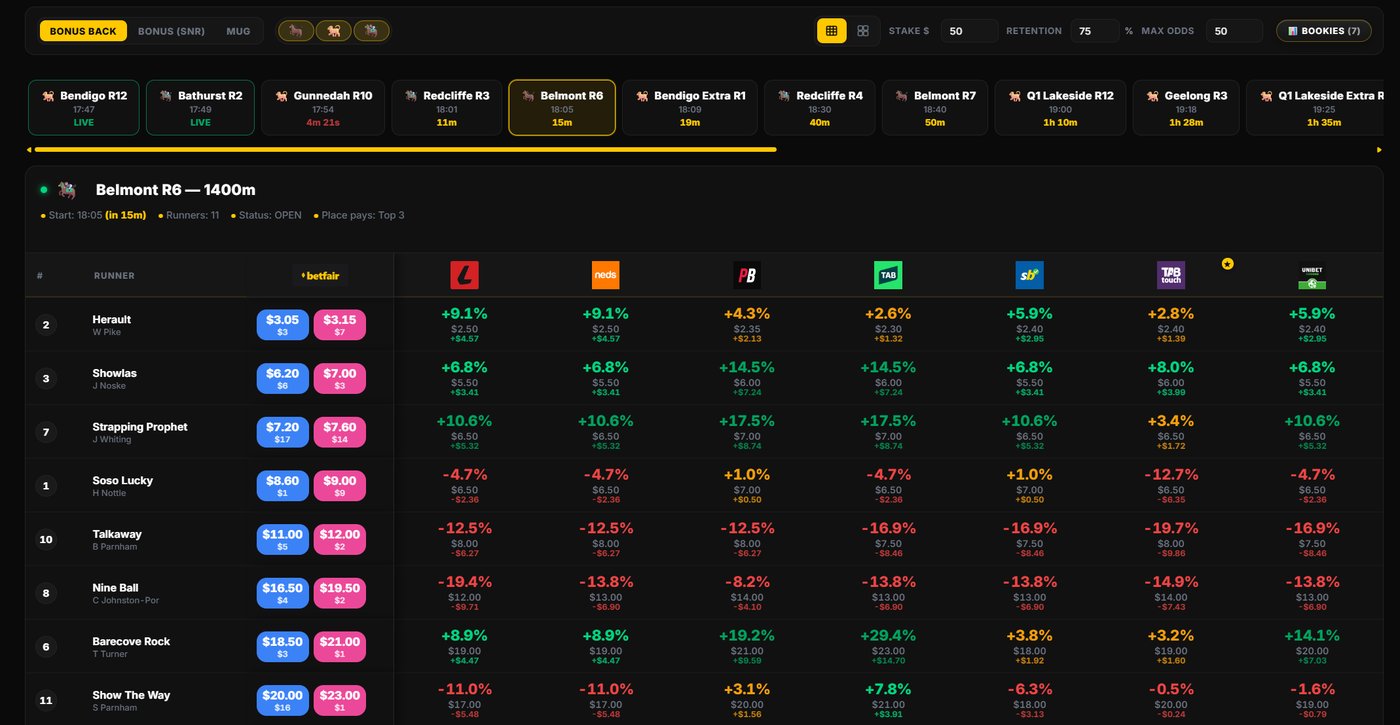
DegenToPro's racing software displays the current place terms alongside the win and place prices for every bookmaker in real time, so you can instantly identify which book offers the best combined each-way value without manually visiting a dozen websites.
Tote Place vs Fixed Place Prices
In Australia, each-way bets can be settled on a tote (pari-mutuel) price or a fixed price. The difference matters enormously to your expected return.
Tote Place
When you bet on the tote, your money enters a pool with all other punters backing the same market. The final place dividend is determined after the race by dividing the total pool (minus the operator's deduction, usually 14 to 20%) among the winning tickets. You do not know your return until the race result is declared.
Tote place dividends on long-shot runners can be very generous when the field is large and the favourite dominates betting turnover. Conversely, in a small field where the favourite runs second, tote place returns on the favourite can be poor - sometimes returning less than $1 on the dollar after deductions.
Fixed Place
Fixed-place prices are set by the bookmaker's market at the time you place the bet. You know your exact payout immediately. Fixed place odds are calculated from the bookmaker's fixed win price using the place fraction (e.g. 1/4 odds of 8.00 = place price of 2.75).
The advantage of fixed place is certainty and the ability to compare across books. The disadvantage is that bookmakers bake a margin into both the win and place prices. Best-tote options - where bookmakers pay you the TAB tote dividend if it beats their fixed price - add another dimension and are available at most major Australian books for thoroughbred races.
| Price Type | Return Known Upfront? | Can Beat Fixed? | Best For |
|---|---|---|---|
| Tote Place | No | Yes (on outsiders) | Longer-priced runners in large fields |
| Fixed Place | Yes | No (you take the fixed) | Comparing value across books before the race |
| Best Tote | No (whichever is higher) | Yes | Any runner where tote may outperform fixed |
For serious each-way punters, the strategy is: use DegenToPro to compare fixed place prices across all books, identify which book offers the best combined win-plus-place value, and assess whether best-tote coverage adds further upside.
When Each-Way Betting Is +EV
Not every each-way bet is good value. The place leg dilutes your win-only return, so you need the combined expected value of both legs to exceed $1 per $1 staked to be in positive EV territory. Several conditions make this more likely.
Long-priced runners with generous place terms
The biggest each-way edges exist at the longer end of the market. A runner priced at 15.00 to win in a 16-runner field qualifies for four-place coverage at 1/4 odds. The place price is (15.00 - 1) x 0.25 + 1 = 4.50. If the true probability of placing is, say, 35%, the place leg alone has an expected value of 4.50 x 0.35 = 1.575 per $1 staked. That is positive EV of 57.5% on the place leg even before the win leg is considered.
Enhanced place terms promotions
When a bookmaker offers extra places - for example, four places instead of three on a Saturday metro race - the value of every each-way bet in that race increases. The denominator of fair probability across four positions is larger than across three, so the place price now has a lower implied probability relative to the true probability. Sharp punters watch for these promotions and act quickly, because they represent the clearest +EV each-way opportunities available.
Market over-rounds weighted toward favourites
Bookmaker margins are not evenly distributed across the field. In practice, the margin is often heaviest on short-priced runners and lighter on longer-priced runners competing for the same pool. This means the win price on an outsider frequently understates the true odds less than the win price on the favourite does. Add in a place leg, and the relative edge on that longer-priced runner can be significant.
Book A win price + Book B place price
This is an advanced angle: it is possible to split the each-way bet across two bookmakers - taking the best available win price at one book and the best available place price at another. Because most punters and even many sharp bettors treat win and place as a single each-way wager, the place price market sometimes receives less attention from books, creating stand-alone value on the place leg alone. DegenToPro's field-wide price comparison surfaces these splits automatically.
Each-Way Value and Arbitrage Angles
Beyond identifying individually +EV each-way bets, there are structural angles that sharper punters use to extract guaranteed or near-guaranteed profit from the each-way market.
Win/Place Split Arbitrage
If Book A is offering a runner at 12.00 to win and Book B is offering that runner's place at 4.20 in a 12-runner field, it is possible to calculate whether a combination of a win bet at Book A and a lay of the place at Betfair (effectively a place lay) creates a risk-free profit. This is a genuine arbitrage requiring three-sided action, but when place prices diverge significantly between fixed-odds books and the exchange, the opportunity is real.
Each-Way "Dutching" Across Books
A softer version of the above: identify the best win price and best place price independently, compare the combined return to the true probability estimate of the runner winning or placing, and bet accordingly. This is not a guaranteed arbitrage but it is a way to consistently widen your edge on each-way bets beyond what any single bookmaker offers.
Best-Tote vs Fixed Each-Way Arbitrage
Some books pay best-tote on the win leg and a fixed fraction on the place leg. Others do the reverse. When the tote market and the fixed market diverge significantly on a runner, it is possible to construct a position where you hold exposure to the better of two outcomes across legs. This is not true arbitrage (the tote is unknown) but it materially improves expected return.
All of these angles require fast, accurate, field-wide price data. Doing it manually across 100+ books is not realistic. DegenToPro was built precisely for this - dedicated racing software that compares best-tote versus fixed, shows place prices side-by-side across every active book, and flags when divergences create genuine value.
Compare Win and Place Prices Across 100+ Australian Bookmakers
DegenToPro's racing software shows you the best win price, best place price and best-tote coverage for every runner in every race - in real time. World Cup Offer: 20% off all plans right now.
Start Free →Worked Examples with Decimal Odds
The following examples use realistic Australian racing scenarios to illustrate the EV calculations behind each-way betting decisions.
Example 1 - Clear +EV Each-Way Bet
Runner: Ironclad Ruler, Race 7, Randwick, 18 runners.
Best win odds: 14.00 (Sportsbet). Best place terms: 1/4 odds, 4 places.
Calculated place price: (14.00 - 1) x 0.25 + 1 = 4.25.
Estimated true win probability: 8.5% (based on sharp market reference). Estimated true place probability: 36%.
| Leg | Stake | Odds | True Probability | Expected Return | EV per $1 |
|---|---|---|---|---|---|
| Win | $20 | 14.00 | 8.5% | $20 x 14.00 x 0.085 = $23.80 | +19% |
| Place | $20 | 4.25 | 36% | $20 x 4.25 x 0.36 = $30.60 | +53% |
| Total | $40 | - | - | $54.40 | +36% |
This is a strongly positive EV each-way bet. The place leg is doing the heavy lifting because the true place probability (36%) materially exceeds the implied place probability (1 divided by 4.25 = 23.5%). The win leg is also positive because the market is slightly underestimating the runner's chance of winning outright.
Example 2 - Negative EV Each-Way on a Short-Priced Runner
Runner: Cerulean Star, Race 3, Flemington, 10 runners.
Win odds: 2.80 (TAB). Place terms: 1/4 odds, 3 places.
Calculated place price: (2.80 - 1) x 0.25 + 1 = 1.45.
Estimated true win probability: 40%. Estimated true place probability: 72%.
| Leg | Stake | Odds | True Probability | Expected Return | EV per $1 |
|---|---|---|---|---|---|
| Win | $20 | 2.80 | 40% | $20 x 2.80 x 0.40 = $22.40 | +12% |
| Place | $20 | 1.45 | 72% | $20 x 1.45 x 0.72 = $20.88 | +4.4% |
| Total | $40 | - | - | $43.28 | +8.2% |
This example looks positive, but note what happens when you change the TAB's win odds. If TAB is only marginally better than the sharp market, and the true win probability is closer to 37%, the win leg flips negative. On short-priced runners the margin between implied and true probability is much tighter, leaving less room for the place leg to contribute meaningful value. Always calculate both legs before assuming each-way is worth doing on a short-priced runner.
Example 3 - Splitting Win and Place Across Two Books
Runner: Desert Wind, Race 5, Eagle Farm, 14 runners.
Best win odds available: 9.00 at Neds. Best place price available: 3.10 at BlueBet (same race, independently quoted).
Place terms at BlueBet: 1/4 odds, 3 places. Implied place price from win: (9.00 - 1) x 0.25 + 1 = 3.00. BlueBet is quoting 3.10 - a 3.3% premium on the place leg alone.
| Strategy | Win Book | Win Odds | Place Book | Place Odds | Combined Each-Way Value |
|---|---|---|---|---|---|
| Standard each-way (Neds only) | Neds | 9.00 | Neds | 3.00 | Baseline |
| Split across books | Neds | 9.00 | BlueBet | 3.10 | +3.3% on place leg |
On a $20 place stake the extra 0.10 in place odds delivers $2 more if the runner places. Across a full day of racing, consistently finding these 3 to 5% edge differences on the place leg compounds into meaningful additional profit. DegenToPro's field-wide comparison view makes this split-book approach straightforward.
Mistakes to Avoid
Each-way betting has a reputation as a casual, low-stakes wager. That reputation is exactly why sharp punters can exploit it - because most recreational punters make the same avoidable mistakes.
Automatically betting each-way on every runner
There is no universal rule that each-way is better than win-only. On short-priced runners in small fields, the place leg often has deeply negative EV. Calculate the place leg's implied probability and compare it to your true probability estimate before deciding to include it.
Ignoring place term differences between books
Accepting the first each-way price you see without comparing across books is the most expensive passive mistake in Australian racing. A 1/4 terms offer on four places is dramatically better than 1/5 terms on three places for the same win odds. The difference can change a bet from negative EV to strongly positive.
Betting each-way on small fields
Each-way bets on races with fewer than eight runners typically pay only two places. In a seven-runner race, the implied place probability is quite high (around 28% per runner) but the place odds are modest. Unless the win price is very generous, the two-place coverage rarely offers enough return to justify the additional stake.
Overlooking enhanced place promotions
Australian bookmakers regularly offer extra-place promotions on feature race meetings - four places instead of three on Caulfield Cup day, for instance, or five places on a major Melbourne meeting. These promotions are heavily advertised but the EV impact is sometimes underestimated. An extra place can add 8 to 12% expected value to an each-way bet on a double-digit priced runner. Track these promotions through DegenToPro's race alerts.
Treating each-way as two independent bets for staking purposes
Each-way bets tie up double the capital. A $20 each-way bet is $40 at risk. Many punters apply their standard unit size to the each-way stake without accounting for the fact that they are deploying twice as much bankroll. Adjust your unit size when betting each-way to keep total exposure consistent with your bankroll management rules.
Relying on tote-only place prices without checking fixed alternatives
Tote place dividends on favourites can be extremely poor after the operator's deduction. On a 2.20 favourite in a 10-runner field, the tote place dividend on a $1 bet could be as low as $1.05 after deductions. The fixed place price at the same book might be 1.25 or better. Always check both options before committing.
How DegenToPro Helps You Find Each-Way Value
DegenToPro is Australian-built EV, arbitrage and racing software designed specifically for Australian punters. For each-way betting, it solves the core problem: the best each-way value is almost never at a single bookmaker, and finding it manually across 100+ books before the market moves is not realistic.
| Feature | How It Helps Each-Way Punters |
|---|---|
| Field-Wide Price Comparison | Displays every bookmaker's win and place price side-by-side for every runner in every race - updated in real time |
| Best-Tote vs Fixed Display | Shows which books are offering best-tote and how that compares to fixed place prices so you can make an informed choice |
| Place Terms Tracker | Lists the number of places paid and the place fraction for each bookmaker so you can immediately identify the best terms |
| +EV Finder for Racing | Flags each-way and place bets where the combined expected value exceeds 0% based on sharp market reference prices |
| Enhanced Place Promotions | Alerts you to extra-place promotions and enhanced terms across books so you never miss a value window |
| Bet Tracker + Verified CLV | Logs every each-way bet with win and place breakdown, and tracks your closing line value on both legs over time |
| Race Alerts | Notifies you when a race you are watching hits a target price or when a promotion triggers on a market you have flagged |
| 100+ Bookmakers | Covers all major Australian corporate bookmakers so no each-way edge slips past undetected |
The core insight behind each-way value hunting is simple: win and place markets are priced by different parts of the bookmaker's risk management function and they do not always move together. A bookmaker that takes a large win bet on a runner and shortens its win price will not always shorten the place price at the same rate. That lag is an edge window. DegenToPro watches every window across every book so you do not have to.
Pricing is accessible for every budget. The FREE tier requires no card and gives you access to core features. Weekly access is $59.99 AUD, Monthly is $299.99 AUD, and the Lifetime plan is $699.99 AUD. A World Cup Offer of 20% off all plans is currently active.
Frequently Asked Questions
Is each-way betting legal in Australia?
Yes. Each-way bets are a standard wager type offered by all Australian-licensed bookmakers and totalisators. They are fully legal for adults 18 and over.
What is the minimum field size for each-way betting in Australia?
Most fixed-odds Australian bookmakers require a minimum of five runners to offer each-way markets. Fields of four or fewer are almost always win-only. Some bookmakers extend this minimum to six or seven runners for 1/4 place terms - check the individual book's terms before betting.
Can I bet each-way on harness and greyhound racing?
Yes, though place terms on harness and greyhound racing may differ from thoroughbreds. Many books apply 1/4 odds across the board, but the number of places paid can vary. Always confirm the specific terms with the bookmaker before placing each-way bets on non-thoroughbred codes.
Is it better to bet win-only or each-way on a short-priced favourite?
In most cases, win-only is better value on short-priced favourites. The place price on a $2.00 favourite (1/4 odds, 3 places) is approximately 1.25 - barely above even money. You are deploying extra stake for a place return that barely covers the cost of the extra bet. Calculate the EV of both legs separately before deciding.
What are "best-tote" each-way bets?
Best-tote means the bookmaker will pay you whichever is higher - their fixed price or the TAB tote dividend - at settlement. On the win leg, best-tote can be valuable when the tote is likely to return more than the fixed price (typically on longer-priced runners in large fields). On the place leg, best-tote can occasionally deliver large dividends when the tote pool is small relative to the favourite's turnover.
How does DegenToPro help with each-way betting specifically?
DegenToPro's dedicated racing software compares win prices, place prices, place terms and best-tote availability across 100+ Australian bookmakers in real time. It flags +EV each-way opportunities, alerts you to enhanced place term promotions, and tracks your each-way performance including closing line value on both the win and place legs separately. Start free - no card required.
Can I combine the best win price from one book and the best place price from another?
Yes, and this is one of the most effective ways to maximise each-way value. Place $20 on the win with the book offering the highest win odds, and $20 on the place separately with the book offering the highest place price. You are essentially building your own each-way bet with the best available terms from the entire market. DegenToPro's comparison view makes this straightforward by displaying the best available win and place prices for each runner across all books simultaneously.
How many bets do I need to judge whether my each-way strategy is working?
Racing bets have high variance due to the range of odds and outcomes. A minimum sample of 300 to 500 each-way bets is needed before results are statistically meaningful. Focus on tracking closing line value across both legs rather than results alone - if your CLV is consistently positive you have an edge regardless of short-term outcomes.
The Bottom Line
Each way betting explained properly is not complicated - a win bet and a place bet on the same runner, settled according to the bookmaker's place terms. But betting it profitably requires a clear-eyed view of whether the combined expected value of both legs is positive, which place terms are most generous, whether the split-book approach extracts additional value from the place market, and when tote coverage adds meaningful upside over fixed prices.
The each-way market is one of the most inefficient in Australian racing, precisely because most punters treat it as an instinctive safety net rather than a calculated EV decision. That inefficiency creates real, exploitable edges - particularly on longer-priced runners in large fields, during enhanced place promotions, and when place prices lag behind win price adjustments across books.
Finding those edges manually is slow and error-prone. DegenToPro's dedicated racing software automates the comparison - showing you the best win price, best place price, best-tote options and live place terms across every Australian bookmaker for every race, every day. More than 6,000 members are already using it to find value that casual punters leave behind.
The each-way market rewards the punter who does the maths. DegenToPro does the maths for you.
Find Each-Way Value Across 100+ Australian Bookmakers
Join 6,000+ Australian punters using DegenToPro to compare win and place prices, track each-way EV and build long-term profit from racing. Start on the FREE tier with no card required - or unlock the full racing software and +EV finder from $59.99/week AUD.
Start Free →