
Pick up any introductory betting guide and it will tell you to look for value. What most guides skip over is that one of the most reliable sources of systematic mispricing in betting markets has been staring punters in the face for decades: the favourite-longshot bias.
The bias is simple to state. Across tens of millions of historical betting observations - spanning horse racing in Australia, the United Kingdom, the United States, and elsewhere, as well as major sport markets worldwide - longshots win less often than their odds imply and favourites win more often than their odds imply. Bettors over-estimate the chances of long-priced runners and under-estimate the chances of short-priced ones. This means, on average, the best value in a market sits at the short end of the price board.
This is not a tip sheet. It is a structural market inefficiency backed by decades of peer-reviewed research. Understanding it changes how you evaluate every odds board you look at - and tools like DegenToPro are built to make sure you never miss a favourite that the market is undervaluing.
What Is the Favourite-Longshot Bias?
The favourite-longshot bias (often abbreviated FLB) describes the empirical observation that, in pari-mutuel and fixed-odds betting markets, the implied win probabilities of longshots exceed their actual win rates, while the implied win probabilities of favourites fall below their actual win rates.
Put differently:
- Longshots (high odds) are over-bet. More money flows onto them than their true chances justify, driving their price down and their implied probability up - beyond reality.
- Favourites (low odds) are under-bet. Less money flows onto them relative to their true chances, leaving their price slightly inflated and their implied probability below what they actually achieve.
The result is a systematic pattern: if you had blindly backed every heavy favourite in Australian thoroughbred racing over the past twenty years, you would have lost less money per dollar wagered than if you had backed every outsider. The losses at the longshot end of the field are substantially larger. In some studies, backing all favourites flat across racing markets has even returned a small profit before considering bookmaker margins.
The bias does not guarantee that every favourite is a value bet - you still need to know whether the bookmaker's price is above or below the fair line. But it tells you that, all else equal, the structural market pressure pushes value toward the short-priced end.
The Evidence Across Racing and Sport
The favourite-longshot bias is not a theory. It is one of the most replicated findings in the economics of gambling.
Horse Racing
The bias was first formally documented in horse racing pari-mutuel markets by Griffith (1949) and has since been confirmed in virtually every jurisdiction studied. Australian research has consistently found the same pattern in TAB tote markets: the return on investment (ROI) curves steeply downward from short-priced horses to long-priced horses. A horse at $2.00 returns closer to 95 cents per dollar wagered; a horse at $20.00 may return as little as 55-65 cents per dollar wagered over large samples. The shorter the price, the closer to breakeven - or even profit - before accounting for the standard 15-20% tote margin on longshots.
In fixed-odds racing markets, the same pattern appears, though it is slightly compressed. Corporate bookmakers generally keep margins tighter than the tote, but the directional bias - worse returns at longer prices - remains consistent.
Sport Markets
The bias extends well beyond racing. Studies across football (soccer), American football, basketball, and tennis markets all document similar tendencies, though the magnitude is often smaller than in racing. In soccer, heavy match-odds favourites (those priced below 1.40) outperform their implied probability more consistently than underdogs priced above 4.00. In NRL and AFL markets, the pattern is visible at the extreme ends: teams at very short prices win more often than their fixed-odds imply, while teams at very long prices win less often.
The implication for EV bettors is that when a fair-odds calculation shows a short-priced team at, say, 1.60 on a soft Australian book is slightly above the devigged sharp-market fair value, the favourite-longshot bias adds extra confidence: the market structurally under-prices these selections, so your identified edge is supported by a known directional tendency, not working against it.
Why It Happens: The Psychology
If the bias is so well documented, why does it persist? The answer lies in human psychology - specifically, the way people perceive and mis-perceive probabilities involving rare events.
Probability Weighting and Lottery Thinking
Behavioural economists, including Kahneman and Tversky in their landmark prospect theory work, demonstrated that people systematically overweight small probabilities and underweight large ones. We find the possibility of a big long-priced winner more exciting - and subjectively more likely - than an analytical assessment of the true odds would warrant. A $51 shot feels like it "could easily" win the Melbourne Cup. The reality is that a 2% chance is a 2% chance, but our brains inflate it to something closer to 5-8%.
Conversely, a $1.25 favourite feels "boring" and the possibility of losing feels uncomfortably real. We underweight the 80% chance of it winning because our attention focuses on the 20% chance of failure. This is lottery thinking applied to betting markets: punters willingly accept worse expected value for the excitement of a long-shot outcome.
Skewness Preference
Related to lottery thinking is the documented preference for positively skewed outcomes - small losses with a chance of a very large gain. Longshot bets offer exactly this profile: a likely small loss with the remote chance of a large multiple return. Many punters consciously or unconsciously prefer this to the near-certain small return of backing a heavy favourite. This preference drives excess money into longshots and insufficient money into favourites, creating the pricing distortion the bias describes.
Informed Bettor Limits
Sharp bettors who identify the bias and try to bet into favourites run into practical limits: maximum bet sizes, account restrictions, and the friction of operating across many bookmakers. The capital required to fully arbitrage away the favourite-longshot bias is enormous. Retail markets therefore retain the distortion even when informed participants are aware of it.
Bookmaker Behaviour
In fixed-odds markets, bookmakers also contribute to the bias. They know from experience that the public over-bets longshots and are willing to price favourites slightly shorter than true odds to attract money onto longshots - where the margin is fattest. This is a deliberate commercial choice that compounds the structural mispricing.
The Bias in Numbers
The table below illustrates how the favourite-longshot bias manifests across different price ranges in Australian thoroughbred racing, based on the directional patterns documented across multiple studies. The exact numbers vary by market, year, and bookmaker type, but the directional pattern is consistent.
| Price Range (decimal) | Implied Win % (at market odds) | Actual Win % (historical) | Bias Direction | Avg ROI per $1 wagered |
|---|---|---|---|---|
| 1.10 - 1.50 (hot favourite) | 67% - 91% | 75% - 93% | Under-bet (value) | ~$0.94 |
| 1.51 - 2.50 (short price) | 40% - 66% | 42% - 67% | Near-neutral (slight under-bet) | ~$0.88 |
| 2.51 - 5.00 (midfield) | 20% - 40% | 20% - 39% | Near-neutral | ~$0.82 |
| 5.01 - 15.00 (longshot) | 6.7% - 20% | 5% - 17% | Over-bet (poor value) | ~$0.72 |
| 15.01+ (outsider) | 0% - 6.6% | 0% - 4% | Significantly over-bet | ~$0.55 |
Note: ROI figures are illustrative of the directional pattern documented across the literature, not a guarantee of results. Actual returns vary by track, condition, bookmaker type and year.
The pattern is clear. Hot favourites return close to their invested dollar. Outsiders return barely half their invested dollar. The market is structurally paying too much for lottery tickets and not enough for near-certainties.
How to Exploit the Favourite-Longshot Bias
Understanding the bias is one thing. Profiting from it requires a disciplined process. Here is how sharp Australian punters translate this knowledge into an edge.
Lean Toward Short Prices When Fair Odds Agree
The bias does not mean blindly backing every favourite - that will still lose you money because bookmaker margins apply everywhere. The bias means that when your fair-odds calculation shows a short-priced selection as +EV, you should back it with confidence. The structural market pressure is working with you, not against you.
Conversely, when your fair-odds calculation shows a longshot as barely +EV - say, a +1.5% edge on a $20 runner - treat that figure with more scepticism. The bias suggests the actual edge is likely to be smaller than your model predicts, because the market tends to over-price longshots relative to reality.
Apply a Longshot Discount to Your Models
Many professional bettors and modellers apply an explicit longshot discount when evaluating selections above a certain price threshold. If your devig model shows a $15 runner as having a 2% edge, you might require a 4-5% modelled edge before betting, to account for the likelihood that the true fair price is slightly shorter than the sharp reference market implies. Below $5, no such haircut is needed - the bias runs in your favour.
Target Favourites in Weak Markets
Australian corporate bookmakers (Sportsbet, Neds, BlueBet, TAB, Ladbrokes, Unibet) often lag the sharp market on favourites in smaller races and niche competitions. When a strong favourite's price drifts even slightly above the devigged fair value on a soft book, the combination of positive EV and the structural under-betting of that price range creates a compounding edge.
Use the Bias to Filter, Not to Select
The favourite-longshot bias is a filter on your bet selection, not a standalone strategy. It does not replace a rigorous fair-odds calculation. Think of it as a secondary layer of confidence: when your EV analysis says bet, and the selection is in the short-price range where the bias runs in your favour, bet with conviction. When your EV analysis says bet and the selection is a $20+ outsider, apply more caution.
Let DegenToPro Find the Fair-Odds Value for You
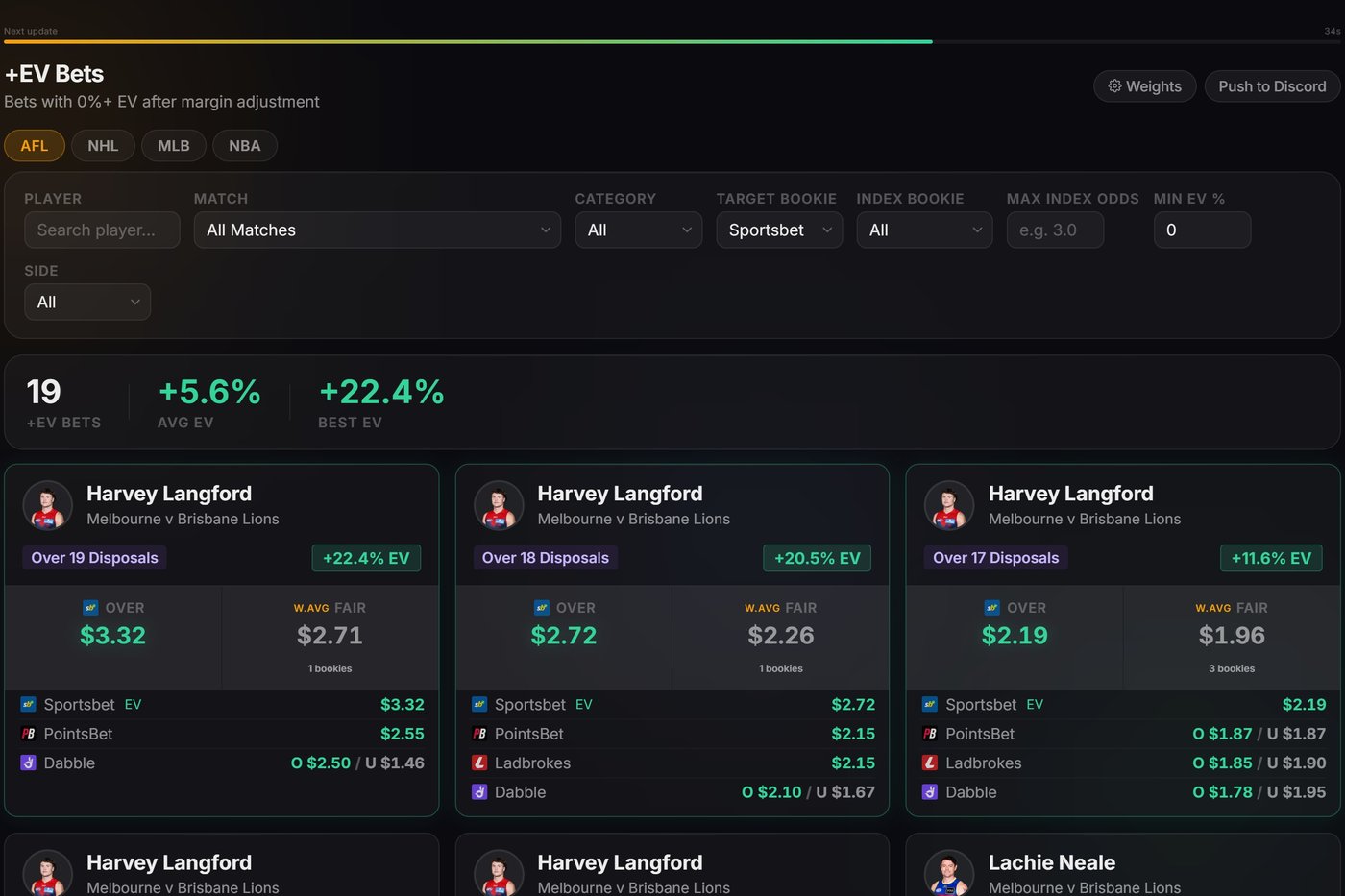
DegenToPro's +EV Finder calculates fair odds using multiple devig methods - including power devig - across 100+ Australian bookmakers in real time. It flags every +EV opportunity so you can act before the line moves. World Cup Offer: 20% off all plans right now.
Start Free →Where the Power Devig Method Accounts for the Bias
Not all devigging methods are equal when it comes to the favourite-longshot bias - and this is where the choice of devig method genuinely matters for Australian punters.
The Problem with Simple Multiplicative Devig
The most common devigging method - multiplicative (also called proportional) devig - removes the bookmaker's margin by scaling all implied probabilities proportionally. It is simple and widely used, but it has a known flaw: it distributes the overround evenly across all outcomes regardless of price. In reality, bookmakers do not apply their margin evenly. They apply a heavier margin to longshots (where the public over-bets, giving them more room to extract value) and a thinner margin to favourites (where more informed money concentrates). Multiplicative devig, applied to a market with significant longshots, can therefore overstate the true probability of short-priced runners slightly and understate the true probability of long-priced runners - the opposite of what the favourite-longshot bias tells us about the real world.
Power Devig: A Better Fit for Racing Markets
The power devig method (sometimes called the Shin method or the power-transform method) addresses this directly. Instead of scaling all probabilities proportionally, it applies a non-linear transformation that assigns a larger share of the margin to longer-priced outcomes and a smaller share to shorter-priced ones. This is mathematically consistent with how bookmakers actually construct margins - and it aligns with the direction of the favourite-longshot bias.
In practical terms, power devig produces fair-odds estimates for favourites that are slightly longer (more generous) than multiplicative devig, and fair-odds estimates for longshots that are slightly shorter (more sceptical) than multiplicative devig. This is exactly the correction the favourite-longshot bias tells us is needed.
| Devig Method | How Margin Is Distributed | Best Use Case | FLB Alignment |
|---|---|---|---|
| Multiplicative (proportional) | Evenly across all outcomes | Two-way sport markets with similar prices | Neutral - does not correct for FLB |
| Additive | Equal absolute amount removed from each | Rarely used; distorts extreme prices | Poor - worsens FLB distortion at extremes |
| Power (Shin transform) | Non-linear - more to longshots, less to favs | Racing; multi-runner markets; FLB contexts | Strong - explicitly corrects for FLB direction |
| Pinnacle-based (sharp market) | Devig from live sharp market prices | Sport markets with active Pinnacle pricing | Excellent - sharp market accounts for FLB |
For Australian horse racing in particular - where markets often have 10 to 20+ runners and the favourite-longshot bias is most pronounced - power devig is the most theoretically sound method available. It produces fair-odds estimates that account for the known direction of market distortion, giving you a more accurate read on whether a short-priced runner truly represents +EV.
DegenToPro includes power devig as one of its available devig methods alongside multiplicative and sharp-market-based calculations. You can see the fair-odds output from each method side by side - so you always know which method is most appropriate for the market you are evaluating.
How DegenToPro Flags the Bias Automatically
DegenToPro is Australian-built EV betting, arbitrage and racing software designed specifically for punters in this market. It is not a generic global odds comparison tool - it is purpose-built for the Australian landscape: 100+ local bookmakers, dedicated racing software, the full range of devig methods, and a bet tracker with verified CLV.
Here is how the platform's features connect directly to the favourite-longshot bias:
| DegenToPro Feature | How It Relates to the FLB |
|---|---|
| +EV Finder (multiple devig methods) | Calculates fair odds using power devig (and others) so short-price value is not obscured by margin distribution errors |
| Power Devig Option | Explicitly corrects for FLB by applying non-linear margin distribution - most accurate for racing and multi-runner markets |
| Pro Odds Screener | Scans 100+ books for prices above devigged fair odds - surfaces the favourite value that soft books regularly misprice |
| Dedicated Racing Software | Purpose-built for Australian thoroughbred and harness racing where the FLB is most pronounced; accounts for tote vs fixed-odds dynamics |
| Bet Tracker + Verified CLV | Tracks whether your short-price bets are beating the closing line - the ultimate proof that your FLB-aware strategy has genuine edge |
| Edge % Display | Shows the calculated edge for every opportunity so you can apply appropriate thresholds at different price points |
When DegenToPro's +EV Finder flags a short-priced selection as +EV using power devig, you have two layers of confidence working in your favour: the calculated edge from the fair-odds comparison, and the structural market tendency to under-bet selections at that price range. That is a materially stronger signal than a bare edge calculation alone.
For punters who have been burned by chasing longshots that "looked like value" on paper, this is the corrective lens the market demands. The favourite-longshot bias tells you to be sceptical of apparent value at long prices and to trust - and act on - value at short prices. DegenToPro builds that scepticism directly into its fair-odds calculations.
Frequently Asked Questions
Does the favourite-longshot bias mean I should always back favourites?
No. The bias tells you that longshots are, on average, over-priced and favourites are, on average, under-priced relative to their true win rates. But you still need to identify selections where the bookmaker's price exceeds the fair value. Blindly backing every favourite will still lose you money because of the bookmaker margin. The bias narrows your hunting ground and tells you where structural value is more likely to exist - it does not eliminate the need for fair-odds analysis.
Is the favourite-longshot bias stronger in racing or sport?
The bias is generally stronger and more consistently documented in horse racing, particularly in multi-runner pari-mutuel markets. This is likely because racing attracts a higher proportion of recreational, lottery-style bettors than sport markets do, and because the pari-mutuel structure amplifies crowd psychology. In sport markets, the bias exists but is typically smaller in magnitude and concentrated at the extreme ends of the price range.
Does the bias apply in Australian corporate bookmaker markets?
Yes, though the mechanism is slightly different from tote markets. Corporate bookmakers consciously shade their margins to extract more from longshots where the public over-bets. The result is the same directional pattern: fixed-odds longshots in Australian racing markets return significantly worse per dollar wagered than fixed-odds favourites, consistent with the FLB pattern documented in tote markets.
What is the power devig method and why does it matter for the bias?
Power devig applies a non-linear transformation to remove the bookmaker's margin, assigning more of the margin to longer-priced outcomes and less to shorter-priced ones. This reflects how bookmakers actually price markets and how the FLB actually distributes overround. Simple multiplicative devig treats all outcomes equally, which can produce slightly inaccurate fair-odds estimates at the extremes. For Australian racing with large fields, power devig is the more theoretically sound choice. DegenToPro offers both methods so you can compare and choose appropriately.
Can I use the favourite-longshot bias in my sport betting, not just racing?
Yes. In sport markets, the practical application is to be appropriately sceptical of apparent value at very long prices - particularly outsiders priced at $8 or above. When your EV calculation shows a heavy favourite as +EV, the bias provides additional structural support for that bet. Think of it as a confidence modifier: amplifies your conviction on short-price +EV bets, adds a discount to long-price apparent +EV bets.
How does DegenToPro help me apply this in practice?
DegenToPro's +EV Finder calculates fair odds across 100+ Australian bookmakers using multiple devig methods - including power devig - and flags every selection where the available price exceeds the fair odds. For racing, the dedicated racing software handles the specific dynamics of Australian thoroughbred and harness markets. The edge percentage displayed for every opportunity lets you apply your own price-range thresholds. Start free - no card required.
The Bottom Line
The favourite-longshot bias is one of the most robustly documented anomalies in betting market research. Longshots are systematically over-bet - punters pay too much for the excitement of a big return. Favourites are systematically under-bet - the boring near-certainty gets less money than it deserves. The result is a structural pattern where short-priced selections return closer to fair value and long-priced selections bleed punters dry at accelerating rates as odds lengthen.
For Australian punters, this knowledge has two practical applications. First, when your fair-odds analysis identifies a short-priced selection as +EV, back it with confidence - you are swimming with the current, not against it. Second, when your analysis identifies a $20+ longshot as marginally +EV, require a larger modelled edge before acting - the market's structural tendency runs against you at that price range.
The missing piece for most punters is an accurate fair-odds calculation in the first place. That is where DegenToPro changes the game. Its +EV Finder uses multiple devig methods - including power devig, which explicitly corrects for the favourite-longshot bias direction - to produce fair-odds estimates that reflect how markets actually price risk. The Pro Odds Screener then surfaces every opportunity where an Australian bookmaker's price exceeds that fair value, across 100+ books in real time.
Over 6,000 Australian punters are already using DegenToPro to find these edges every day. The live profit dashboard shows community results with no smoke and mirrors. The favourite-longshot bias has been hiding in plain sight for seventy-five years. Now you know how to use it.
Start Betting with the Bias Working For You
Join 6,000+ Australian punters who use DegenToPro to find +EV bets with power devig fair-odds calculations, track CLV and build long-term profit. Start on the FREE tier with no card required - or unlock the full Pro Odds Screener, racing software and bet tracker from $59.99/week AUD.
Start Free →