
Most recreational punters focus entirely on thoroughbred racing. Harness racing runs every week across tracks like Menangle, Melton, Cambridge and Globe Derby, yet the betting markets are thinner and the bookmakers price them with less precision. For a disciplined punter armed with the right tools, that is an opportunity, not a drawback.
Harness racing betting rewards preparation. Unlike thoroughbred racing, where a horse's raw ability often dominates, harness racing involves additional variables - the gait rule, barrier position in mobile starts, driver quality and pace tactics. Each of these creates pricing inefficiencies that canny punters can exploit. Pair that knowledge with a field-wide price comparison tool and you have a genuine edge over the market.
Let's start with the fundamentals.
How Harness Racing Differs from Thoroughbred Racing
Harness racing is a standardbred discipline where horses pull a two-wheeled cart (a sulky) with a driver on board. They race at specific gaits - either trotting or pacing - rather than galloping freely. This single distinction creates an entirely different racing dynamic that punters need to understand before placing a dollar.
The standardbred is a purpose-bred athlete, generally shorter and stockier than a thoroughbred, selected over generations for a controlled, rhythmic gait at speed. Australian harness racing is dominated by pacers, who move with a lateral gait (left front and left hind moving together, then right front and right hind). Trotting races also run in Australia, particularly in Victoria and South Australia, and trotters use a diagonal gait (left front with right hind, right front with left hind).
Key structural differences compared to thoroughbred racing:
- Driver on board: The driver's skill, positioning and race-day decision-making is a significant performance variable in harness racing in a way that a jockey's role differs from the human on foot in gallops.
- Gait enforcement: A horse that breaks gait must be pulled back and re-established before continuing - this can cost several lengths and is a form factor unique to the harness code.
- Mobile vs standing starts: Most harness races use a mobile start (horses follow a pace car from behind a moving gate). Some events use a standing start from barriers. The start type dramatically influences which runners are advantaged.
- Longer distances: Most harness races are run over 1,600m to 2,200m, with the distance factor playing differently to thoroughbred sprints and middle-distances.
- Track configuration: Australian harness tracks are typically ovals with tight corners. Positional advantage and the ability to lead or sit parked (wide, without cover) is critical to race outcomes.
These factors mean that harness racing form analysis involves a different checklist to gallops. Miss any of them and you are missing part of the puzzle the market may have already priced in - or left mispriced.
Gaits, Breaks and Why They Matter for Bettors
One of the most important concepts in harness racing betting is the gait break. When a horse switches from its correct gait to a gallop mid-race, the stewards can require it to be pulled back before rejoining the race. This penalty can cost a runner three to six lengths or more, turning a winning position into a no-chance proposition in seconds.
Gait breaks have several causes and each tells a different story from a form perspective:
- Equipment fit: Poorly fitted gear, particularly hopples (the straps that regulate a pacer's leg movement), can cause repeated breaking. A gear change noted in the form should always be investigated.
- Racing pattern: Horses put under extreme pressure early in a race, particularly if forced wide or rushed in a bunched field, are more prone to breaking. This is a pace-related risk to factor in from the draw.
- Fitness and fatigue: A horse racing past its fitness peak, or returning from an extended break, is more likely to break when pressure is applied late in the race.
- Inherent tendency: Some horses are simply more prone to breaking at certain stages of a race. Form lines often reveal a pattern - note any "b" notations in the run description.
For bettors, a recent gait break is not automatically a negative. If the break was clearly equipment-related and the gear has been adjusted, the horse may represent value at a price the market has marked down excessively. Conversely, a horse that has broken in consecutive runs at the same point of the race (usually when asked to accelerate in the straight) is showing a genuine flaw that the market may be underweighting.
Trotters, being less common in Australian fields, deserve extra scrutiny around gait. A trotter that breaks to a pace is disqualified from the race result in most jurisdictions. The break risk in trotting fields is structurally higher than in pacing races, which affects how you assess the form and price runners.
Barrier Draws and Mobile vs Standing Starts
The barrier draw in harness racing has a far greater impact on race outcomes than in thoroughbred racing. Understanding start types is essential before you assess any runner's win probability.
Mobile Starts
The majority of Australian harness races use a mobile start. The field lines up behind a motorised gate attached to a car, which accelerates down the straight until it reaches racing speed, then folds its wings and pulls away. The inside barrier positions (one, two, three) provide a significant advantage - the horse on the gate rail has less distance to travel on every corner throughout the race.
Runners drawn wide (barriers seven through twelve in large fields) face two unappealing options: go forward immediately and park wide for the entire race, burning energy without cover, or drop back and try to find cover, giving up ground at the start. Either option represents a clear disadvantage, and the market usually prices this in - but not always accurately.
Importantly, the advantage of a low draw diminishes in certain conditions:
- On rain-affected tracks, horses wide on the track often gain traction advantages on firmer ground away from the inside rail churn.
- In fields where the expected leader is drawn wide and must lead regardless, the pace structure can be disrupted, occasionally benefiting horses drawn back off a fast speed.
- In short-priced, high-class fields where the best horse is drawn wide, the market often over-corrects back toward its true probability once the driver is known to be aggressive in finding the front early.
Standing Starts
Standing start races require drivers to control their horse from a stationary position as the gates open. The advantage shifts subtly from inside barriers to horses with clean beginnings and strong early pace. A horse that jumps cleanly from a standing start has less barrier disadvantage than in a mobile start, but those that jump slowly are stuck - there is no rolling run-up to compensate.
Standing start events typically attract slightly larger fields and the barrier factor is less deterministic. This can create value situations where a well-performed horse drawn wide is underestimated by the market because punters automatically apply mobile-start barrier logic.
The Role of Driver and Trainer in Harness Racing
Driver and trainer statistics are arguably more important in harness racing than jockey and trainer statistics are in thoroughbred racing. The driver makes real-time tactical decisions throughout the race - when to push forward, when to sit, when to send - that directly influence the outcome in a way the horse cannot independently control.
Key driver factors to assess in your form analysis:
- Win strike rate from the driver's book: Top harness drivers in Australia (the professionals at Menangle, Melton, Gloucester Park) maintain strike rates of 18-25% in their peak years. A leading driver picking up a ride on an unfancied horse is a positive form signal worth noting.
- Driver change: When a top driver replaces a lesser one, or when the stable's preferred driver takes the reins after several weeks of substitutes, pay attention. Form guides note driver changes and they are frequently associated with improved performances.
- Driver and horse combination record: Some horses perform measurably better with specific drivers. If a horse's two wins from twelve starts both came with the same driver now back in the saddle, that is a positive form factor.
- Trainer win rate with distance and class: Harness trainers who specialise in staying races, sprint heats or claiming grades tend to have strong win percentages in those specific conditions. A trainer with a high win rate preparing horses for their first start after a long break (first-up records) is a valuable handicapping angle.
Unlike thoroughbred racing, the driver's race-day instructions are often observable through race replays. A driver who repeatedly wins from the lead with a particular horse is telling you the horse's optimal pattern even if the form guide does not make it explicit.
Reading Harness Racing Form Lines
Harness form guides carry more information than thoroughbred form guides once you know how to read them. The key data points for each start include:
- Barrier position and start type: Always noted, critical for context as described above.
- Sectional times: Harness racing records detailed split times - the time for each quarter of the race. A horse that finishes strongly off a fast tempo (shown in the splits) is better than one that wins easily off a slow tempo.
- Position in run: The notation shows where the horse sat at each call. A horse that was three-wide parked throughout and still ran a fast mile rate is showing genuine ability against the conditions.
- Mile rate: The time per mile normalised for distance, the standard harness speed comparison. A 1:57 mile rate is fast; a 2:05 rate on a dry track at a quality meeting is weak.
- Gear changes: Noted in most Australian form guides. Hopple changes, head checks, shadow rolls and equipment additions all warrant investigation before taking a price.
- Class of race: Graded conditions (open handicap, Preferred, etc.) vary significantly across tracks and jurisdictions. A horse winning at Albion Park in a C4 handicap is at a different class level to a C4 winner at Gloucester Park on a West Australian night of racing.
Once you can read a harness form line confidently, the next step is comparing the market price against what the form actually suggests the horse's true probability should be. That gap - between market price and true probability - is where value lives, and where DegenToPro does its best work for Australian harness punters.
Harness Racing Markets and Bet Types
Harness racing offers a range of betting markets, from simple win bets to complex exotics. Understanding which markets suit which race types is an important part of a disciplined betting approach.
| Market / Bet Type | How It Works | Best Used When | Value Tip |
|---|---|---|---|
| Win | Back a horse to finish first | You have a strong opinion on the winner and want full price | Compare best-tote vs fixed across all bookmakers before committing |
| Place | Horse must finish first, second or third (first or second in small fields) | Shorter fields (8 or fewer), races with multiple contenders | Place dividends on tote can outperform fixed-odds place in soft fields |
| Each-Way | Win + Place combined; half stake on each component | Backing a longer-priced runner (6.00+) with a place chance | Check fixed-odds each-way terms vs tote before placing |
| Quinella | Pick the first two in any order | Races with two clear standouts | Tote quinellas can pay well in fields where the public over-boxes |
| Exacta | Pick the first two in the correct order | When you have a strong view on both first and second | Box multiple combinations in open fields; single exactas for short fields |
| Trifecta | Pick first three in correct order | Races with a clear top three and meaningful field depth | Use a banker on top (horse you are very confident about first) to reduce combination cost |
| First4 | Pick first four in correct order | Large fields (10+) where the top four is somewhat predictable | High variance - size investment accordingly; can produce large dividends |
| Multi-race (Pick 3/4/6) | Pick winners across multiple consecutive races | When you have strong form reads across a sequence of races on the program | TAB jackpot pools sometimes offer outsized value when rollovers accumulate |
For most harness punters focused on building a long-term edge, the win market is the primary focus. Exotic markets are useful supplementary plays but their larger variance makes them poor vehicles for systematic value betting unless you are extremely selective. The disciplined approach is to identify win value first and use exotics sparingly around your strongest race opinions.
Finding Value: Best-Tote, Fixed Odds and Betfair
Value in harness racing betting does not come from picking winners. It comes from finding situations where the price available is better than the true probability of the outcome. Even a basic understanding of the three main pricing mechanisms available to Australian punters can meaningfully improve your bottom line.
Best-Tote
Best-tote is a pricing option offered by many Australian corporate bookmakers that guarantees you the highest win dividend across the TAB pools in each state (usually NSWTAB, Tabcorp VIC/SA and UBET QLD). For harness racing, where tote pools are thinner and more likely to be moved by a single significant bet, best-tote is frequently the superior option compared to a fixed-odds pre-race price.
The key insight: when a short-priced favourite is over-bet into the tote pool, the outsiders in the same race are automatically pushed out. Best-tote lets you collect that inflated price on a horse that finished ahead of expectation without having to predict which way the pool moved. For value-focused harness punters, best-tote is often the correct default choice on any horse priced above 3.00 in the pre-race fixed market.
Fixed Odds
Fixed-odds harness racing prices are set by bookmakers before the race and are locked in when you bet. The advantage is certainty - the price you see is the price you get, regardless of what happens in the tote pool. Fixed odds become preferable when:
- You believe the tote favourite will attract heavy late money, compressing the pool and reducing outsider dividends.
- The fixed-odds price available is already superior to the expected tote return based on current pool proportions.
- You are betting on a race with very thin tote pools where individual bets from other punters can drastically move the dividend.
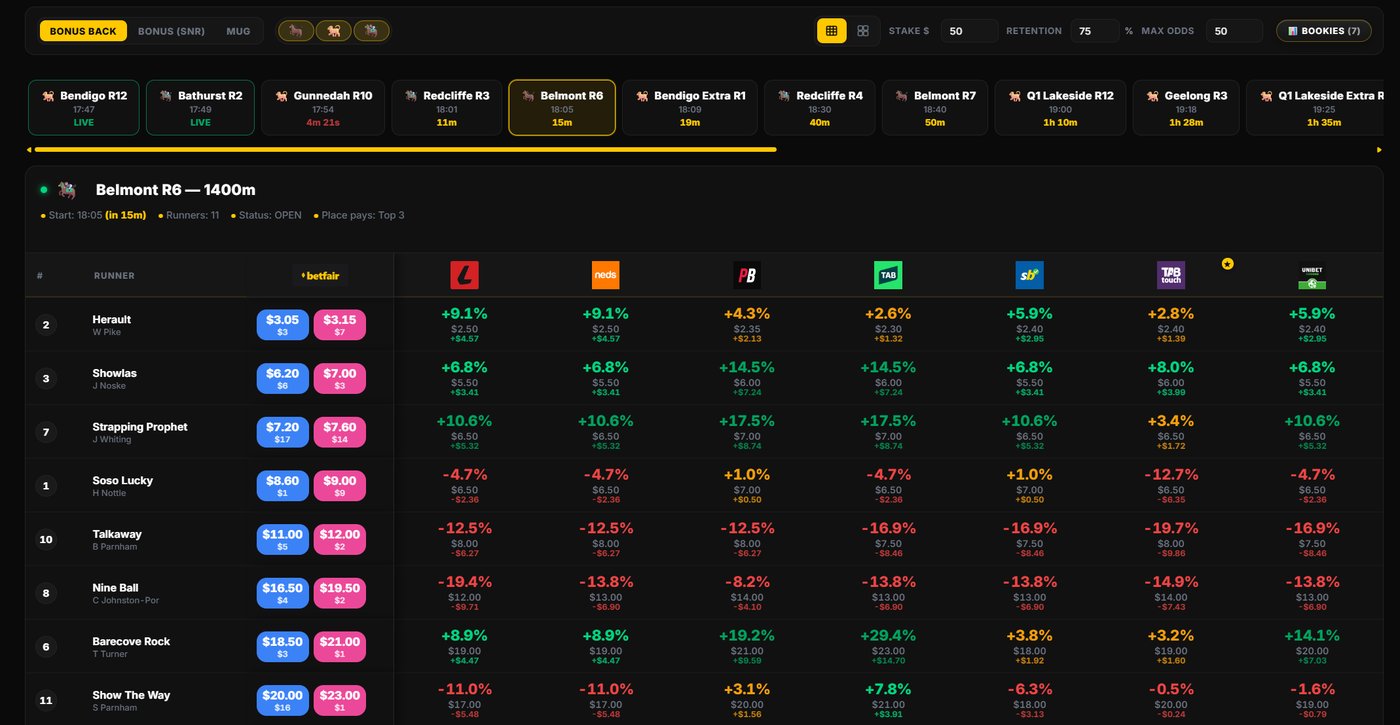
Comparing best-tote against fixed across multiple bookmakers simultaneously is where significant value is left on the table by most Australian harness punters. Most only check one or two sources. DegenToPro's dedicated racing software runs that field-wide comparison automatically, live to the jump, across every Australian harness race - so you always know which pricing mechanism and which bookmaker is offering the best number before your bet goes on.
Betfair Exchange
Betfair operates as a peer-to-peer betting exchange, meaning you are betting against other punters rather than the bookmaker. In Australian harness racing, Betfair is valuable for two reasons. First, you can back horses at marginally better prices than the corporate books when the exchange market is liquid. Second, Betfair's in-play market allows live betting on races as they unfold - particularly useful in harness racing where mid-race incidents (a driver making a bold move, a horse parked early and fading) create live pricing anomalies.
The limitation of Betfair in harness racing is liquidity. Major races at Menangle and Melton attract reasonable Betfair pools, but country mid-week meetings may have insufficient liquidity to get meaningful bets matched at your desired price. Use Betfair as a value check and top-up tool rather than your primary market for harness racing.
Field-Wide Price Comparison in Practice
Consider this example from a typical eight-horse harness field at Melton:
| Horse | Sportsbet Fixed | TAB Fixed | Neds Fixed | Best-Tote Est. | Best Available |
|---|---|---|---|---|---|
| No. 1 (Fav) | 2.10 | 2.05 | 2.15 | 2.00 | 2.15 (Neds Fixed) |
| No. 3 | 3.80 | 4.20 | 3.90 | 4.40 | 4.40 (Best-Tote) |
| No. 5 | 5.50 | 5.00 | 5.50 | 6.20 | 6.20 (Best-Tote) |
| No. 7 | 8.00 | 9.00 | 8.50 | 7.80 | 9.00 (TAB Fixed) |
Without a field-wide comparison, a punter backing No. 3 at Sportsbet receives 3.80 when 4.40 was available via best-tote. That is a 15.8% better price for the same bet - a difference that compounds significantly over a betting season. DegenToPro shows this comparison automatically for every harness runner, so you never leave that gap on the table.
Stop Leaving Value on the Table in Harness Racing
DegenToPro's dedicated racing software compares best-tote vs fixed odds across all major Australian bookmakers for every harness race, live to the jump. See the best available price for every runner in the field before you bet. World Cup Offer: 20% off all plans right now.
Start Free →Staking and Bankroll Management
Even the sharpest form reader in harness racing will go on losing runs. Variance is an inherent part of racing betting, and managing it properly is what separates professional punters from those who blow their bankroll in the first three months.
The principles that apply to all value betting apply equally to harness racing:
- Unit size discipline: Never stake more than 2-3% of your total bankroll on any single race, regardless of how strong your opinion is. Harness racing is genuinely unpredictable due to gait breaks and race-day variables.
- Flat staking vs Kelly: Flat staking (the same unit on every bet) is the safest approach for most punters. Kelly Criterion staking adjusts unit size based on your perceived edge, but requires an accurate edge estimate to work correctly. For harness racing where edge estimates are less precise than sport markets, flat staking is often more reliable.
- Separate racing and sport bankrolls: If you bet on both racing and sport, keep separate bankrolls with separate tracking. The variance profiles are different and merging them makes it impossible to evaluate either strategy fairly.
- Exotics sizing: Exotic bets should be sized at a fraction of your win unit. A trifecta investment that costs you five win units to box all combinations is too large. Exotics should supplement your approach, not dominate it.
- Review cycles: Assess your harness betting results monthly. Are you consistently finding positive CLV on your win bets? Are your prices better than average final tote dividends? These are the metrics that matter, not just raw profit over a small sample.
Record keeping is non-negotiable. Without a detailed log of every bet - price taken, best available price at the time, final dividend, result - you cannot tell whether you are genuinely finding value or just running hot. DegenToPro's built-in bet tracker handles this automatically, logging your verified CLV alongside every race result.
How DegenToPro Covers Harness Racing
DegenToPro is Australian-built betting software designed for punters who take their edge seriously. The platform's dedicated racing software covers harness racing alongside thoroughbreds and greyhounds, giving you a complete set of tools for every code in a single interface.
| Feature | How It Helps Harness Punters |
|---|---|
| Field-Wide Price Comparison | Compares best-tote vs fixed odds across all major Australian bookmakers for every runner, live to the jump - so you always bet the best number available |
| Live to the Jump Updates | Prices refresh right up until race start, capturing late market moves and final tote pool estimates before you commit |
| Harness, Thoroughbred and Greyhound Coverage | All three codes covered in the one platform - no need for separate tools or tabs |
| Best-Tote vs Fixed Indicator | Instantly shows whether best-tote or fixed is the superior option for each runner based on current pool and bookmaker prices |
| Bet Tracker + Verified CLV | Logs every bet with the price taken and best available price at placement - your long-term edge measurement is automatic |
| Daily Race Alerts | Get notified when pricing anomalies appear in harness markets that meet your value criteria |
| +EV Finder for Racing | Identifies harness runners where the market price implies a lower win probability than the sharp reference price suggests |
| 100+ Bookmaker Database | Covers all major Australian corporate bookmakers so you have options when accounts get limited |
| 6,000+ Discord Community | Active harness racing discussion, shared form analysis and daily tips from the DegenToPro team and community members |
The core insight behind DegenToPro's racing software is straightforward: most harness punters lose value on every single bet simply by failing to check all available prices before they bet. The difference between the worst and best available price on a harness runner is frequently 10-20%. Over a season of betting, that gap is the difference between breaking even and building a genuine profit.
DegenToPro closes that gap automatically. You assess the form, identify your selection, then check the platform for the best price across the entire field before your money goes on. It takes seconds and it costs nothing on the FREE tier - no card required to get started. For punters who want the full racing software suite, field-wide comparison and live alerts, plans start from $59.99 per week AUD with the current World Cup Offer of 20% off.
Frequently Asked Questions
Is harness racing betting legal in Australia?
Yes. Betting on harness racing through Australian-licensed bookmakers and TAB operators is entirely legal for adults 18 and over. All major corporate bookmakers (Sportsbet, TAB, Neds, BlueBet, Unibet, Ladbrokes) offer harness racing markets.
What is the difference between a trotter and a pacer in harness racing?
A pacer uses a lateral gait where the legs on the same side move together (left front and left hind simultaneously). A trotter uses a diagonal gait (left front with right hind). Australian harness racing is predominantly pacing. Trotting events are more common in Victoria and South Australia and typically attract smaller fields.
How important is the barrier draw in harness racing?
Very important in mobile start races. Barrier one to three provides a clear advantage in most field sizes on Australian oval tracks. Wide draws (seven or higher) impose a significant energy cost unless the horse has the natural gate speed to lead immediately or the driver plans to drop back and settle. Always assess the draw in the context of the expected pace structure of the race.
What does best-tote mean for harness racing?
Best-tote is an option offered by most Australian corporate bookmakers that pays you the highest win dividend across the state TAB pools (NSWTAB, Tabcorp, UBET). Because harness tote pools are thinner than thoroughbred pools, late market moves can significantly affect dividends. Best-tote protects you from those moves and often returns better value than fixed odds for runners priced above 3.00.
Can I bet on harness racing in-play?
In-play betting on harness racing is available through Betfair Exchange for most metropolitan meetings. Corporate bookmakers generally do not offer in-play betting on racing in Australia due to regulatory restrictions. Betfair's in-play market on harness racing can offer value when mid-race incidents move the exchange price, but liquidity is limited outside major race nights.
How do I find value in harness racing betting?
Value comes from situations where the available price is better than the true probability of the outcome. In harness racing, the most reliable approaches are: comparing best-tote against fixed odds across all bookmakers; identifying horses where the market has over-penalised a recent gait break that was equipment-related; finding wide draws that the market has punished too heavily relative to the expected pace scenario; and backing driver changes where a leading reinsperson takes the reins for the first time on a capable horse.
Does DegenToPro cover harness racing?
Yes. DegenToPro's dedicated racing software covers harness racing alongside thoroughbreds and greyhounds. It provides field-wide best-tote vs fixed price comparison, live to the jump updates and a bet tracker with verified CLV for all three codes. Start on the FREE tier with no card required.
What Australian harness racing tracks should I focus on?
Menangle (NSW) and Melton (VIC) are the two major metropolitan harness tracks and attract the best fields, deepest tote pools and most bookmaker attention. Gloucester Park (WA), Globe Derby (SA), Albion Park (QLD) and Cambridge (NZ, which Australian bookmakers also cover) are the other principal venues. For value betting, mid-week provincial meetings often offer less efficient pricing than the metropolitan feature nights.
The Bottom Line
Harness racing betting rewards punters who understand the code. The gait rule, barrier draw dynamics, mobile vs standing starts, driver quality and pace structure all create pricing inefficiencies that the market does not always resolve correctly. For disciplined punters who do their homework, those inefficiencies represent genuine, repeatable edge.
The single biggest improvement most harness punters can make has nothing to do with form reading. It is simply ensuring they always bet the best available price for their selection. The difference between best-tote and the worst fixed-odds price on a single harness runner can be 15-20%. Multiply that across every bet you place in a season and the value you are currently leaving on the table is significant.
DegenToPro's dedicated racing software solves that problem automatically. Field-wide price comparison, live to the jump, across all major Australian bookmakers - for harness racing, thoroughbreds and greyhounds in a single platform. Pair that with the bet tracker that logs your verified CLV on every bet, and you have the infrastructure to know whether you are genuinely finding value or just riding luck.
More than 6,000 Australian punters already use DegenToPro to sharpen their edge across racing and sport. The FREE tier gives you access with no card required. If you are serious about harness racing betting in 2026, this is where you start.
Ready to Find Real Value in Harness Racing?
Join 6,000+ Australian punters using DegenToPro's racing software to compare best-tote vs fixed odds across every harness runner, live to the jump. Start FREE with no card required - or unlock the full suite from $59.99/week AUD with 20% off right now.
Start Free →