
In this guide
Before you automate anything
One principle governs everything below: automate a process you already understand. A bot is an amplifier. Pointed at a validated edge it captures far more of it than you can by hand; pointed at something you have not verified, it removes your ability to notice that you were wrong.
Order of operations: understand the strategy → validate it manually → automate it small → scale it. Every step people skip is a step they end up doing later, in the dark, with money on the table.
1. Validate the edge by hand
Place a meaningful sample manually first — enough that you can look at the record and say something specific about it. What you are checking is not whether you made money. Over a small sample that is noise. What you are checking is whether you consistently took prices that were better than where the market closed.
If your manual bets show positive closing-line value, you have something worth automating. If they do not, automation will faithfully scale a strategy that does not work.
Use this phase to learn the failure modes too: which markets go stale fastest, which books move first, where the prices you want actually live.
2. Decide your thresholds
Three numbers, set before you arm anything:
Minimum EV. The edge a bet must clear to fire. Start high. This is your conservatism dial — a high threshold means fewer, stronger bets while you are still building trust in the setup.
Stake cap per account. The maximum any single bet can be on any one book. Set it low enough that a bug is an annoyance rather than a disaster.
Bankroll allocation. How much is actually in play, and how it is spread across books. Decide this when you are calm, not after a losing week.
3. Connect one account
One. Not all of them. With a single book connected, every observation you make has one obvious cause. With six, you are debugging a system.
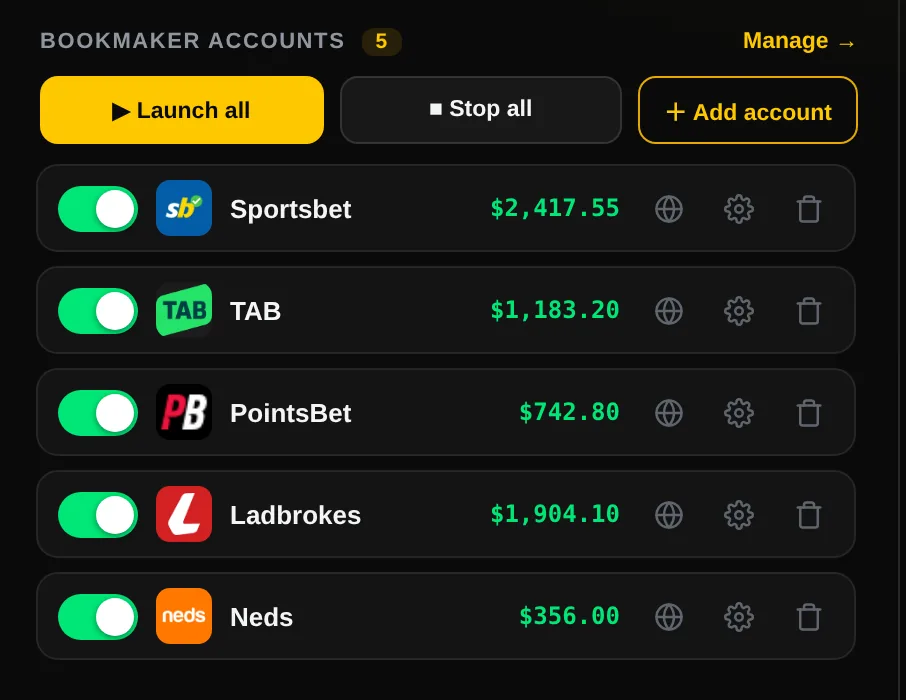
Add the account, let the app establish a session, and confirm the live balance on the row matches what you see when you log in yourself.
4. Dry-run and read the logs
This is the step people skip and the one that pays for itself.
Run the account unarmed and watch the activity feed. You are looking for: opportunities arriving at a sensible rate, prices that match what you see in the book, instructions being dropped when they go stale, and nothing firing that you would not have placed yourself.
If the logs show it wanting to place bets you would not take, do not go live and adjust the threshold instead. The dry run is the cheapest information you will ever get.
5. Arm it conservatively
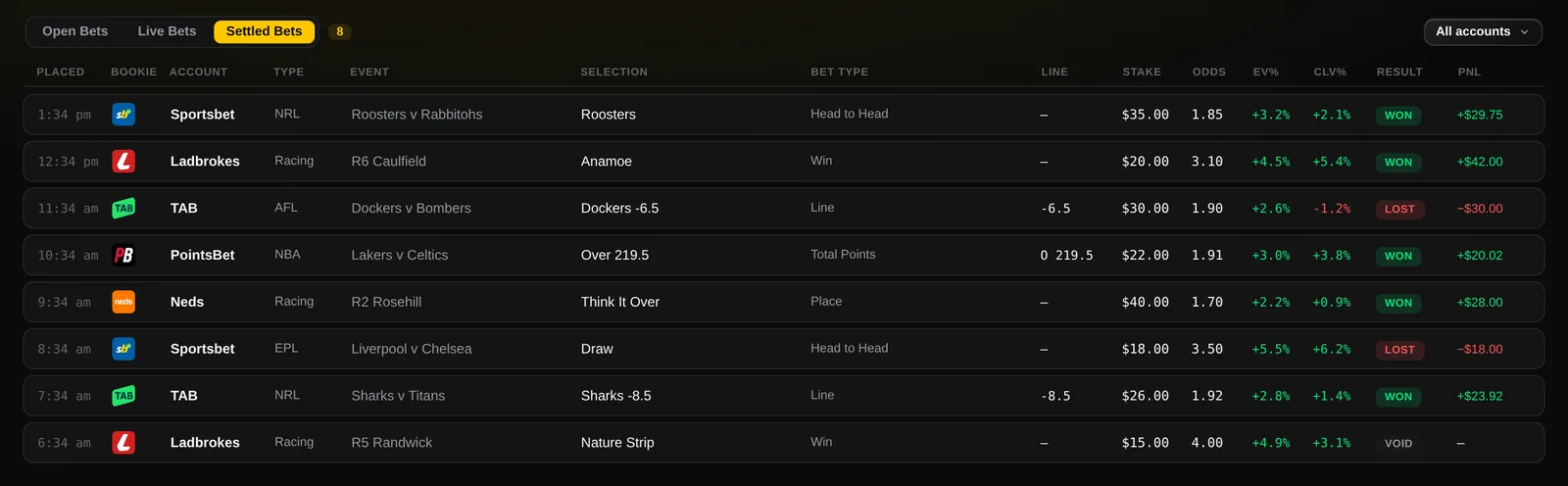
Go live on one account, with a low stake cap and a high minimum EV. The point of the first live period is not profit — at these settings there will barely be any. It is confirming that placement works end to end: bets land, they appear in the bets table with the right numbers, they settle correctly, and P&L reconciles with the bookmaker.
6. Judge on CLV
Now the discipline. After a few hundred settled bets you will have an opinion, and it will be driven by profit and loss, and it will probably be wrong — in either direction.
Closing-line value is the honest signal. If you are consistently taking prices better than where the market closes, you are ahead of the market and the money follows given enough bets. If your CLV is flat or negative while your P&L is positive, you have been lucky, and the correct response is to fix the strategy rather than celebrate.
This is why per-bet CLV reporting is not a nice-to-have. Without it you are flying on a lagging, extremely noisy indicator.
7. Scale deliberately
Once one account is stable and CLV is positive, scale on one axis at a time:
- Add a second book. Let it stabilise. Then a third.
- Once several books are running cleanly, raise stake caps gradually.
- Only after that, consider lowering the minimum EV to increase volume.
Changing two things at once means you learn nothing from the result. This is slower than you want it to be and it is the reason some people compound steadily while others blow up and cannot explain why.
Ongoing tuning
A value strategy is not set-and-forget forever, even when the execution is automatic. Markets adapt, books reprice, and accounts get restricted.
Check monthly: is CLV holding? Are particular books contributing negative CLV — a sign they have moved against you or an adapter needs attention? Are stake caps still sensible relative to bankroll? Has any account been quietly limited?
The tooling handles execution. The judgement about whether the strategy still works remains yours, and that is the part worth keeping your hands on.
Frequently asked questions
What is value betting?
Placing bets where the bookmaker price is longer than the true probability of the outcome. Over enough bets, a consistent positive edge produces profit regardless of individual results.
How many bets before I know if it works?
More than most people think. A few hundred settled bets is a reasonable starting point for judging closing-line value; profit and loss needs considerably more to be meaningful.
What minimum EV should I set?
Start high - it is a conservatism dial, not a profit dial. A higher threshold means fewer, stronger bets while you are building confidence, and you can lower it once the logs and CLV look right.
Automate a validated edge
BetPilot ships with pre-built +EV and racing strategies, or plug in your own signal. Applications reviewed by a human.
Apply for BetPilot →