
Ask most Australians what "vig betting" means and you will get a blank stare. Yet every single bet placed through any bookmaker - Sportsbet, TAB, Ladbrokes, Neds - carries a vig. It goes by different names: juice, overround, margin, or edge. The concept is always the same. The bookmaker prices each outcome so that if you were to bet every outcome simultaneously, you would spend more than $1.00 to win $1.00. That difference is the bookmaker's guaranteed long-run profit, and it comes straight out of your returns.
The good news: once you understand what the vig is and how it works, you can take concrete steps to reduce its impact - by choosing lower-margin books, line shopping, and focusing exclusively on bets where the fair-odds price suggests genuine edge. Let us walk through it all.
What is the vig (juice)?
The vig is the bookmaker's built-in commission. It is not charged as a separate fee like a brokerage or exchange commission. Instead it is embedded directly into the odds, pushing each outcome's implied probability slightly higher than reality so that all outcomes together add up to more than 100%.
Think of a fair coin toss. The true probability of heads is 50% and tails is 50%. A perfectly fair market would pay 2.00 on each side (1 divided by 0.50). A bookmaker running a 5% vig might instead offer 1.90 on both sides. Now 1 divided by 1.90 equals 52.63%, and both sides together sum to 105.26%. That extra 5.26% represents the vig - the guaranteed house edge built into the market regardless of which side wins.
The term "vigorish" traces back to early 20th-century American bookmaking slang, borrowed from the Yiddish word vyigrysh meaning "winnings." Today it is used interchangeably with juice, overround, and margin across sports betting worldwide. In Australian racing contexts you will most often hear "overround" or "margin," but they all describe exactly the same thing.
How the vig shows up in odds
The easiest way to spot the vig is to convert all the odds in a market to implied probabilities and add them up. Any total above 100% reveals the presence of a vig, and the size of that excess tells you how large the margin is.
Here is a real-world style example using a two-way NRL match:
| Outcome | Bookmaker Odds | Implied Probability (1 / odds) |
|---|---|---|
| Team A to win | 1.80 | 1 / 1.80 = 55.56% |
| Team B to win | 2.05 | 1 / 2.05 = 48.78% |
| Total | 104.34% |
The implied probabilities sum to 104.34%, not 100%. That 4.34 percentage points above 100% is the vig. In a perfectly fair market the total would be exactly 100%. Every dollar above that represents money flowing from bettors to the bookmaker over time.
Notice that no single outcome looks obviously mispriced. The vig is spread across both sides, so a casual glance at either price alone reveals nothing. This is why most punters never consciously register it - they just notice, over thousands of bets, that their results are worse than expected.
Calculating the vig from decimal odds
The formula for the vig percentage in a two-outcome decimal odds market is straightforward:
Vig % = (overround - 1) x 100
Where overround = sum of all implied probabilities = sum of (1 / each decimal odd).
For a three-outcome market (for example, a football match with a draw option):
| Outcome | Odds | Implied Probability |
|---|---|---|
| Home win | 2.10 | 47.62% |
| Draw | 3.40 | 29.41% |
| Away win | 3.60 | 27.78% |
| Total | 104.81% |
Overround = 1.0481. Vig = (1.0481 - 1) x 100 = 4.81%. For every $100 wagered across all three outcomes, the bookmaker expects to keep $4.81 in the long run regardless of the result. That is a significant structural tax on your bankroll.
To express the vig per dollar wagered on a single outcome rather than across the whole book, some analysts use the "effective vig" formula: effective vig = (overround - 1) / overround. In the three-way example that gives 0.0481 / 1.0481 = approximately 4.59% per dollar wagered.
Removing the vig to get fair odds
Once you know the overround, you can strip it out to reveal the fair - or no-vig - odds. The most widely used method is multiplicative devigging: divide each implied probability by the overround, then convert back to decimal odds.
Fair probability = implied probability / overround
Fair decimal odds = 1 / fair probability
Using the two-way NRL market from above (overround 1.0434):
| Outcome | Bookie Odds | Implied Prob | Fair Prob (no-vig) | Fair Decimal Odds |
|---|---|---|---|---|
| Team A | 1.80 | 55.56% | 55.56% / 1.0434 = 53.25% | 1 / 0.5325 = 1.878 |
| Team B | 2.05 | 48.78% | 48.78% / 1.0434 = 46.75% | 1 / 0.4675 = 2.139 |
| Total | 104.34% | 100.00% |
The fair prices - 1.878 on Team A and 2.139 on Team B - represent what you would expect to see if a perfectly fair market existed with no bookmaker margin. Any Australian bookmaker offering better than 1.878 on Team A or better than 2.139 on Team B in this market would be offering a +EV (positive expected value) bet by definition.
This is the core insight behind all serious sports betting: the vig is not random noise, it is a mathematically precise tax. Strip it out and you have a benchmark against which every price in the market can be evaluated objectively. For a deeper look at the different devigging methods (multiplicative, additive, power, Shin), see our guide on how to calculate fair odds.
Why low-vig books are sharper
Not all bookmakers charge the same vig. The margin a book runs is closely tied to its business model and the sophistication of its customer base.
| Book type | Typical vig (two-way market) | Why? |
|---|---|---|
| Pinnacle (sharp) | 2 - 3% | Accepts sharp bettors; volume-based model; no need for large margin to offset sharp action |
| Betfair (exchange) | 0 - 5% commission on winnings | P2P exchange; no book risk; charges a flat commission per winning bet |
| Major AU retail books | 5 - 8% | Soft-money model; large margin to offset promotional cost and restricted accounts |
| Corporate racing books | 12 - 20%+ (especially exotics) | Multi-runner markets with heavy favourite-longshot bias; wide margin on each runner |
A low-vig book is sharper because it can only survive on thin margins if its odds are accurate. If its prices were consistently wrong, sharp bettors would hammer the mispriced side until the book either corrected or went broke. Books like Pinnacle therefore function as a global truth machine: their odds, after devigging, are widely regarded as the best publicly available estimate of true outcome probabilities.
This is why serious Australian +EV bettors treat Pinnacle and Betfair as reference books rather than primary wagering venues. You use their fair prices as the benchmark, then compare every Australian bookmaker's odds against that benchmark to find genuine value. Anything above the Pinnacle fair price on a given outcome is, by definition, a positive-expectation opportunity.
Understanding bookmaker margin and overround in more depth will help you internalise exactly why this matters across different market types.
How vig destroys long-term ROI
The impact of vig on long-term returns is easy to underestimate because it looks small in any single bet. Compound it across thousands of bets and the damage is severe.
Consider three hypothetical bettors, each placing 1,000 bets at $100 per bet ($100,000 total wagered), all on true 50/50 coin-flip outcomes. The only difference is the vig charged by their chosen book:
| Scenario | Odds offered | Vig | Expected return per $100 | Expected P/L over 1,000 bets |
|---|---|---|---|---|
| Fair market | 2.00 | 0% | $100.00 | $0 (breakeven) |
| Low-vig sharp book | 1.95 | 2.56% | $97.50 | -$2,500 |
| Typical AU retail book | 1.87 | 6.95% | $93.50 | -$6,500 |
The difference between betting at 1.87 versus 1.95 looks small per bet - just $0.08 per dollar wagered. Over 1,000 bets at $100 each that gap costs you an extra $4,000. Over a lifetime of betting the compounding effect is staggering. This is why recreational punters who back roughly the right teams at the wrong prices still tend to lose steadily over time - the vig is quietly collecting its toll on every single bet.
The only escape routes are: (a) eliminate the vig entirely by using an exchange; (b) reduce it as much as possible via low-vig books and line shopping; or (c) find bets where the bookmaker's price is above the true fair price, meaning you are paid more than the event is worth. That third option is what +EV betting is all about. Understanding implied probability is the foundation of making that comparison reliably.
Let DegenToPro find the no-vig fair price for you
DegenToPro strips the vig from every market across 100+ Australian bookmakers and shows you the true fair odds in real time. When any book's price beats that fair price, you see a +EV alert - automatically. Start free today, no card required.
Start Free →Beating the vig: line shopping and +EV
The vig is not unbeatable. There are two practical strategies that serious Australian bettors use to fight back against it every day.
Strategy 1 - Line shopping
Line shopping means checking multiple bookmakers before placing a bet and always taking the best available price. Because different books carry different vigs and set their own lines independently, there is almost always variation in the odds offered on the same outcome across the market.
Here is what that looks like in practice for a single AFL match outcome:
| Bookmaker | Odds on Team A | Return on $100 bet |
|---|---|---|
| Book A (soft) | 1.75 | $175 |
| Book B (mid-tier) | 1.82 | $182 |
| Book C (sharp reference) | 1.88 | $188 |
| Book D (soft with promo) | 1.91 | $191 |
A bettor who always uses Book A collects $175 when they win. A bettor who line shops and takes Book D's best price collects $191 - an extra $16 for zero additional risk, on the exact same bet. Over hundreds of bets that difference compounds into a significant advantage. Line shopping does not eliminate the vig, but it consistently ensures you face the smallest vig available at the time of betting.
Strategy 2 - +EV betting (positive expected value)
Line shopping is essentially defensive. Positive expected value betting is offensive. The goal is to identify markets where a specific bookmaker's price is not just the best available - it is actually above the fair no-vig price entirely, meaning the bet has a positive mathematical expectation.
To determine whether a bet is +EV you need three things:
- A reliable fair-odds benchmark (typically derived from a sharp book like Pinnacle or Betfair)
- The bookmaker's offered price on the same outcome
- A comparison: if the bookmaker price is higher than the fair price, the bet is +EV
Example: the Pinnacle no-vig fair price on a tennis player winning is 2.15. An Australian retail bookmaker is offering 2.25 on the same player. The edge is (2.25 / 2.15) - 1 = 4.65%. Every $100 wagered on this bet has an expected profit of $4.65, regardless of whether this particular match goes your way. Over a large sample of +EV bets, your results must trend towards that positive expected return.
The challenge is identifying these opportunities at scale and speed before the market corrects. Most soft Australian bookmakers adjust their lines towards sharp consensus within minutes - often seconds - of a discrepancy appearing. Manual line shopping simply cannot keep pace.
How DegenToPro removes the vig for you
DegenToPro is an Australian-built EV, arbitrage, and racing software platform designed specifically to automate the vig-removal and +EV identification process across the Australian market.
Here is exactly what it does:
- No-vig fair odds calculated in real time: DegenToPro ingests live prices from 100+ Australian and international bookmakers and applies a multiplicative devigging model against sharp reference books (Pinnacle, Betfair) to produce continuously updated fair-odds benchmarks for every monitored market.
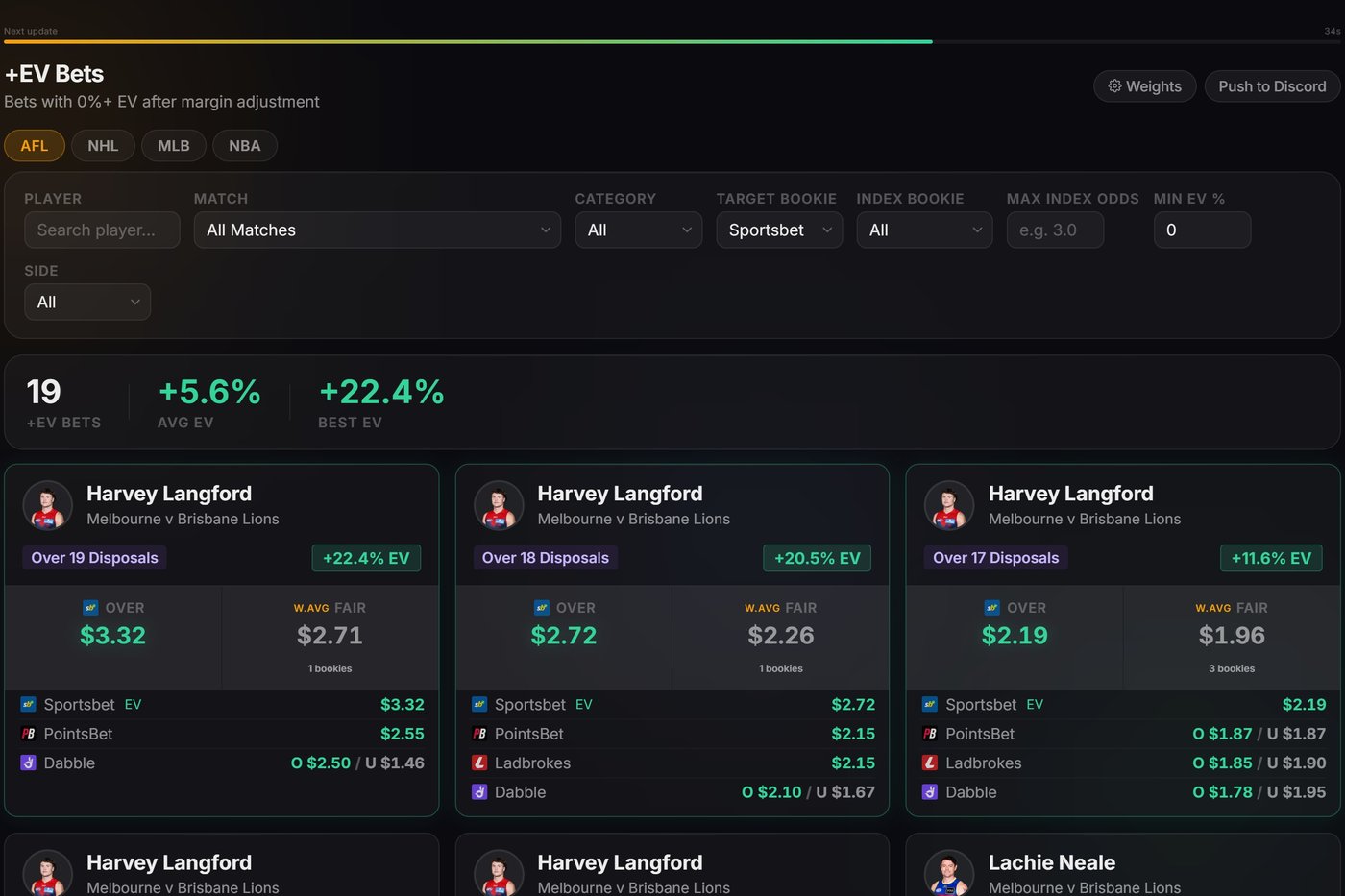
- +EV flags displayed automatically: Every line in the platform shows a market EV percentage. A positive figure means the bookmaker's current price exceeds the fair-odds benchmark - a live +EV opportunity. You never need to calculate it manually.
- Pro Odds Screener: The Pro Odds Screener surfaces the highest-EV opportunities across all sports simultaneously, ranked by edge size. Instead of checking books one at a time, you see every significant mispricing on a single screen.
- Arbitrage detection: Because fair odds are already stripped of vig, cross-book arbitrage (where two books disagree enough that betting both sides guarantees profit) surfaces automatically as a by-product of the same engine.
- Bet tracker with verified CLV: Every bet you log is tracked against the closing fair price, giving you a verified closing line value (CLV) result - the most reliable measure of whether you are genuinely finding edge or just getting lucky.
- Racing software: A dedicated vig-removal and EV engine covers Australian thoroughbred, harness, and greyhound racing, where bookmaker margins are often 12%+ and finding genuine value requires systematic devigging.
The platform is used by more than 6,000 members in the DegenToPro Discord community, from recreational punters taking their first steps into structured +EV betting to full-time professionals managing five- and six-figure annual bankrolls with verified CLV as their north star.
Pricing starts with a FREE tier (no card required), giving you access to the dashboard and live fair-odds data across major Australian sports. Paid plans unlock the full 100+ bookmaker scan, the Pro Odds Screener, racing software, and the complete bet tracker. Plans are available Weekly ($59.99 AUD), Monthly ($299.99 AUD), or Lifetime ($699.99 AUD). A World Cup Offer of 20% off is currently running - check the pricing page for details.
For Australians, where soft bookmakers routinely price markets at 6 - 8% vig and then restrict accounts the moment a bettor shows any edge, having a tool that identifies genuine +EV opportunities before the window closes is not a luxury. It is the only sustainable path to long-term profit.
Stop paying vig you do not have to pay
DegenToPro calculates fair no-vig odds across 100+ Australian bookmakers automatically, flags every +EV opportunity in real time, and tracks your edge with verified CLV. Join 6,000+ members and start for free today.
Start Free →The bottom line
The vig is the single biggest structural obstacle between any bettor and long-term profit. It is not a conspiracy and it is not unusual - it is simply how bookmakers build a sustainable business. Understanding what vig betting means, how to calculate it from decimal odds, and how to remove it to get fair prices is the foundational literacy every serious Australian punter needs.
On its own, knowing the theory will not make you money. The edge comes from acting on it: choosing low-vig books wherever possible, line shopping relentlessly to capture the best available price, and concentrating your wagering on genuinely +EV opportunities where the bookmaker's price is provably above the fair-odds benchmark. Done manually, this is a full-time job. Done with the right tools, it becomes a systematic, scalable process.
That is precisely what DegenToPro was built for. The platform removes the vig, calculates market EV, surfaces +EV bets, and tracks your results against verified CLV - all in real time, across 100+ Australian bookmakers. The free tier gives you access immediately, with no card required. Start there, see the fair odds for yourself, and you will never look at a set of bookmaker prices the same way again.
Related guides
Bookmaker Margin and Overround Explained
The overround is the vig by another name. Learn how bookmakers build their margin into prices, why it varies across market types, and what it costs you over time.
Read guide →How to Calculate Fair Odds (Devigging Guide 2026)
Four industry-standard methods for stripping the vig and calculating true no-vig prices - multiplicative, additive, power, and Shin - with full worked examples.
Read guide →Implied Probability Explained
Implied probability is the bridge between decimal odds and the fair-odds benchmark. Master this concept and +EV identification becomes straightforward.
Read guide →