
Walk into a TAB in Sydney and every price is decimal. Open a UK bookmaker and you will likely see fractions - "5/1", "9/4", "evens". Browse a US sportsbook and suddenly everything is "+110" or "-135". These are not three different things: they are three different ways to express exactly the same information. Understanding betting odds formats explained in full means you can read any price from any market in the world and know immediately what it implies about probability, and what return you stand to make on a winning bet.
More importantly, converting between formats - and converting any format into an implied probability - is the first step toward calculating whether a bet has positive expected value (+EV). That is where serious Australian bettors begin, and it is where DegenToPro does the heavy lifting automatically.
Decimal odds - the Australian standard
Decimal odds are the format used by virtually every Australian bookmaker and the TAB. They are also the standard across continental Europe, Canada, and New Zealand. They are the easiest format to work with mathematically, which is a significant reason why professional bettors and EV-betting tools overwhelmingly prefer them.
How to read decimal odds
A decimal odd represents the total return per dollar staked, including your original stake. So a price of 3.50 means: for every $1 you bet, you get $3.50 back if you win - $2.50 profit plus your $1 stake returned.
- Odds of 2.00 = even money (100% profit on your stake)
- Odds below 2.00 = the selection is favoured to win (you get less than double your money)
- Odds above 2.00 = the selection is the underdog (you more than double your money)
Decimal odds formula
Profit = (Decimal odds - 1) x Stake
Total return = Decimal odds x Stake
Example: $50 on Melbourne City at 2.80.
- Total return = 2.80 x $50 = $140
- Profit = (2.80 - 1) x $50 = $90
Fractional odds - the British tradition
Fractional odds are the format you will encounter on UK and Irish bookmakers, and in horse racing coverage on British television. They look like 5/1, 7/2, or 11/4. Despite the less intuitive notation, the concept is straightforward once you know the rule.
How to read fractional odds
A fractional odd expresses profit relative to stake. The left number (numerator) is your profit; the right number (denominator) is your stake. Stake is NOT included in the fraction - you get it back separately on a win.
- 5/1 ("five to one") = $5 profit for every $1 staked. Total return = $6.
- 7/2 ("seven to two") = $7 profit for every $2 staked ($3.50 profit per $1). Total return = $4.50 per $1.
- 1/2 ("one to two" or "on") = $1 profit for every $2 staked. Total return = $1.50 per $1. This is a heavily backed favourite.
- Evens (1/1) = equal profit to stake. The same as decimal 2.00.
Fractional odds formula
Profit = (Numerator / Denominator) x Stake
Total return = ((Numerator + Denominator) / Denominator) x Stake
Example: $50 on a horse at 7/2.
- Profit = (7/2) x $50 = 3.50 x $50 = $175
- Total return = ((7 + 2) / 2) x $50 = 4.50 x $50 = $225
American (moneyline) odds - the US format
American odds are used by US sportsbooks and are also referred to as moneyline odds. They are the most confusing format for Australian bettors because they use two separate conventions - one for favourites (negative numbers) and one for underdogs (positive numbers) - and neither one directly tells you the total return per dollar.
How to read American odds
Positive American odds (+150, +300, +1100) apply to underdogs. The number tells you how much profit you would make on a $100 stake.
- +150 = $150 profit on a $100 bet. Total return = $250.
- +300 = $300 profit on a $100 bet. Total return = $400.
Negative American odds (-110, -200, -350) apply to favourites. The number tells you how much you need to stake to make $100 profit.
- -110 = stake $110 to win $100 profit. Total return = $210 on a $110 bet.
- -200 = stake $200 to win $100 profit. Total return = $300 on a $200 bet.
Noticing "100" appearing in both conventions is the key. For positives, 100 is the stake. For negatives, 100 is the profit. Once that clicks, American odds become readable.
Converting between all three formats
Decimal odds are the most useful pivot format because every other format converts cleanly to and from decimal. The simplest approach: convert everything to decimal first, then convert from decimal to your target format.
Fractional to Decimal
Decimal = (Numerator / Denominator) + 1
Example: 7/2 = (7/2) + 1 = 3.50 + 1 = 4.50
Decimal to Fractional
Fraction = (Decimal - 1) / 1, then simplify.
Example: 4.50 - 1 = 3.50, expressed as 7/2 (multiply both parts to remove the decimal).
In practice, decimal-to-fractional is done by finding the nearest standard market fraction, which is why this conversion is handled by software rather than by hand.
American to Decimal
For positive American odds: Decimal = (American / 100) + 1
Example: +300 = (300 / 100) + 1 = 3.00 + 1 = 4.00
For negative American odds: Decimal = (100 / |American|) + 1
Example: -200 = (100 / 200) + 1 = 0.50 + 1 = 1.50
Decimal to American
When Decimal is 2.00 or above (underdog): American = (Decimal - 1) x 100
Example: 3.50 = (3.50 - 1) x 100 = +250
When Decimal is below 2.00 (favourite): American = -100 / (Decimal - 1)
Example: 1.65 = -100 / (1.65 - 1) = -100 / 0.65 = -154 (rounded)
Converting each format to implied probability
Implied probability is what any odds format is really telling you: the bookmaker's implied chance that a given outcome will occur. Because bookmakers apply a margin (the vig), implied probabilities across all outcomes in a market add up to more than 100%. Understanding this is the starting point for identifying +EV bets.
Decimal odds to implied probability
Implied probability = 1 / Decimal odds
Example: 2.50 = 1 / 2.50 = 40.00%
Example: 1.65 = 1 / 1.65 = 60.61%
This is the cleanest conversion of any format, which is another reason decimal is the professional standard.
Fractional odds to implied probability
Implied probability = Denominator / (Numerator + Denominator)
Example: 7/2 = 2 / (7 + 2) = 2 / 9 = 22.22%
Example: 1/4 = 4 / (1 + 4) = 4 / 5 = 80.00%
American odds to implied probability
For positive American odds: Implied probability = 100 / (American + 100)
Example: +300 = 100 / (300 + 100) = 100 / 400 = 25.00%
For negative American odds: Implied probability = |American| / (|American| + 100)
Example: -200 = 200 / (200 + 100) = 200 / 300 = 66.67%
Comparison table - the same price in every format
The table below shows a range of common market prices expressed simultaneously in all three formats alongside the implied probability. Use it as a quick reference when you encounter an unfamiliar format.
| Decimal | Fractional | American | Implied Probability | Classification |
|---|---|---|---|---|
| 1.25 | 1/4 | -400 | 80.00% | Heavy favourite |
| 1.50 | 1/2 | -200 | 66.67% | Strong favourite |
| 1.65 | 13/20 | -154 | 60.61% | Favourite |
| 1.91 | 91/100 | -110 | 52.36% | Slight favourite (typical spread line) |
| 2.00 | 1/1 (evens) | +100 | 50.00% | Even money |
| 2.50 | 3/2 | +150 | 40.00% | Mild underdog |
| 3.00 | 2/1 | +200 | 33.33% | Underdog |
| 4.00 | 3/1 | +300 | 25.00% | Clear underdog |
| 6.00 | 5/1 | +500 | 16.67% | Long shot |
| 11.00 | 10/1 | +1000 | 9.09% | Big outsider |
| 21.00 | 20/1 | +2000 | 4.76% | Extreme long shot |
A few things stand out from this table. American odds flip their sign at 2.00 (even money / +100). Decimal odds below 2.00 always correspond to negative American numbers. Fractional odds become awkward for prices that do not map cleanly to a simple ratio - "13/20" is technically correct for 1.65 but you will rarely see it written that way. UK bookmakers round to the nearest standard fraction, which is why implied probabilities from fractional odds are sometimes approximations.
Which format do professional bettors use and why?
Ask any professional bettor which format they prefer and the answer is almost universally decimal odds. There are four reasons for this.
1. Implied probability is a single division
Converting decimal odds to implied probability requires one calculation: 1 divided by the decimal. That makes mental-arithmetic checks fast and error-free. Fractional odds require you to remember the denominator addition step; American odds require you to remember the positive/negative split. Neither is difficult, but at scale - when you are scanning hundreds of markets per hour - the simplicity of decimal odds compounds into a meaningful time saving.
2. Edge percentage is instantly visible
In decimal odds, edge% is expressed as: Edge% = (Your probability estimate / (1 / Decimal odds)) - 1, multiplied by 100. If you believe the true probability is 55% and the decimal odds imply 50%, you have a 10% edge on that bet. Performing the same check in American odds requires first converting to decimal or probability. Pros eliminate unnecessary steps.
3. EV calculations are cleaner
Expected value for a bet in decimal odds is: EV = (Probability x (Decimal - 1)) - ((1 - Probability) x 1). The formula maps directly to the decimal number on the screen. In fractional or American formats you need an extra conversion step before you can apply the same logic.
4. All serious EV-betting software is built on decimal
Every major odds comparison tool, EV screener, and arbitrage finder - including DegenToPro - works in decimal odds internally. Even when a bookmaker displays fractional or American prices, software converts them to decimal before any calculation is performed. Using decimal odds yourself means your mental model matches the tool, reducing the chance of interpreting a number incorrectly.
Fractional odds remain useful for quickly reading horse racing prices in a traditional context. American odds are a practical requirement if you are betting into US-licensed books or communicating with US-based bettors. But for systematic, data-driven sports betting in Australia, decimal is the professional's format by a wide margin.
See edge% and EV in decimal odds - automatically
DegenToPro converts every price from every bookmaker into decimal odds and shows you your edge at a glance. No spreadsheets, no manual conversions, no guesswork. Built for Australian punters who want to bet with an actual edge.
Start Free →How DegenToPro handles odds formats for Australian bettors
DegenToPro is an Australian EV-betting, arbitrage, and racing software platform that monitors more than 100 bookmakers simultaneously. Here is how odds formats work inside the platform:
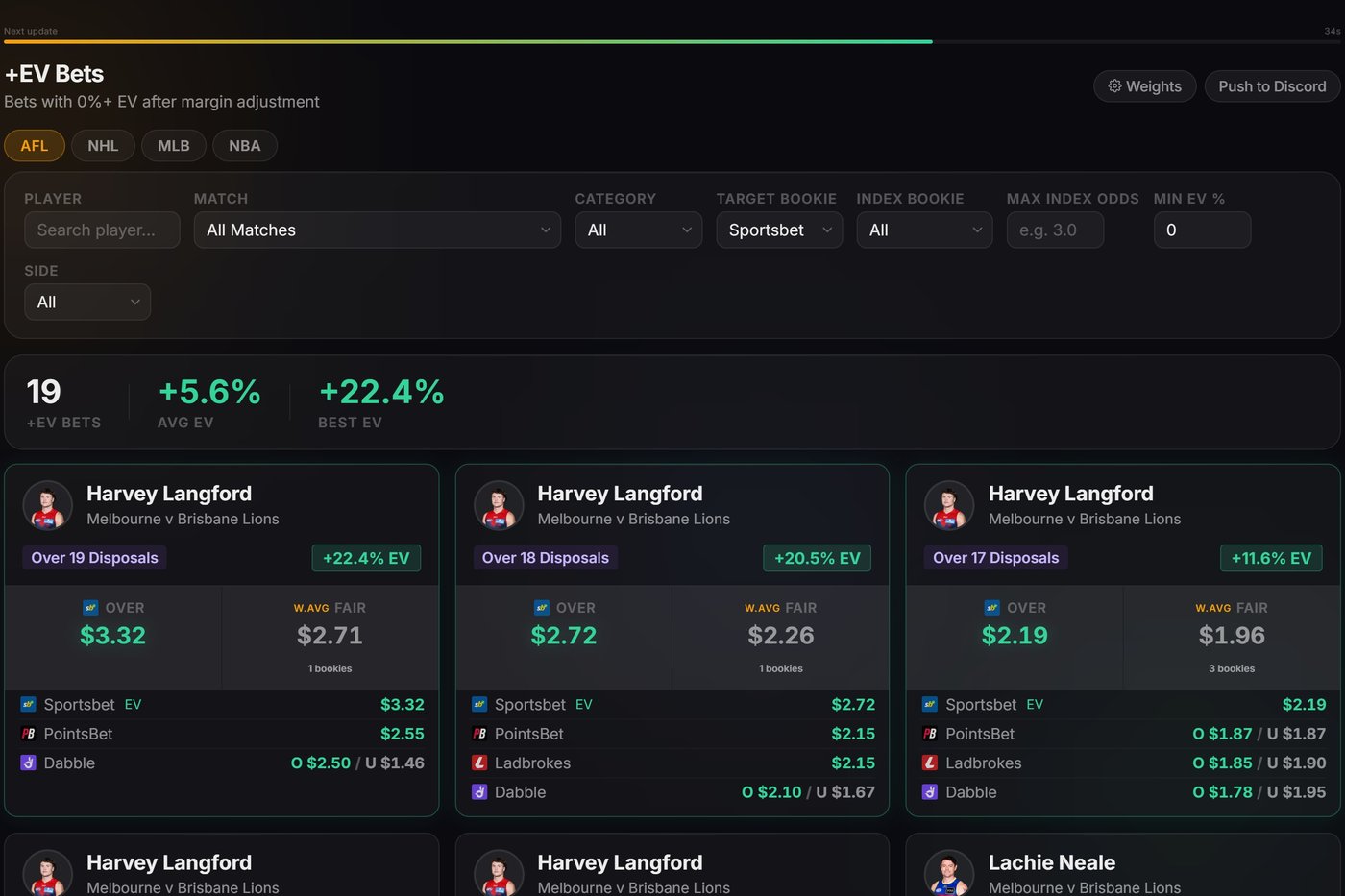
- Pro Odds Screener: All prices are displayed in decimal odds. Each line shows the bookmaker price, the fair (no-vig) decimal price derived from the sharpest reference books, and the edge% in plain sight. You never need to convert a number to understand whether a bet is positive EV.
- +EV Finder: When a book displays American odds (for US sports imports) or fractional odds (for UK-sourced racing markets), DegenToPro converts them to decimal before any EV comparison is made. The number you see on screen is always in a consistent format.
- 100+ bookmakers covered: Australian bookmakers (Sportsbet, TAB, Ladbrokes, Neds, PointsBet and more) plus international sharp books used as reference lines. Price differences surface as arbitrage or +EV alerts.
- Bet tracker with verified CLV: When you log a bet, DegenToPro records the decimal odds at the time of the bet and at market close, then calculates your closing-line value (CLV) against the devigged decimal benchmark. CLV is the most reliable long-run measure of betting skill.
- Racing software: Australian thoroughbred, harness, and greyhound markets presented in decimal odds with EV% and edge signals derived from proper devigging models.
The DegenToPro community has grown to over 6,000 members on Discord, ranging from recreational Australian punters making their first +EV bets to full-time professionals managing five- and six-figure annual profits against verified CLV.
Pricing starts with a FREE tier (no card required), giving you access to the dashboard and live decimal odds data across major sports. Paid plans unlock the full bookmaker scan, racing software, bet tracker, and advanced EV alerts. Plans are available on a Weekly ($59.99 AUD), Monthly ($299.99 AUD), or Lifetime ($699.99 AUD) basis. A World Cup Offer of 20% off is currently live across all paid plans - check the pricing page for full details.
For Australians, the full ecosystem of DegenToPro tools is built specifically around how Australian bookmakers price markets, the sports that dominate Australian betting volumes, and the regulatory environment local punters operate within. That focus means less noise and more relevant edge signals compared to generic international platforms.
Ready to bet with a real edge?
DegenToPro monitors 100+ Australian and international bookmakers, displays every price in decimal odds, and shows your edge% and EV on every market - automatically. Join 6,000+ Australian punters and start your free account today.
Start Free →The bottom line
Decimal, fractional, and American odds are three different languages describing exactly the same thing: how much you stand to win and what probability the bookmaker is implying for each outcome. Every format converts cleanly into the others through straightforward formulas, and every format converts directly into an implied probability that you can compare against your own probability estimate to determine edge.
Australian bettors operate in a decimal-odds environment by default, and decimal is also the superior format for systematic +EV betting because the implied probability calculation is a single division, edge% is visible without extra steps, and every serious EV tool is built around it. If you encounter fractional or American odds - through a UK horse racing site, a US sports broadcast, or an international bookmaker - the conversion rules in this guide get you back to a familiar decimal number in seconds.
Knowing the maths is necessary. But doing it manually across hundreds of markets per session is not feasible if you want to bet at a volume where the edge becomes meaningful profit. That is the gap DegenToPro fills for Australian punters - converting, comparing, and flagging edge automatically so your time goes toward placing bets, not crunching numbers.