
In this guide
What CLV actually tells you
Closing-line value is the difference between the price you took and the price that market closed at. Take $2.40 on something that closes at $2.20, and you have positive CLV — you were on the right side of where the market ended up.
Its value is statistical. The closing line is the market’s best collective estimate after all information has arrived and all the sharp money has been placed. It is the most accurate widely-available probability estimate in existence for that event. Consistently beating it means your process is finding real mispricing.
Why it matters so much: profit and loss over a few hundred bets is mostly noise. CLV is measurable on every bet, settled or not, and it does not care whether the favourite happened to win. It gives you a usable read in weeks instead of years.
How fast an edge decays
Here is the part that connects speed to money. A price is valuable because it is out of line with the market. But other people are looking at the same market, and the bookmaker is watching its own book. So the moment a price becomes clearly valuable, forces start moving it back.
Edge decay is not linear. It is steepest immediately after the mispricing appears — the first seconds carry most of the loss — then flattens. Which means the difference between placing at three seconds and placing at ninety is not a small proportional haircut. It is often most of the edge.
Racing sharpens this further. The pre-jump window concentrates both the value and the movement into a few minutes, so a manual punter is competing for the same prices in the exact period when they are least able to react.
The 90-second tax
Walk through what manual placement actually costs in time. The alert fires. You notice it. You unlock your phone. You open the bookmaker app. You find the event, then the market, then the selection. You type a stake. You confirm. Possibly you re-authenticate.
Ninety seconds is a good outcome for that sequence, and it assumes you were available at all.
Now consider what that does to a strategy averaging a 3% edge. If the typical valuable price loses a meaningful fraction of its edge in the first minute, you are not capturing 3%. You are capturing something considerably smaller — while your records, if they log the alert price rather than the price you got, cheerfully report 3%.
The quiet killer: a strategy that shows +3% EV in your spreadsheet and delivers +0.5% in reality is not a broken strategy. It is a placement problem, and it is invisible unless you record the price you actually took and compare it to the close.
Measuring it properly
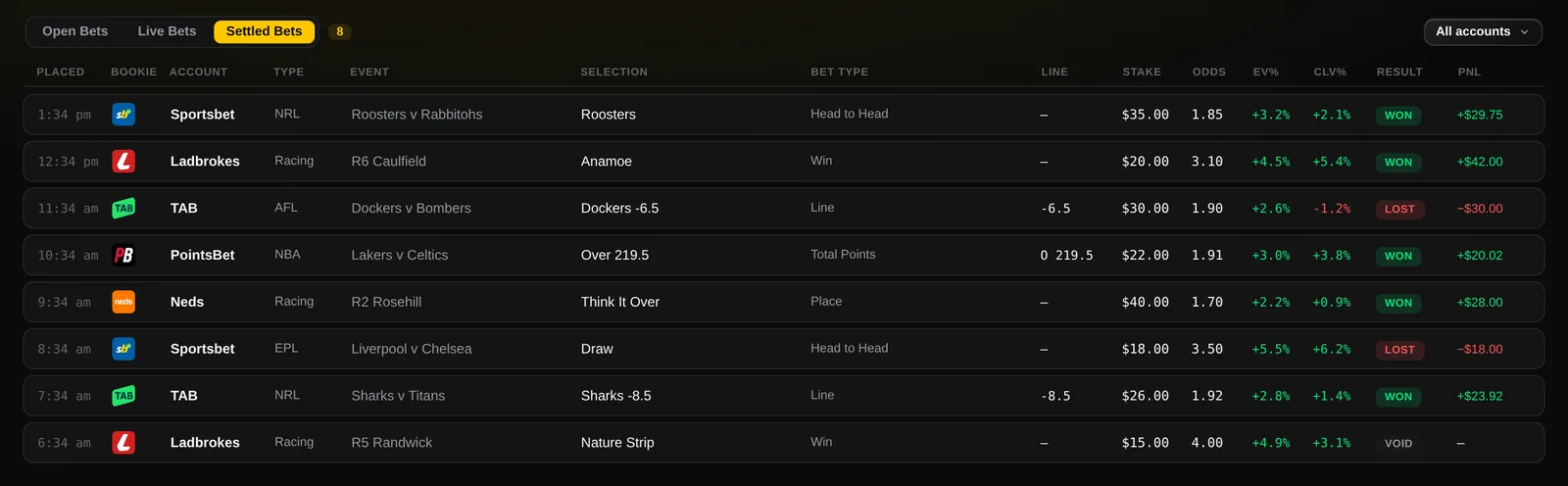
To know whether any of this applies to you, you need three things recorded per bet: the price you actually took, the timestamp, and the closing price. Then:
- Average CLV. Positive and stable is what you want. Flat means you are not beating the market. Negative means you are behind it, whatever your P&L says.
- CLV by book. One bookmaker dragging the average down usually means it moves faster than the others, or an adapter needs attention.
- CLV by delay. The revealing one. Bucket your bets by how long after the opportunity appeared they were placed. If CLV falls off a cliff past thirty seconds, you have just measured your own capture problem.
Almost nobody does the third one by hand, because reconstructing it after the fact is tedious. It falls out for free when placement and recording are the same system.
Where speed comes from
Fast placement is an architecture question, not an effort question. Four things determine it:
- Push, not poll. A persistent connection means opportunities arrive when they exist, rather than on the next check.
- Warm sessions. If the app has to log in before it can place, the login is inside your latency budget. Sessions kept warm remove that.
- Local execution. Placement from your own machine means the only queue is yours, rather than sharing infrastructure with every other customer.
- Concurrency. When one move creates opportunities at four books simultaneously, a machine takes all four. You take one.
Speed without stale bets
Speed alone is not the goal, and chasing it naively creates a worse problem than the one it solves.
If a system fires at whatever price it finds, without checking that the opportunity is still real, it will place bets whose edge has already evaporated — and record them as good bets. That is how a bot produces a healthy-looking expected value and a shrinking bankroll.
The defence is that instructions carry an expiry and the executor re-checks immediately before placing. BetPilot works this way: signed, time-limited instructions, local final checks against the current price and your thresholds, and anything stale dropped rather than fired.
A missed bet costs you nothing but opportunity. A stale bet costs you money and lies to you about it.
Reading your own numbers
Once you have per-bet CLV, a few patterns are worth knowing how to read:
CLV positive, P&L negative. Normal, and usually fine. You are beating the market and running badly. Do not change anything.
CLV negative, P&L positive. The dangerous one. You are behind the market and lucky. This is the point at which people scale up and then wonder what happened.
CLV drifting down over months. The strategy is decaying, a book has adjusted, or an adapter is placing late. Diagnose by book and by delay.
CLV fine on some books, poor on others. Usually a speed problem specific to how quickly that bookmaker reprices. Consider a higher threshold there.
None of this requires a bot. It requires honest per-bet records, which a bot happens to produce as a by-product of doing its job.
Frequently asked questions
What is closing line value?
The difference between the price you took and the price the market settled at before the event started. Consistently beating the close is the strongest available evidence that your bets are genuinely valuable rather than lucky.
Why is CLV better than profit for judging a strategy?
Because profit over a few hundred bets is dominated by variance. CLV measures whether you were on the right side of the market on every bet, so it produces a usable signal from a far smaller sample.
Does faster placement really matter that much?
Yes, in the markets where value concentrates. Prices that are valuable are valuable to other people too, so they move quickly - and the bets you capture late are systematically the ones taken at a degraded price.
Take the price, not what is left of it
BetPilot re-evaluates the instant a line shifts and fires within seconds, dropping anything stale. Applications reviewed by a human.
Apply for BetPilot →